O2O Vault Brief, Issue 3. Data as of October 23rd, 2026. Vault links: Veda's Kraken page, Ink explorer, Sentora.
O2O Research publishes general market commentary for information only. Nothing in this brief is investment advice, a recommendation or an offer of any security, including interests in any O2O vault. O2O is developing credit vaults of its own and may seek business relationships with protocols, curators or issuers it writes about.
Key findings
The brief reaches six findings:
- Holdings: The vault borrows PayPal USD (PYUSD) against two real-world asset (RWA) credit tokens, Hastra PRIME and Huma's PayFi Strategy Token (PST), and purchases more as a loop strategy. After subtracting the borrowed PYUSD, exposure to the two tokens is about 72% of net asset value (NAV). Another 14% is idle USDC on Stellar.
- Incentives: Rewards, primarily from the Merkl rewards platform, some unlisted and some paid on Stellar, funded 61% to 65% of lifetime gross earnings and 26% to 30% of gross yield at the October 2026 run rate.
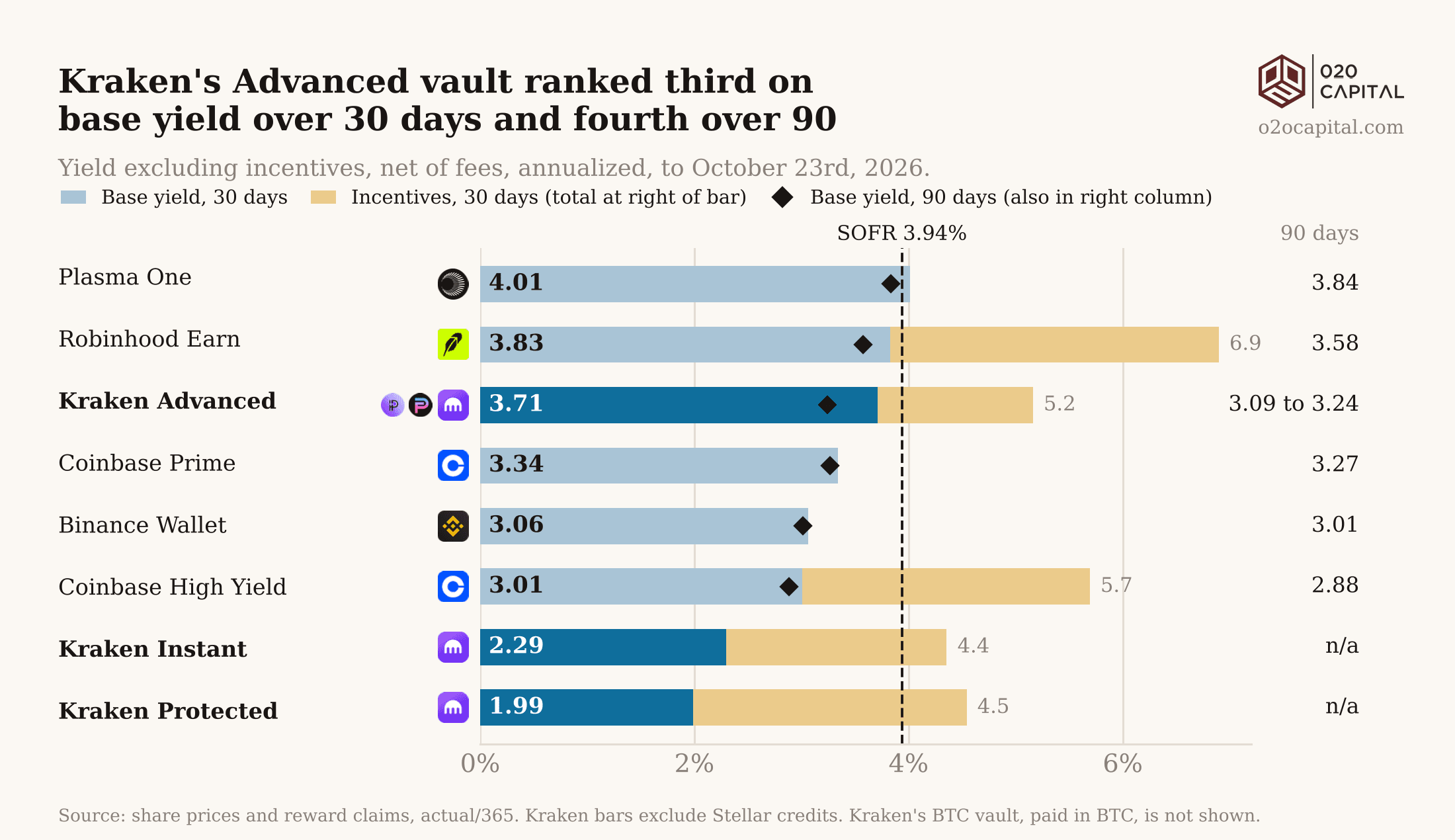
- Base yield: Excluding all incentives, including those paid on Stellar, the vault's base yield of about 3.7% ranked third of six over the 30 days to October 23rd, 2026, behind vaults O2O links to Plasma One and Robinhood, and fourth over 90 days. In October, the vault earned slightly less than the Secured Overnight Financing Rate (SOFR).
- Pricing: The posted share price has never fallen, and the yield has moved independently of crypto markets so far, backed by credit outside crypto.
- Crypto risk: Redemption requests rise with the size of bitcoin's (BTC) daily move. A June 2026-sized redemption run without new deposits would need about $20 million beyond liquid assets.
- Coverage: Firelight's new vault coverage applies only to Kraken's Protected Strategies USDC vault, not this one.
Why this vault
Kraken DeFi Earn's Advanced Strategies USDC option sends USD Coin (USDC), Circle's dollar stablecoin, into a vault at 0x9761...1CcA on Ink, Kraken's blockchain. Veda supplies the vault contracts, and Sentora, the curator, runs the strategy. On October 23rd, 2026, the vault held about $254 million for more than 51,000 holder addresses, the largest of Kraken DeFi Earn's three USDC vaults.
Kraken's support pages list the other two as Protected Strategies USDC (0xDbD8...A271) and Instant Strategies USDC (0xcaae...789f). Their tokens still read Boosted Yield USDC and Balanced Yield USDC. This vault's name is unchanged in the app and onchain.
Kraken's frequently asked questions (FAQ) page says "Vaults use leverage" and "Withdrawals are usually instant." Kraken's strategy data list a one-day wait for this vault, and onchain exits took a median of about seven hours.
Vaults 101
A vault pools deposits and issues shares whose price rises with earnings. Four mechanics govern this one:
- Strategy accounts: The vault issues shares on Ink, while about 99% of its assets sit on Ethereum, held directly or through 17 strategy accounts it owns. A loop posts a token as collateral on Morpho, a lending protocol, borrows against it and buys more. The PST loop runs at a loan-to-value (LTV) ratio of about 58%, against a liquidation threshold of 86%.
- Control: A 4-of-6 Safe, a multisig wallet, controls roles, fees and allowed actions. Its changes wait one hour in a timelock, less than the median exit time. Loop operators can raise a loop's LTV without a timelock.
- Pricing: A 2-of-3 Safe posts the share price about twice a day, and none of its 572 updates since December 2025 moved it down. Value rests on posted prices (marks): a Chainlink feed that prices PST on a fixed path of 8.00% a year, Hastra's PRIME rate on a second feed and the operator-reported NAV of Sentora USD Earn (sentUSD), 67% owned by the vault.
- Exits: A queue fixes each exit price at request and has paid nearly 73,000 requests worth about $446 million. Only about $1.7 million of USDC sits on Ink, so larger exits wait for new deposits or for USDC bridged from Ethereum.
What the vault holds
Gross exposure counts every dollar tied to PST and PRIME: tokens held or posted as collateral, plus PYUSD lent to others who borrow against them. For every $100 depositors own, the vault has about $105 of such exposure and owes about $34 of PYUSD borrowed against it, which leaves about $72 net (Exhibit 1). Only about $17 million, or 6.7% of NAV, is readily liquid. Total PYUSD debt of about $104 million lifts gross assets to 1.41 times NAV.
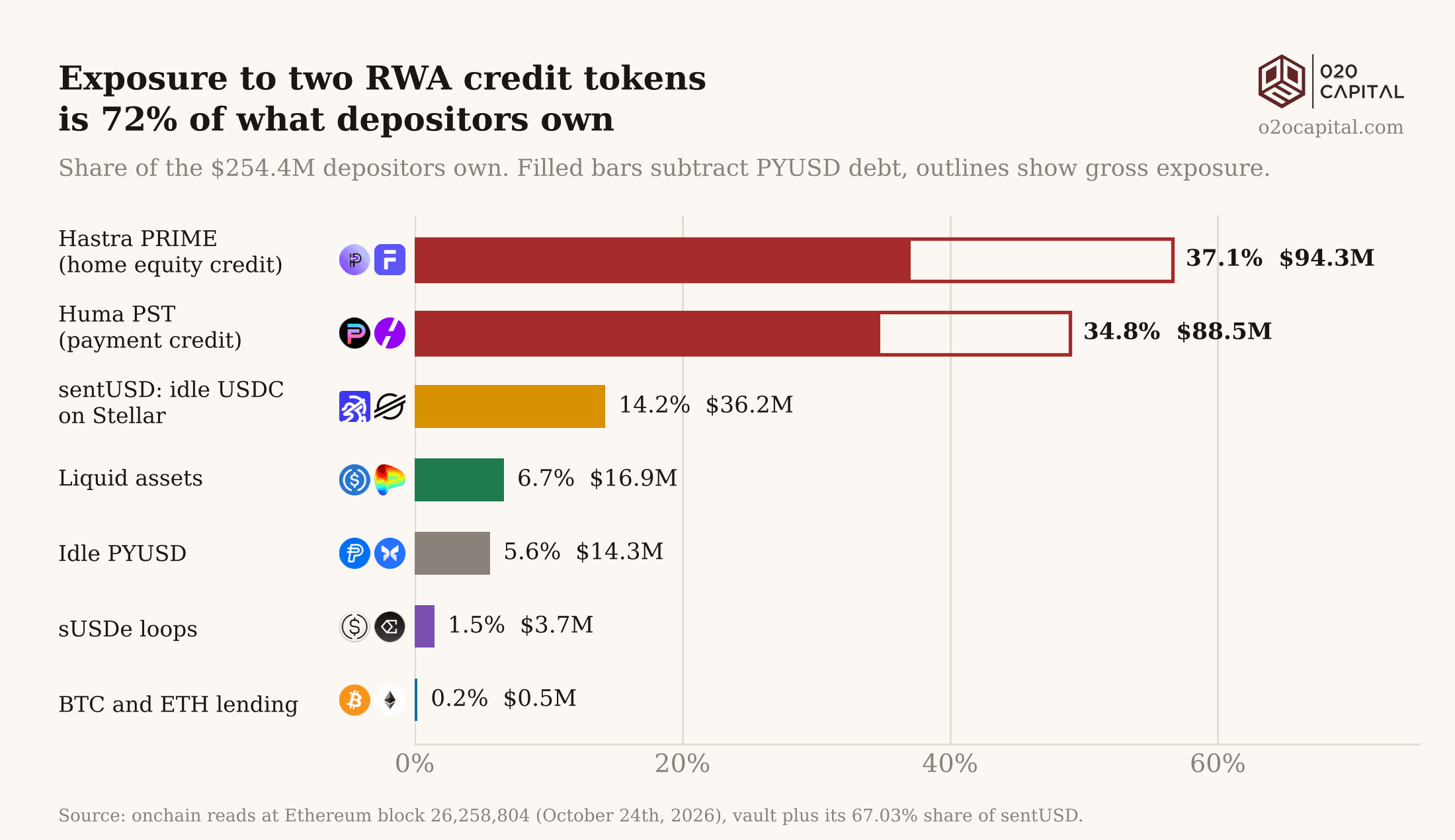
The two credit tokens work as follows:
- PRIME: A staked share of Hastra's wYLDS token, whose reserves fund a subsidiary of Figure, a US home equity lender, through a repurchase agreement that rolls hourly. The collateral is home equity lines of credit "generally secured by second mortgages."
- PST: Funds payment receivables that turn over in one to seven days for 16 payment firms outside the United States. Huma reports no loans written off, a record no independent data confirm. The vault holds 26% of all PST, about $105 million, against about $10 million of exchange liquidity.
About $54 million of sentUSD's roughly $117 million sits on Stellar, not Ethereum, and the vault's share of that is about $36 million. sentUSD's single-key subaccount sends USDC to a Circle deposit address. Minutes later Circle pays the same amounts on Stellar to an account that deposits them into Sentora's USDC vault. That vault holds the money as idle USDC and earns nothing itself. Upshift, sentUSD's platform, does not list the Stellar account among sentUSD's operators.
Where the yield comes from
Over the 30 days to October 23rd, 2026, the vault paid 5.16% net and earned 6.89% gross, as simple annual rates. Net yield ran 1.22% over SOFR. Each loop earns the gap between its token's accrual and the PYUSD borrow rate: 8.0% against 6.4% for PST and 6.2% against 5.1% for PRIME.
Since December 2025 Merkl has paid the vault's strategy accounts about $5.3 million, mostly in PYUSD and Ripple USD, including about $1.3 million through an unlisted stream. Since September 2026 a second stream has come through the Stellar leg, which earns only Merkl rewards in USDC, about 8% a year, paid by weekly campaigns from a multisig whose home domain belongs to LOBSTR, a Stellar wallet. Its funders include a wallet labeled "Incentives wallet" and, on October 21st, 2026, an account Stellar's main explorer labels as Kraken's exchange (memo "SD5 Incentives Wallet"). sentUSD's share price credits the leg at about 10% a year, through marks that rise by an almost fixed amount at each update.
Counting both streams, incentive income fell from about 9.1% of assets under management (AUM), annualized, in February 2026 to about 1.9% in October, while gross yield held near 7% (Exhibit 2). Over the 30 days to October 23rd, the Stellar stream added about 0.6% to net yield.
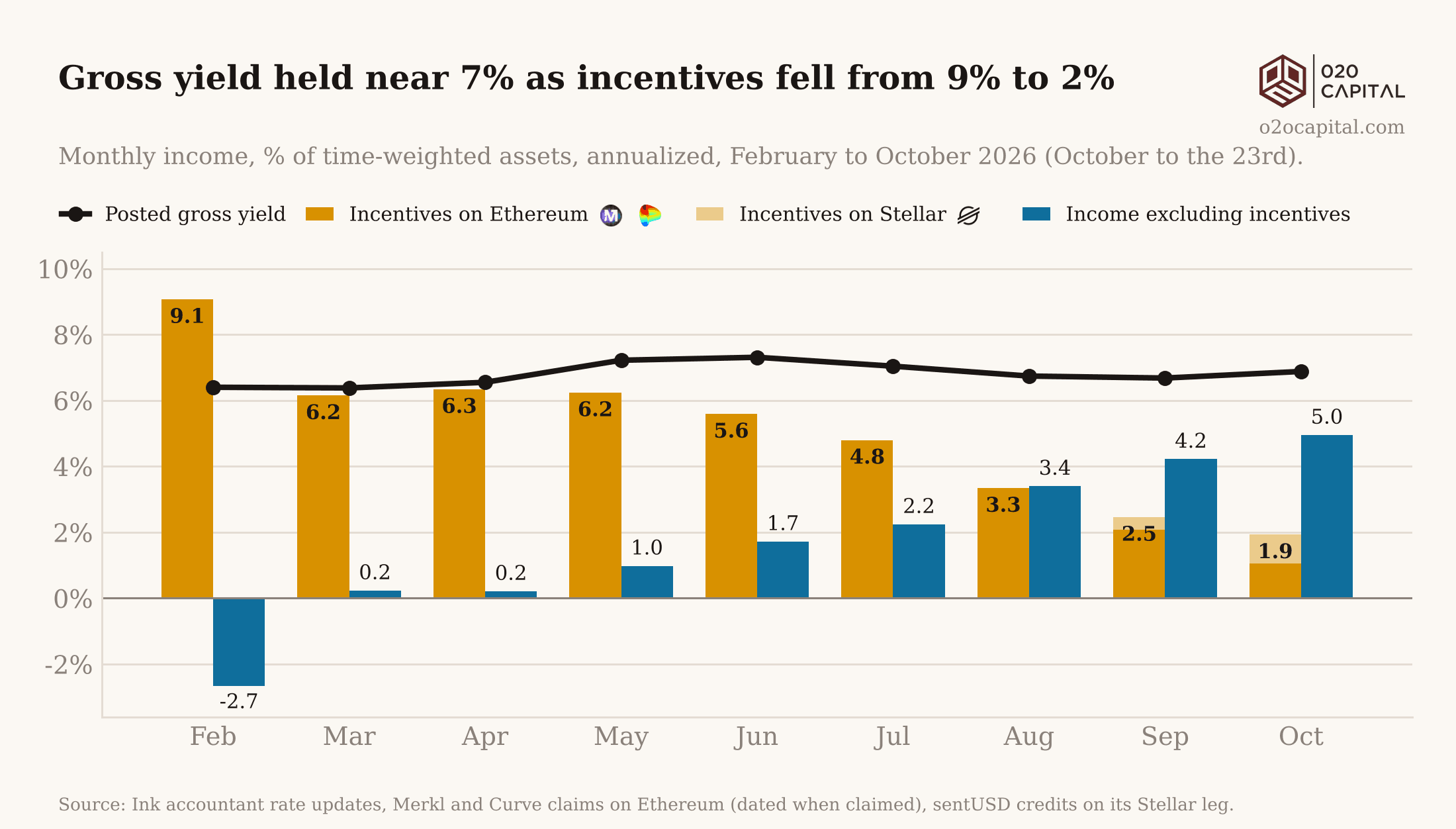
Merkl's listed campaign on Ethereum renews weekly, and the current round ends on October 29th, 2026. Without it, net yield would fall about 0.4%. Without any incentives, October income (carry) was about 3.7% net, about 0.2% below SOFR.
How the base yield compares
O2O compared base yield, meaning yield excluding incentives and net of fees, with five vaults behind four other Earn programs: Coinbase (two vaults), Robinhood, Binance Wallet and Plasma One. All are measured from share prices over the same 30.6 days. The peers pay any incentives outside their vaults, so O2O subtracted the 0.84% net that Kraken's vault claimed in the window and the 0.61% credited to it through the Stellar leg (Exhibit 3):
- Last 30 days: Kraken's base of about 3.7% trailed Plasma One (4.0%) and Robinhood (3.8%) and topped Coinbase's Prime vault (3.3%), Binance Wallet (3.1%) and Coinbase's High Yield vault (3.0%).
- Longer windows: Kraken ranked last of six in July 2026. Over 90 days it ranked fourth at about 3.1% to 3.2%, behind Plasma One, Robinhood and Coinbase's Prime vault.
- With incentives: Robinhood (6.9%) and Coinbase's High Yield vault (5.7%) paid more than Kraken (5.2%).
- Kraken's other vaults: Instant Strategies USDC earned a base of about 2.3%, and Protected Strategies USDC about 2.0% once its own Stellar incentives are removed.
What remains matches the income O2O can tie to positions: about 2.1% from PST and PRIME held with depositors' money, 1.2% from PYUSD lent against them and 0.4% from leverage. The remaining 0.6% is the Stellar credit.
The peers lend mostly against BTC, ether (ETH) and USDe, Ethena's synthetic dollar, collateral that liquidators can sell quickly. Kraken's depositors own two private credit tokens partly on borrowed money, at marks posted before any credit loss. Three limits apply. The vaults hold different stablecoins. PYUSD rewards paid to Kraken's lenders may cut its borrowing cost by up to about 0.4%. The Binance Wallet and Plasma One matches are unconfirmed. On this evidence, adding RWAs has not let Kraken pay a higher base yield than the leading peers.
Is the yield correlated with crypto?
Not so far. Over 34 weeks to October 2026, the vault's yield moved independently of crypto markets. Median correlations with six crypto factors run from -0.18 to +0.13, and none holds up once many factors are tested together. Weekly returns had annualized volatility of 0.054%, against about 42% for BTC.
That independence comes from what the vault owns. Most of its income is credit to US homeowners and to payment firms outside the United States. The other Earn vaults in Exhibit 3 lend mostly against BTC, ETH and USDe, collateral whose value rises and falls with crypto prices. Their weekly yields also showed only weak links to bitcoin and funding rates over the same period, so the difference lies in what backs the loans more than in week-to-week yield. Posted marks spread each week's return over about two weeks, which adds to the calm, and a modest link could still appear with more data.
Where crypto risk actually sits
Crypto markets reach the vault through withdrawals and through Figure. Redemption requests rise with the size of BTC's daily move (Exhibit 4). From May 17th to October 23rd, 2026, each 1% of BTC's daily move went with requests of 0.25% of AUM that day and 0.15% the next.
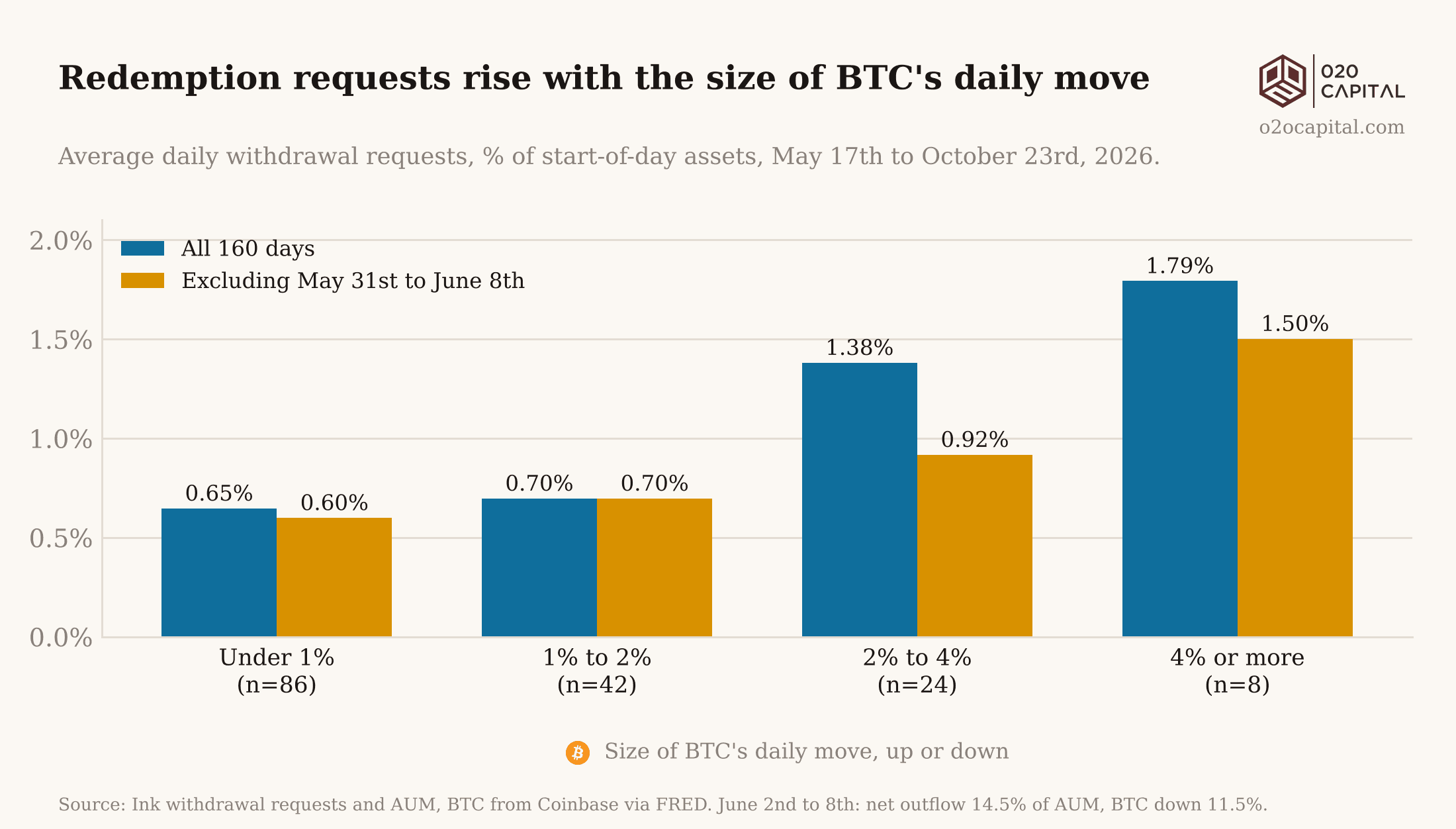
In the only week of heavy net outflows, June 2nd to 8th, 2026, net outflows reached 14.5% of AUM while BTC fell 11.5%. The queue still paid within a median of nine hours. Without new deposits, which have funded most exits, a June-size week would need $20 million more than liquid assets. Raising it from Sentora's PRIME lending vault would lift the PRIME borrow rate from about 5.1% to about 14%, past the 8.4% to 10.3% at which the PRIME loops stop earning.
Figure is the second channel. PRIME's credit depends on Figure, whose stock had a correlation of +0.52 with BTC over 58 weeks. A crypto sell-off and stress at Figure could coincide.
Marks add a third risk. Because the queue fixes exit prices at request time, a loss posted in steps pays early requesters the old price, and holders who stay absorb the gap. A 10% PST markdown posted after a June-size week would cost them about 4.8%, against 4.1% if posted at once. That sits awkwardly with the FAQ's line that losses are "shared proportionally across vault users." A 10% PRIME mark cut would lower NAV about 3.0%, and about $39 million of other borrowers' debt in the PRIME market liquidates on a mark cut under 5%.
What Firelight's coverage means here
Firelight, a cover protocol on the Flare network, sold $30.5 million of cover on Kraken's Protected Strategies USDC vault from October 6th, 2026. This vault appears in none of Firelight's markets. The cover pays for code, oracle and mechanism failures, not market losses, and caps payouts at $100,000 per depositor address. Sentora incubated Firelight, and about $62 million of staked XRP, the Ripple network's token, backs all of its cover, so a fall of about 40% in XRP would leave less capital than cover sold. Applied to this vault, the same cover would answer a code exploit, which this vault has not had, but not credit losses on PST or PRIME, a slow exit queue or a misused key.
What a sleeve outside crypto would and would not change
Consider a generic, illustrative sleeve of short duration credit with no link to crypto prices. Assume it targets 9% unlevered, is priced at NAV and lets holders redeem up to 5% of its NAV per quarter. These round numbers are assumptions for illustration, not a forecast or any actual product.
- Correlation and exits: A steadily accruing sleeve would shrink the vault's crypto beta in line with its weight but leave measured correlation unchanged. The 5% limit would slow exits in a sell-off, so the sleeve should stay a small share of a vault shrunk by a run.
- Yield: At 9% with a 10% cash buffer earning 3.3%, each 10% of the vault in the sleeve adds a target of about 0.12% of net yield under the 25% fee, or about 0.33% with the fee waived.
- Marks: A sleeve priced at NAV would also look smooth, so a curator should ask who sets the NAV and how loss reserves enter it.
What to watch
Four signals would change this reading:
- Incentives: Merkl budgets after October 29th, 2026, will show whether PYUSD lender rewards keep Kraken's borrowing costs where they are.
- Figure credit: The share of Figure's securitized loans 60 days or more delinquent rose from 0.8% to 1.1% in the first half of 2026.
- Stellar rewards: The weekly campaigns that add about 0.6% a year to yield have no public end date, and their ultimate funders are not identified.
- Settings: Each 1% cut in PST's 8.00% feed rate, to 7.00% for example, would lower net yield by about 0.3%.
Curators and portfolio managers who want the data behind this brief, or who see something it missed, can reach O2O Research through o2ocapital.com/research.
— O2O Research
Notes on sources and method
The notes cover sources, conventions, the peer comparison, the Firelight and naming checks, other details, the illustrative sleeve and statistics:
- Dune check: A public Dune dashboard on Kraken DeFi Earn (lindyhan/kraken-defi-earn), rerun on October 26th, 2026, shows this vault at $252.8 million on October 25th, 2026, with 242,245,650.65 shares, which matches the share supply on Ink exactly. Its "onEthereum" figure of 95.5% is the dashboard's own valuation ratio. Onchain, the vault held $2.15 million of USDC on Ink that day, under 1% of assets. Its fee and allocation tables do not change any figure in this brief.
- Sources: Onchain reads come from public Ink, Ethereum, Base, Plasma and Flare nodes (archive calls and event logs), the Ink, Ethereum, Robinhood Chain and Flare Blockscout explorers, and Morpho Blue contract state. The share price series is all 572 rate updates on the Ink accountant from December 12th, 2025, to October 23rd, 2026, at 21:14:45 Coordinated Universal Time (UTC). Positions are pinned at Ethereum block 26,258,804 (October 24th, 2026, 00:06 UTC) and flows at Ink block 59,305,309. The vault contract on Ethereum is at the same address. Kraken's DeFi Earn page, its support FAQ (last updated October 15th, 2026), its articles on rewards and fees and on Firelight coverage, its public web app code and its public Earn strategies data were fetched on October 24th, 2026. The holder count is an exact replay of every share transfer (51,384). Blockscout shows about 51,867. The sentUSD subaccount's explorer page shows many tiny spam transfers from look-alike addresses, which readers should ignore.
- Conventions: Yields are net, simple annual rates on an actual/365 basis over the trailing 30 days, from posted share prices with exact elapsed time, unless stated. A basis point (bp) is 0.01 percentage point. Compounded, the 30-day figures are 5.29% net and 7.11% gross. Veda's displayed 5.25% annual percentage yield (APY) matches a simple seven-day rate to within 0.23 bp, and Kraken's displayed 5.27% on October 24th, 2026, equals Veda's seven-day figure. Gross yield divides net by one minus the fee in force: 20% of gross before August 24th, 2026, at 12:32 UTC and 25% after. The fee change was scheduled on August 14th, 2026, 236.8 hours before it took effect, and applied to four Kraken DeFi Earn vaults. SOFR is converted to actual/365 and averaged over the same window, which gives a 30-day net spread of 1.22%. Monthly incentive yields are dollar based, counted on claim dates and annualized on time-weighted AUM. October covers 22.9 days. Exhibit 2's Stellar layer is this vault's share of sentUSD's credits on its Stellar leg, counted when posted: 0.38% of AUM in September and 0.87% in October, annualized. Income excluding incentives subtracts both layers from posted gross yield. Lifetime gross ties to fees actually paid to within two cents, and cumulative fees are about $2.0 million. Since December 12th, 2025, Merkl has paid the strategy accounts $5.29 million and Curve gauges $0.19 million. Lifetime incentives, including direct transfers, are $5.87 million against gross earnings of $9.37 million. The unlisted stream paid $1.32 million. The brief uses four incentive figures. The listed Merkl campaign on PRIME adds about 0.41% to net yield at current rates, and the Curve gauge about 0.16% (0.56% together). All incentives claimed in the 30-day window, listed and unlisted, came to 0.84% net. An end to all incentives at the run rate would cut net yield by up to 0.93%. The gross run rate of 101 to 124 bp, or 14% to 18% of gross yield, adds 101 to 102 bp of direct streams (55 from the PRIME campaign, 21 from the Curve gauge, 26 unlisted) to 0 to 22 bp from sentUSD's positions. The PRIME campaign has run 24 weekly rounds since May 2026, at 59,100 to 103,425 PYUSD a week. A search for the vault's own address on Merkl covered 19 chains. The October carry without incentives (5.82% gross, 4.37% net, 0.42% to 0.46% over October SOFR on consistent bases) is an accounting residual. Claim dates differ from accrual dates, some loops earlier in 2026 existed only because incentives paid for them, and the residual still includes up to 22 bp of sentUSD's Merkl rewards and any borrow rate subsidy. The credit loss break-evens divide the net spread over SOFR (0.43% without incentives, 1.22% with them) by 71.5% of NAV marked to PST and PRIME, times 0.75 for the fee. The look-through book reconciles to shares times price within about 0.01%, a check that takes the sentUSD leg at its reported value. Look-through percentages are of NAV at $254.4 million. Gross exposure to PST and PRIME is $268 million (105.5% of NAV), the PYUSD borrowed against them is $86 million, and the net is $183 million (71.9%). The $34 per $100 in the text is that $86 million over NAV. Gross figures count tokens held, posted and lent against, so they can sum above 100%. Net figures subtract the PYUSD borrowed against each class: $85.7 million against PST and PRIME and $18.7 million against sUSDe, with the vault's 67.03% share of sentUSD applied pro rata. The PRIME and PST market shares include that share. Liquid assets are USDC on Ink ($1.69 million), wallet stablecoins ($0.08 million) and the Curve position ($15.16 million). Another $14.3 million (5.6% of NAV) is idle or unborrowed stablecoins, mostly PYUSD in Morpho lending shared with other lenders. The PST loop holds 41.7 million PST against $27.4 million of PYUSD debt (LTV 0.577). Operator keys can set loop LTVs up to 0.85 (PST, PRIME) or 0.90 (sUSDe), a mark fall of 1.16% or 1.64% from liquidation. Queue figures cover 72,830 requests worth $445.6 million, with a median wait of 7.23 hours. Kraken's strategy data give this vault an unbonding period of 86,400 seconds with delayed withdrawals, and the other two USDC vaults none. The vault holds 91.7 million PST on a look-through basis, 26.3% of all PST, and $104.6 million of PST against about $10.4 million of exchange reserves.
- Peer comparison: The window runs from September 23rd, 2026, at 06:33:04 UTC to October 23rd, 2026, at 21:14:45 UTC (30.612 days), the first and last posted Kraken rates. Peer share prices come from archive calls at matching blocks, except Robinhood Chain, which has no public archive node and uses Morpho's hourly share price. The vaults are Steakhouse USDC on Base for Coinbase's Prime vault, Steakhouse High Yield USDC on Base for Coinbase's High Yield vault, Steakhouse USDG, a vault for the Global Dollar stablecoin (USDG), on Robinhood Chain for Robinhood Earn, Steakhouse USDT on Ethereum for Binance Wallet and PlasmaUSD, a Veda vault that lends USDT on Aave, on Plasma for Plasma One. Four of the five are Steakhouse Financial vaults on Morpho. Steakhouse's documentation names the Coinbase and Robinhood vaults. The Binance Wallet match rests on Morpho's case study and the Plasma One match on a third-party portal, so both are labeled likely. Fees are 25% for both Coinbase vaults, 5% for Binance Wallet's and 0% for Robinhood's and Plasma One's. Robinhood's book is about 66% USDe, 25% Maple's syrupUSDG and 6.1% Midas's mGLO fund token. Coinbase's High Yield vault is about 81% USDe and 8% mGLO, and its Prime vault about 97% Coinbase's wrapped BTC. Kraken's incentives in the window were 125,298 PYUSD and 68,422 RLUSD from Merkl and 47,170 RLUSD from the Curve gauge, annualized on time-weighted NAV of $256.1 million (1.12% gross, 0.84% net). The low end of Kraken's range adds 22 bp gross of sentUSD's rewards, and the high end uses the 101 bp run rate. Outside-vault incentives are window means of DeFiLlama reward yields (about 3.1% for Robinhood and 2.7% for Coinbase High Yield), checked against Merkl campaign budgets. Robinhood's campaign is budgeted to July 1st, 2027. Coinbase High Yield's USDC campaign ends November 12th, 2026. A Merkl campaign for PlasmaUSD holders paid about 0.57% outside the vault, which would put Plasma One's yield with incentives at about 4.6% if its users receive it. Kraken's monthly base was 1.79% in July, 2.68% to 2.83% in August, 3.45% to 3.75% in September and 4.37% in October, the ranges depending on whether $127,019 of PYUSD from an unlabeled wallet counts as incentives. Kraken's base was the lowest of the six in July. In August it was the lowest (2.68%) or second lowest (2.83%, above Coinbase High Yield's 2.81%) on that choice. Its 90-day base is 3.35% to 3.50% on the same choice, against Plasma One 3.84%, Robinhood 3.58%, Coinbase's Prime vault 3.27%, Binance Wallet 3.01% and Coinbase's High Yield vault 2.88%. The driver split uses October 24th, 2026, rates (PST 8.00%, PRIME 6.18%) against a 30-day realized share price: identified income excluding incentives is 4.97% of NAV gross, or 3.73% net, and the 0.79% gross residual is the Stellar credit (0.81% gross, 0.61% net, in the window). Leverage adds 0.51% gross, or 0.38% net, so the unlevered base is about 3.94% if marks and borrow rates stay fixed, although the vault's own borrowing helps set those rates. The net bridge multiplies the gross components by 0.75: PST and PRIME held with depositors' money 2.12, PYUSD lent against them 1.17, leverage 0.38, sUSDe and other positions 0.06 and the residual 0.59, now traced to the Stellar credit, for 4.32. A 1% cut in PST's rate would cut net yield by $104.6 million x 1% / $254.4 million x 0.75, or about 0.31%. Sentora's PST and PRIME lending vaults paid about 4.6% before their 15% performance fee (5.35% and 4.42%) on October 24th, 2026, snapshot rates. Supply rates in the peers' main markets were 4.71% (Coinbase's wrapped BTC, Prime vault), 4.03% (USDe, High Yield vault) and 3.76% (USDe, Robinhood). The 15% fee on the Advanced vault's own lending positions costs about 0.27% of gross yield. Instant Strategies USDC's base is 2.29% after subtracting 69,505 PYUSD of Merkl claims, or 2.96% from its positions' own share-price yields. Protected Strategies USDC's 30-day base of 3.35% includes the 1.35% platform fee it added on October 15th for only about 8 of the 30.6 days. A full month of the fee would take about 1% more off. Merkl campaigns paying USDe borrowers came to about $18 million to $19 million a year on Base and $17 million to $18 million on Robinhood Chain, against vault interest from those markets of $15.2 million and $13.5 million. On the other side, Sentora's lending vaults pay their lenders PYUSD incentives (1.77% to 3.04% now). O2O's estimate of the resulting benefit to Kraken's borrowing cost is up to about 55 bp gross, or 0.41% net, an inference. A small Crypto.com partnership vault ($1.3 million, 0% fee) paid 4.38% over the window, and Steakhouse USDC on Ethereum, one possible Binance Wallet USDC route, paid 4.21%. The 30-day ranking therefore holds only for the five vaults named. The monthly, 90-day and driver figures in this note are before subtracting the Stellar credit, which began on September 1st, 2026. After it, Kraken's 30-day base is about 3.71% (3.55% to 3.79% on the range above) and its 90-day base about 3.09% to 3.24%.
- Firelight and naming: Cover Token 2 (label "Kraken DeFi Protected", $30.5 million at 159 bp a year, period 308 from October 6th to November 5th, 2026, bought from a separate wallet on Flare) resolves through Firelight's allocator to the registry market "Kraken Protected Strategies USDC", rooted at the Protected Strategies vault. Firelight's October 15th, 2026, post calls it "formerly Boosted USDC." The covered vault holds about $45 million, about 89% of it in an Upshift wrapper named Kraken Protected Sentora USD (kpsUSD) that feeds a Stellar USDC vault. The first period's premium of 39,859 USDT0, a bridged form of USDT, was prepaid from that wallet. The premium is about $485,000 a year and the 1.35% fee about $612,000 at today's assets. Backing for a current-period incident is capped at period-start staked assets of 48.5 million FXRP, XRP bridged to Flare (about $62 million at $1.28), plus 1.0 million USDT0 in the first-loss buffer. Active stake today is 43.2 million FXRP. On the protocol's capacity rule and that stake, O2O's arithmetic puts the XRP price needed to renew Kraken's $30.5 million at about $0.91, and all $38 million at about $1.14. Cover sold: $30.5 million for Kraken, $5.0 million for "Sentora RWA" and $2.5 million for "Sentora USD Protected". The capacity break of about 40% applies to the current period, and about 33% to the next one if stakers' pending withdrawals leave. The XRP and BTC correlation uses weekly log returns from July 2023 to October 2026 and varies from +0.64 to +0.72 with the day weeks end. The cap analysis replays 7,028 holders of the covered vault at the October 24th, 2026, share price. Holders at or above $100,000 own about 58% of its value, and 40.8% of its value sits above the cap. On a 10% loss, 86.7% of the loss falls within the cap. The pool-to-vault and above-cap figures for this vault are illustrative: about $63 million against about $254 million, and 51.2% of value above $100,000. Cover scope, exclusions and claim steps come from Firelight's cover scope and Terms of Participation, sections 7.2, 7.7, 7.11 to 7.16. The docs require a claim to be validated and settled before the end of the period after the one in which it was opened, and the vault code allows payout only in those two periods. Oracle cover needs a price more than 1% (stablecoins) or 2.5% (other assets) off long enough for an exploit. Redemption-failure cover needs more than 72 hours without a withdrawal, caused by a malfunction. Bad-debt cover needs bad debt above the greater of 5% of the covered position or $50,000, and excludes correct liquidations at accurate prices. Approved money goes to the payout Safe (3 of 5), whose owners also sit on the Safe that opens incidents. The 2-of-2 Safe that owns every Firelight proxy can also change the payout address without delay. The names come from Kraken's production web app code (build of October 23rd, 2026), which maps the vault types "balanced" and "high_yield" to Instant Strategies and Protected Strategies behind a feature flag and never renames this vault's type, from Kraken's public Earn strategies data linking each type to its address, and from onchain token names. Confidence in the naming is high. Kraken's public strategies data tie the "frontier_high_yield" type to 0x9761...1CcA as Advanced Strategies USDC. Firelight's registry roots the covered market at 0xDbD8...A271. Vault token names are set at deployment and cannot be changed, and Veda's Ink deployer shows no new Kraken vault.
- Other details: This vault and sentUSD have had no liquidations, no canceled exits and no firing of the price guard. Figure books the repo lending as its own debt to a related party. Upshift's listing calls sentUSD "executed fully onchain" and lists only an Ethereum subaccount. The subaccount that sent the money is an externally owned account and was funded by sentUSD's earlier subaccount contract. PRIME's feed fell once, by 26 bp on July 10th, 2026, when its supply and value inputs were posted 14 minutes apart. Hastra's certified hourly NAV covers 5,258 hours from March 18th, 2026, and has not fallen more than 0.069 bp. From October 2nd to 22nd, 2026, the vault sold 26.56 million PRIME at an amount-weighted 1.7 bp below the PRIME feed. sentUSD charges 0.2% a year and lists Upshift Points at a 5x multiplier since January 8th, 2026. Veda's August 25th, 2026, blog describes "a 30-day net yield of up to 6% without incentives." On share prices and claim records, the vault's monthly yield excluding incentives did not exceed 4.4% net in any month from July to October 2026. Forty-one holders with $1 million or more own 29.2% of shares, and the two largest request days were mostly single requests of $12.72 million and $8.83 million. A 5% BTC day implies about $3.3 million of extra requests over two days on the sample without May 31st to June 8th, 2026. Circle's Cross-Chain Transfer Protocol (CCTP) has carried $101.6 million back to Ink in 36 transfers, so at most about $102 million of the $446 million of exits came from Ethereum. Figure's beta to BTC over the same 58 weeks was 1.12. The staggered-markdown case costs remaining holders 4.81% against 4.11%. The vault bears 35.6% of any PRIME market bad debt. The June run stress pays $36.97 million of exits from liquid assets first and takes the rest from Sentora's PRIME lending vault, which lifts PRIME market utilization from 89.2% to 96.0%. The borrow rate follows Morpho's adaptive rate curve and would reach about 25% a year after seven days if utilization held. Separately, $38.9 million of other borrowers' PRIME debt already sits within a 5% mark fall of liquidation, and $119.5 million (64% of market borrowing) within 10%. A USDe fall of 6.8% or 8.5% would liquidate sentUSD's or the vault's sUSDe loop, the only loops a market price can trigger, at a cost of 0.58% or 0.74% of NAV in marks plus up to 0.19% in penalties. A 1% or 3% rise in PYUSD borrow rates would cut net yield by 0.09% or 0.27%, and an end to all incentives by up to 0.93%. The August 2026 fee increase costs holders about 0.35% a year. sentUSD's NAV can move at most about 3 bp a day. Annual credit losses of about 2.3% on PST and PRIME would erase the spread over SOFR with incentives included.
- Stellar leg: Each USDC deposit by sentUSD's subaccount at Circle deposit address 0x3DAa...b315 (forwarded to Circle's wallet 0x55fe...44b8 within about 3 minutes) reappears 5 to 45 minutes later as a payment from Circle's Stellar account GAFK...C3WQ (labeled "Centre") to Stellar account GDXN...PTNBA, for the same amount. On October 22nd, 2026, 3,000,000.00 and 14,641,036.97 USDC went in on Ethereum and 3,000,000.00 and 14,639,572.87 arrived on Stellar, the second net of a 0.01% fee. On September 10th, 2026, GDXN...PTNBA withdrew 16,000,000 and sent 10, 500,000 and 15,500,000 USDC to Circle, which paid the same amounts to sentUSD's subaccount on Ethereum 1.5 to 5 minutes later. A NEAR Intents transfer on September 1st, 2026, names GDXN...PTNBA as recipient and sentUSD's subaccount as refund address, and two Allbridge test transfers on August 14th, 2026, match to the unit. Sentora's Stellar USDC vault CAHE...MJFF, built from the Into-The-Block-Corp StellarVaults repository (IntoTheBlock is Sentora's former name), held 54,988,252.59 USDC on October 25th, 2026. GDXN...PTNBA owns 53,918,040.38 (98.05%) of it, and 92 other depositors own the rest. The contract only takes deposits and pays withdrawals, and its balance equals net deposits to the last unit. The account has earned 322,945.46 USDC of Merkl rewards since September 2nd, 2026, about 7.9% to 8.2% a year depending on the cutoff. The weekly campaigns come from multisig GCY4...IAQL (9 signers, home domain lobstr.co), funded by PYUSD from a wallet with memo "Incentives wallet" and by 155,990 USDC from an account Stellar Expert labels Kraken (memo "SD5 Incentives Wallet") on October 21st, 2026. The same multisig funds the 8% campaign on the Stellar vault behind Kraken's Protected Strategies vault. Kraken's 67.23% look-through share of the leg is $36.3 million. sentUSD carried the leg at $54.04 million against $53.64 million of USDC sent, a credit of about 10.2% a year on cost since September 1st, 2026. Each NAV update since September 5th has raised sentUSD's external assets by 2.00 bp (plus or minus 0.08), whatever the time since the last update, while its Ethereum positions accrued 0.97 to 2.55 bp a day. Kraken's share of the credits in the 30-day window was $173,909, or 0.81% gross and 0.61% net on time-weighted NAV, and $220,207 over 90 days, or 0.35% gross and 0.26% net. October carry without any incentives is 4.37% less 0.65% of October Stellar credit, or 3.72% net, against October SOFR of about 3.93%. The lifetime incentive shares add Kraken's $0.22 million of Stellar credits to the $5.49 million and $5.87 million totals, over gross earnings of $9.37 million. The run rate adds the 81 bp gross Stellar credit to the 101 to 124 bp of other streams, over 6.89% gross. Two independent re-runs reproduced the Stellar flows, balances and rewards. Kraken's Protected Strategies vault holds $40.2 million of kpsUSD, an Upshift wrapper whose Stellar vault (CALF...APUM) held 40,218,476.53 USDC on October 25th, 2026, against about 40.17 million deposited, and earns an 8% Merkl campaign funded by the same multisig. kpsUSD's marks credited $68,298.68 from October 16th to 23rd, 2026, which is 1.81% gross and 1.36% net on the vault's time-weighted NAV of about $44.9 million. Its base falls from 3.35% (3.11% to 3.35%) to 1.99% (1.76% to 1.99%). Instant Strategies USDC holds neither sentUSD nor kpsUSD.
- Illustrative sleeve: The sleeve uses round assumptions chosen by O2O and describes no actual product: a 9% unlevered target, a 10% buffer earning a 3.3% target, a 5% quarterly redemption limit and the vault's 30-day net yield of 5.16%. The sleeve earns 90% of its target plus 10% at 3.3%, and the fee case multiplies that by 0.75. Each 10% of the vault in the sleeve adds (8.43% x 0.75 - 5.16%) x 10%, or about 0.12% under the fee, and (8.43% - 5.16%) x 10%, or about 0.33% with the fee waived.
- Statistics: Correlations use separate weekly changes in simple gross seven-day yield against weekly changes in seven-day factor means (BTC as a seven-day log return), n = 34 at each of seven anchors. SciPy computes the correlations and Fisher confidence intervals, and the statsmodels library applies the Benjamini-Hochberg and Bonferroni corrections. The smallest adjusted p-value is 0.066. Weekly return volatility is 0.054% annualized, against about 42% for BTC. A second-order moving average smoothing model puts about half of each week's return in that week. Redemptions regress daily requests, as a share of start-of-day AUM, on the absolute BTC log return and its lag with Newey-West errors (7 lags), over 160 days from May 17th to October 23rd, 2026. Without May 31st to June 8th, 2026, the coefficients are 0.17% and 0.10% of AUM per 1% of BTC's daily move. A 5% BTC day implies about $3.3 million of extra requests over two days on that sample, with a 95% interval of $2.4 million to $4.3 million. Figure's stock uses 58 weekly log returns from September 2025 with Newey-West errors, 95% interval for r of +0.30 to +0.69. Peer check: the same weekly test, on daily yield histories from Morpho's API (Coinbase's Prime vault and Binance Wallet's USDT vault from February 27th, Coinbase's High Yield vault from April 30th and Robinhood's vault from May 28th, 2026), against weekly changes in average Hyperliquid BTC and ETH funding and BTC's weekly log return, gives correlations from -0.29 to +0.44 over full and common windows. This vault gives +0.16 to +0.18 and -0.13 to -0.14 on the same simple test. Plasma One was not tested. Nothing here supports a causal claim, because the window is eight months with one BTC drawdown and no stablecoin or RWA credit event.
The following could not be verified:
- Stellar leg: Who controls the Stellar account and the campaign multisig, who ultimately funds the Stellar rewards (including whose Kraken account sent 155,990 USDC on October 21st, 2026), how long the campaigns will run, and the lockup terms of Sentora's Stellar USDC vault.
- sentUSD loops: Attribution of the sentUSD loops to sentUSD rests on the Upshift API operator list and flow matching, not on ownership: the position managers are owned by an operator key.
- Names: Whether every Kraken customer sees the new vault names, which sit behind a per-user feature flag, and the exact day they went live. Kraken's mobile apps were not inspected.
- One-day wait: How Kraken's app shows the one-day wait for this vault. It appears in Kraken's public strategy data and app code, not on a signed-in screen.
- Huma cap and PST rate: The size of Huma's daily PST redemption cap, and the formula, inputs and controller of the 8.00% rate in PST's "Calculated" feed.
- Figure pool: The credit profile of Figure's HELOC+ pool (credit scores, combined LTV, lien mix, geography, delinquency), and whether all of Figure's $306.3 million of related-party pool debt at June 30th, 2026, is owed to Hastra.
- PST obligors: PST obligor geography and concentration beyond "16 active clients," and any independent loss data.
- Liquidations: Whether liquidators would act on PST or PRIME after a mark cut, at what discount, and on what terms PRIME redeems.
- sentUSD pricing: Whether Veda's rate operator values sentUSD at its capped share price or at its own look-through.
- Merkl funding: Who funds the unlisted Merkl stream and the listed PYUSD and RLUSD campaigns, whether the unlisted campaigns are restricted to these positions, and whether the weekly campaigns and Curve top-ups continue after October 29th, 2026.
- Direct transfers: The identity of the wallets behind $377,656 of direct transfers: $354,536 of PYUSD from one payments-style wallet, $22,819 of RLUSD from another and $301 of USDC from a third. The 63% lifetime share counts these transfers, and the 59% share excludes them.
- Points: Whether PST held on Ethereum or posted on Morpho earns Huma Feathers, any Ethena points earned on sUSDe collateral, the value of Upshift Points on sentUSD, and any Kraken promotions shown only in the app.
- Keys: Who controls the Safe signers, the strategist, solver and operator keys, and the three fee splitter recipients. A public Dune dashboard (lindyhan/kraken-defi-earn, rerun October 26th, 2026) labels the largest recipient, 0xb66e...E3d8, "kraken". In the latest 50 splitter payouts it received about $1.21 million of USDC, against $0.24 million and $0.08 million for the other two, and it forwards USDC to a wallet that collects from many addresses, a pattern typical of an exchange. Neither address carries a public explorer tag, so O2O could not confirm the label.
- Customers: Whether one queue request or holder address equals one Kraken customer.
- APY: Veda's exact APY formula. The best fit is a simple seven-day rate, 0.23 bp from the displayed figure.
- Peer matches: Which USDT and USDC vaults Binance Wallet uses, whether Plasma One deposits sit only in PlasmaUSD and whether its users receive the holder campaign, and whether any app adds or deducts anything between the vault and the rate it displays.
- Peer subsidies: Who funds the Merkl campaigns paying USDe borrowers, and what subsidy, if any, sits in each program's borrow rates. No program's base is net of these.
- Firelight keys: Who controls Firelight's cover buyer and payout addresses for the Kraken cover, which consortium firm holds which key, and the full cover terms and sublimits. The $100,000 cap appears only in Kraken's and Firelight's text.
- Cover fee: Whether the covered vault's 1.35% platform fee funds the premium, when Firelight's 0% fee share will rise, and who receives the fee today. The covered vault's fee recipients match this vault's three recipients, the largest of which a public Dune dashboard labels as Kraken, so Kraken's statement that it receives no part of the cost cannot be checked onchain.
- Bad-debt trigger: Which position the 5% bad-debt trigger is measured against for a vault-level cover.