September 30, 2026 28 min read
The 7% Button: What Pays for Robinhood's $500M+ Vault
Steakhouse USDG is the largest onchain yield product ever directed at United States retail investors. While it does pay the 7% advertised, about 43% of that rate comes from an incentive budget with a published expiry date of July 1st, 2027, and the vault's unsubsidized yield sits at 4.06%.
Vault Brief, Issue 1. Data as of September 22nd, 2026.
A Robinhood customer opens the app, taps Earn, and reads a single number: an estimated 7% annual percentage yield (APY) for lending the Global Dollar stablecoin (USDG) onchain. There is no minimum, no lockup and no fee. They tap deposit, and a self-custody wallet they did not know they had routes their dollars into a smart contract on a blockchain Robinhood operates, managed by a Panama-incorporated advisory firm most of its depositors have never heard of. That is the beauty of the DeFi mullet: fintech in the front, DeFi in the back.
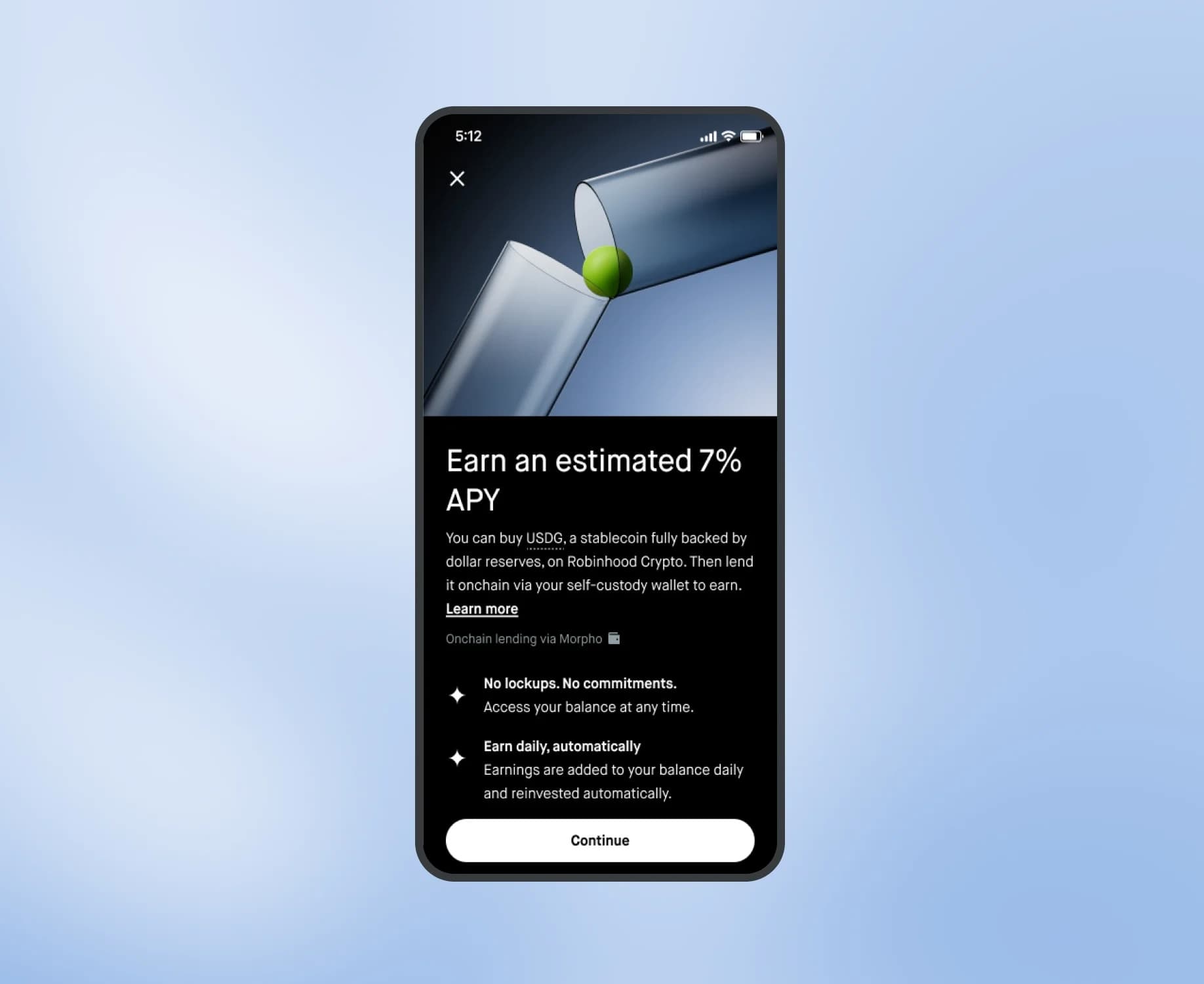
The Earn tab in the Robinhood app. Source: Robinhood, accessed September 2026.
At the time of writing, 65k+ wallets have made that tap, holding roughly $494 million in total value locked. The median position among them is $75, which is what real retail participation looks like at scale.
That vault, Steakhouse USDG, is the clearest test yet of whether curated onchain lending, built for crypto traders, can serve ordinary savers. So far it is passing with flying colors. Depositors have received close to 7% since the product launched, the vault has never lost anyone a dollar, and it charges no fee to end users.
The 7% yield comes from two places: (1) the vault's own lending book, which currently yields 4.06%, and (2) an incentive worth the remaining 3.02 points, which Robinhood funds and pays in extra vault shares through Merkl, an onchain rewards platform. The incentive is open only to Robinhood users and runs until July 1st, 2027. Because those shares are distributed outside the vault's net asset value, the vault's own reported APY cannot see them, which is why most data sources show roughly 4% while depositors receive roughly 7%.
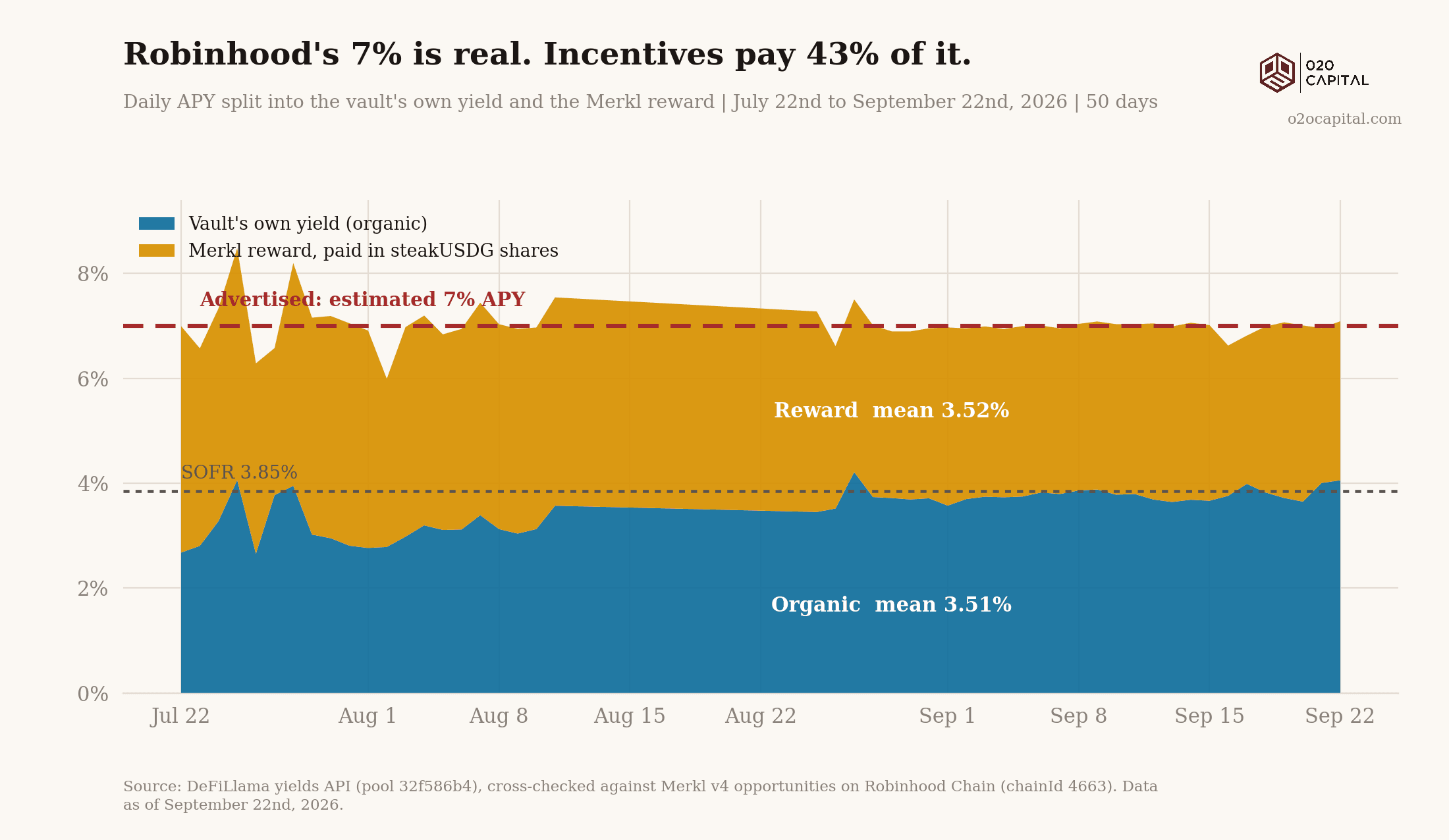
The two numbers that matter are the 4.06% organic yield and the 3.02% subsidy, which expires in about 9 months.
What the Vault Strategy Is
Steakhouse USDG is a Morpho Vault V2 deployed on May 29th, 2026, on Robinhood Chain. Depositors supply USDG and receive steakUSDG, a share token that grows in value as interest accrues. That share price stood at $1.007753 on September 22nd, 2026, up from $1.000000 at launch, and has never once fallen across 2,400+ hourly observations.
The vault charges a 0% performance fee and a 0% management fee, both confirmed onchain with the fee recipient set to the zero address, so every basis point the lending book earns reaches the depositor. Steakhouse usually charges 5% to 10% on its own branded vaults, which makes the zero-fee model a real concession. In most managed products, the end customer funds distribution out of their own return through a performance fee or a spread. Robinhood covers it here out of its own pocket for a second-order reason: as a founding member of the Global Dollar Network, it earns a share of the reserve income on the USDG its customers hold, so growing that balance grows its own revenue.
As a benchmark throughout, this brief uses the Secured Overnight Financing Rate (SOFR), which stood at 3.85% on September 21st, 2026, after the Federal Reserve raised rates by 25 basis points on September 16th. Much like traditional lenders price credit risk as a spread over a benchmark, the spread over SOFR here measures what a depositor is paid to carry the vault's credit, oracle and liquidity risk.
Vault V2 is Morpho's newer architecture driven by three key components:
- Adapters are the plumbing. The vault holds the cash, and an adapter is its connection to somewhere that cash can be lent. A vault with one adapter lends in one venue, and a vault with five can spread across multiple protocols. This one runs a single adapter pointing at Morpho Blue markets.
- Caps are hard dollar ceilings enforced by the contract, much like the concentration limits in an investment mandate. What is new in V2 is what a cap can attach to: one market, one adapter or one collateral asset. That lets a curator write "no more than $1 billion against USDe anywhere in this vault" once, instead of capping every USDe market separately. This ultimately streamlines risk and portfolio management.
- Gates are permission contracts the vault checks before it lets an address receive shares, send shares, deposit or withdraw. Point a gate at an allowlist and only approved wallets can hold or redeem the token, which is how a vault restricted to know-your-customer (KYC) verified wallets gets built.
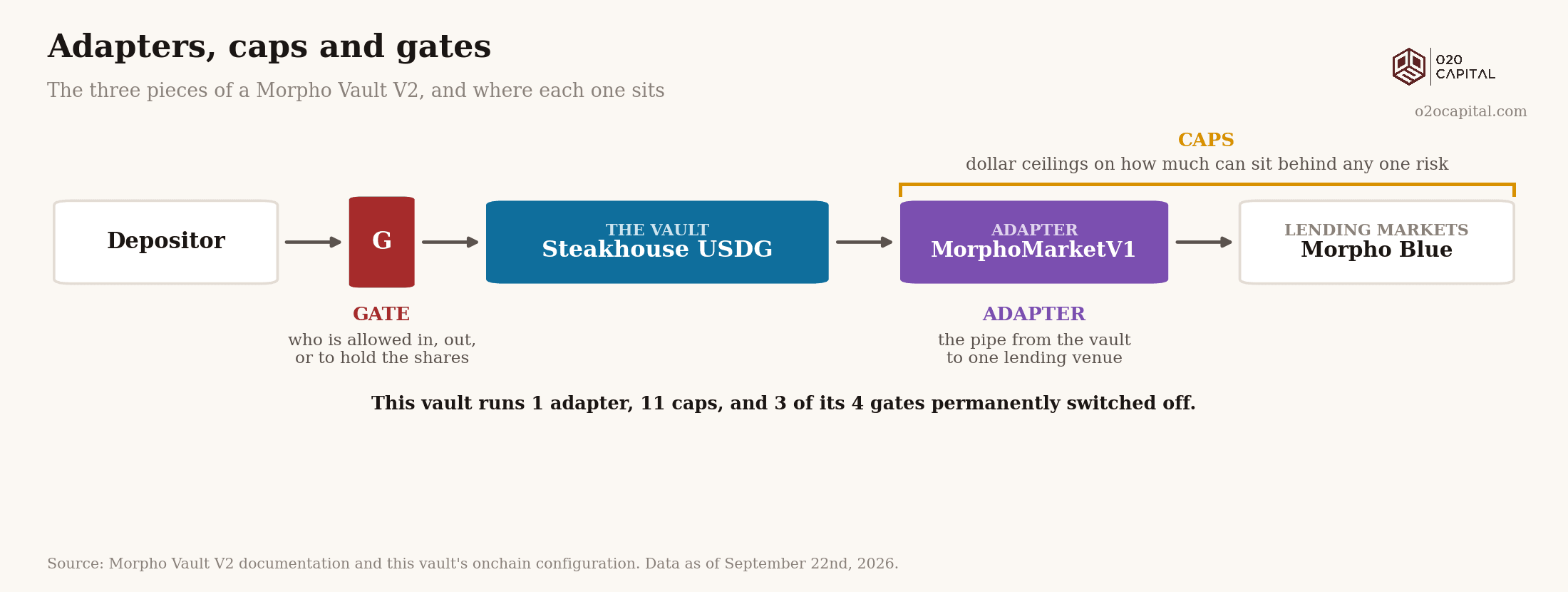
Steakhouse set 11 caps here. Every relative cap is set to 100%, so each exposure is limited in dollars but not as a share of the vault. Three of the four gates were permanently switched off roughly two hours after deployment, meaning no future curator can ever block a holder from receiving, transferring or redeeming shares. The one gate left covers deposits, and switching it on would take seven days' notice. These choices show Steakhouse designed the vault with a controlled entry point and a permissionless exit point.
Control of the vault is split across roles. Steakhouse, as curator, proposes new markets, cap increases and adapters, and on this vault each of those waits out a seven-day timelock, a public waiting period, before it takes effect. Allocators move deposits between approved markets within the caps. The sentinel is the safety role: it can pull money out of a market, cut a cap immediately and cancel any curator proposal still waiting out its timelock, which gives it a veto over the curator's changes. On this vault, Steakhouse holds the sentinel role as well.
Who Steakhouse Financial Is
Steakhouse Financial is the largest vault curator onchain, with roughly $3.1 billion under curation across 10 chains per DeFiLlama, of which about $2.33 billion sits on Morpho across 235 vaults. Steakhouse grew out of MakerDAO, where it helped onboard Treasuries and private credit and ran asset-liability management for the protocol's reserves. Steakhouse moved into curation when Morpho's vault architecture shipped in early 2024. The legal entity that curates these vaults is Carniceria Tropical Inc., a Panama company, per the firm's own governance disclosure.
A curator is best understood by what it can and cannot do. It decides which markets a vault allocates capital into and how much goes to each. It cannot withdraw depositor funds, and it typically posts no first-loss capital, which sets it apart from a collateralized loan obligation manager, who must retain some of the risk. Curators are usually paid a performance fee on yield, sometimes with a management fee on top. Across Steakhouse's V2 vaults, that performance fee averages roughly 7% on a value-weighted basis, although $1.34 billion of those assets, including this USDG vault, sit at 0% because the distributor takes the economics instead.
Steakhouse has a near spotless onchain track record. Every market under their curation reports zero bad debt, even through the marketwide crash of October 10th, 2025. An academic assessment of curator behavior published in December 2025 characterized the firm as the system's defensive outlier, with near-zero drawdown correlation to other curators as shown in the charts below.
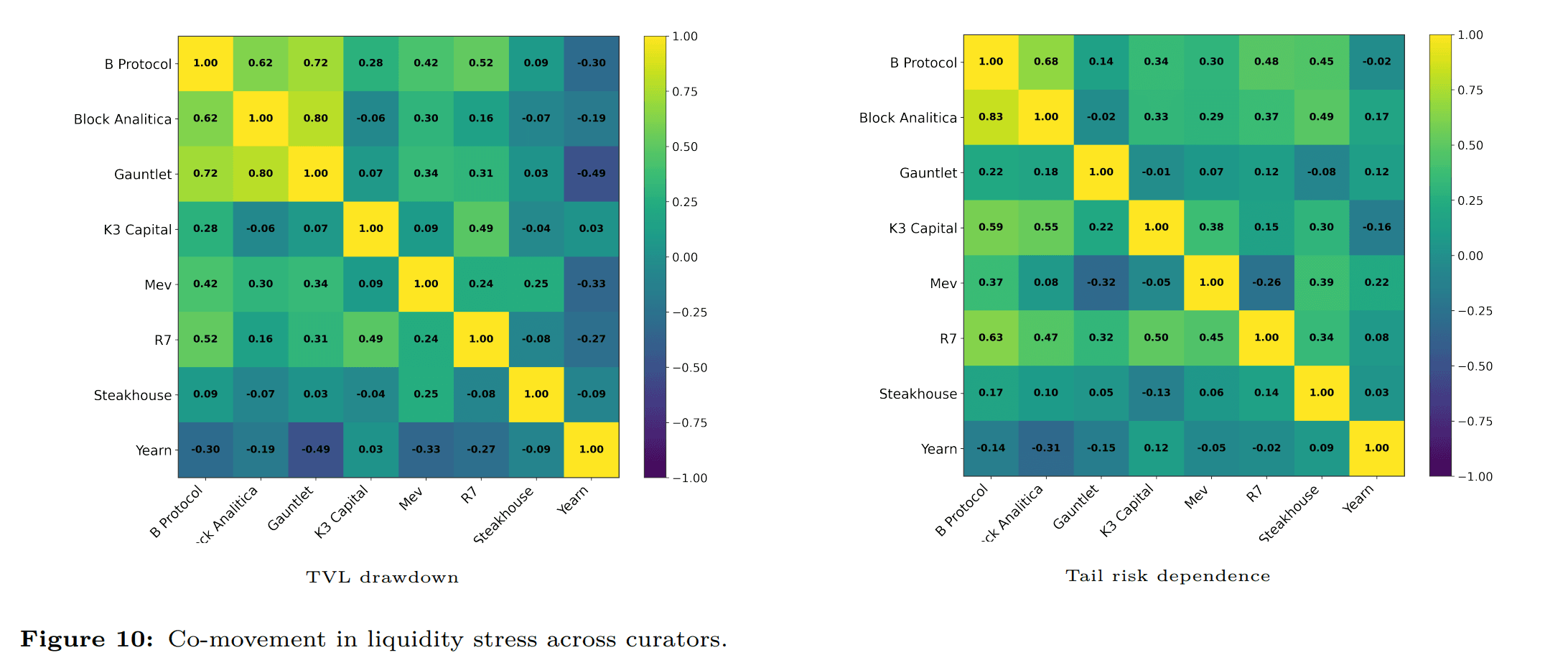
Zbandut, A. and Goldstein, C., "Institutionalizing risk curation in decentralized credit," arXiv:2512.11976, December 2025. Figure 10. CC BY 4.0.
Their transparency is at the top of the peer set. They publish a three-layer collateral framework that rates every market from AA to C, and the final rating is the worst of the three layers rather than an average. They run a seven-day timelock on curator changes, more than double the protocol's three-day minimum, and on their first-generation Morpho vaults they operate an Aragon DAO guardian through which depositors can veto curator actions, with voting power weighted by the size of their deposit. That depositor veto is the strongest protection of its kind among peers, although the USDG vault on Robinhood Chain does not have one.
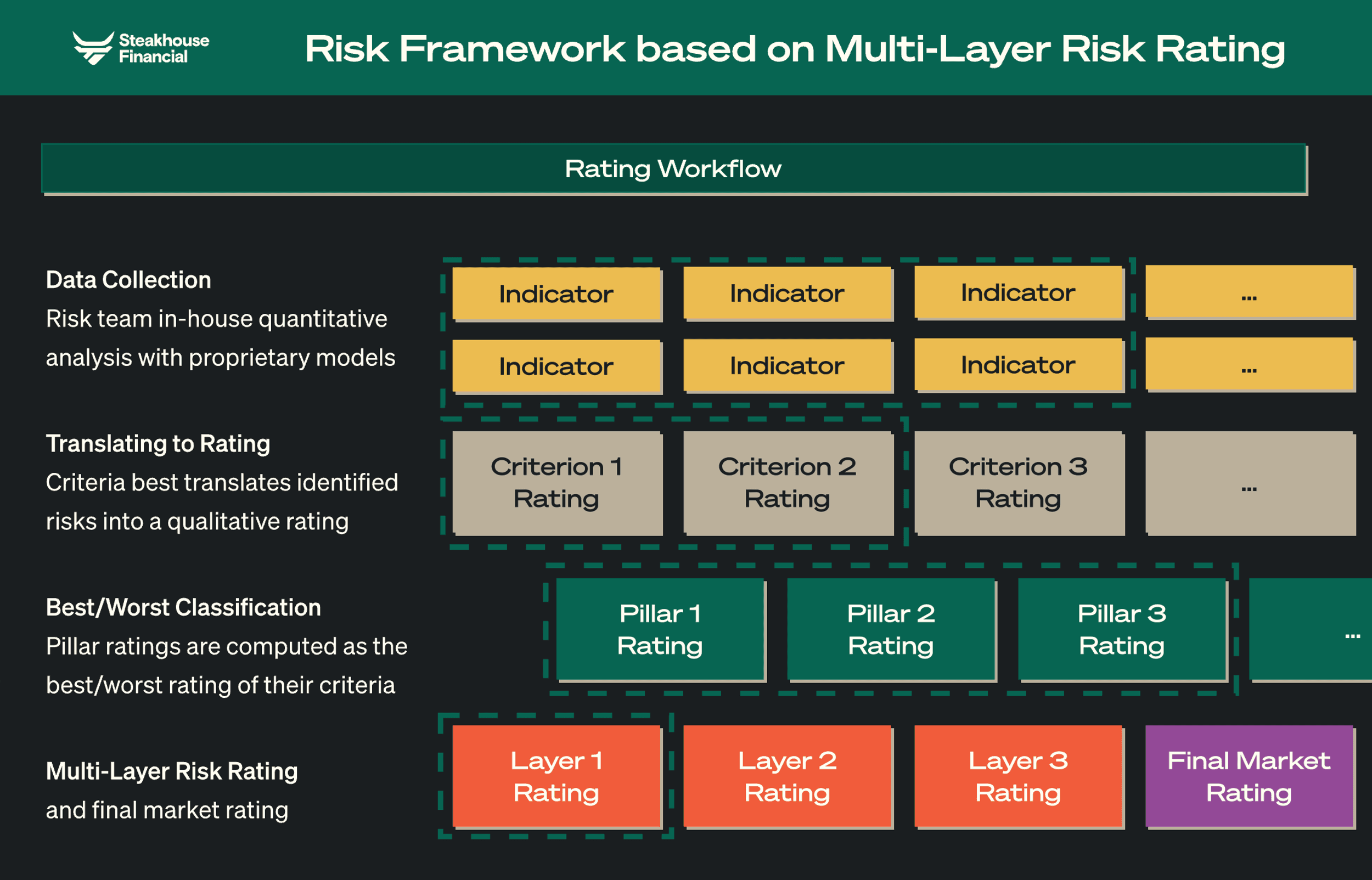
Steakhouse's collateral risk taxonomy: 3 layers, each split into pillars and criteria, rated AA to C. Source: Steakhouse Financial, accessed September 2026.
Who Paxos Is and How USDG Works
Paxos is a trust company regulated by the New York State Department of Financial Services that works across digital asset banking, stablecoins and real-world assets. Paxos issues USDG out of Paxos Digital Singapore Pte. Ltd., which holds a Major Payment Institution license from the Monetary Authority of Singapore (MAS), granted in full on July 1st, 2024, with DBS as its primary reserve custodian. The New York trust company most people associate with Paxos issues USDP, PAXG and PYUSD, which operate under a different regulatory regime from USDG.
The protections follow the entity. Paxos Trust, the entity behind USDP, PAXG and PYUSD, holds those reserves in bankruptcy remote vehicles under its terms. While the European co-issuer's white paper under MiCA, the EU's Markets in Crypto-Assets regulation, spells out segregated accounts, bankruptcy remoteness and creditor priority, no equivalent stipulation exists for the Singapore issuer. MAS only published draft legislation to implement its stablecoin framework on September 1st, 2026, with consultation open until October 16th, so USDG's Singapore leg is still supervised as a digital payment token under the Payment Services Act. That regime carries safeguarding duties without MiCA's specific insolvency drafting.
Segregation itself covers all three entities. The terms describe each reserve account as "separate from our business and operating bank accounts" and "established specifically for the benefit of Customer Token Holders and Non-Customer Token Holders." Importantly, a Robinhood Earn depositor sits in that second group because only Paxos account holders may redeem directly. Distributors and market makers with Paxos accounts keep the token at par for that depositor, since closing any discount to a dollar is simple arbitrage for them. Every large dollar stablecoin works this way, including USDC, which is why a deep secondary market matters as much as the redemption right itself.
The economics behind USDG matter as much as its legal structure. The Global Dollar Network, which launched in November 2024 with Bullish, Galaxy, Kraken, Nuvei, Paxos and Robinhood among its founders, offers distribution partners "up to 100% of the returns generated by assets backing USDG held on your platform." That inverts the usual model, in which the issuer keeps the interest earned on reserves, and it lets a distributor fund a consumer yield offer from outside the vault entirely.
USDG supply stands at roughly $3.20 billion across six chains per DeFiLlama, up 4.7x over 12 months, though it peaked at $3.44 billion in May 2026 and has drifted about 7% below since. Paxos's issuer powers are typical: it can freeze, seize or destroy tokens when a formal legal directive requires it, much as Circle can with USDC. One item belongs on the diligence list: the token contract is upgradeable, so Paxos can change its transfer and supply logic.
The Execution Stack
Four parties sit between the tap and the yield.
- Robinhood operates the chain and owns the customer.
- Paxos issues the stablecoin being deposited.
- Morpho provides the lending markets.
- Steakhouse decides where those deposits are lent.
Robinhood Chain is an Arbitrum Orbit rollup, chain ID 4663, running ArbOS 61. L2BEAT, which rates rollups on how much users must trust their operators, places it at the bottom of its maturity scale: contracts are instantly upgradable with no exit window, fraud proofs are limited to two allowlisted validators, and an authorized party can block specific transactions, even ones submitted directly through Ethereum to get around the operator. The eight-member Security Council includes Robinhood twice and Paxos once, among five other voting members.
Morpho brings roughly $11 billion in deposits across 45 chains, an immutable core, formal verification and about 30 completed audits since 2023. On Robinhood Chain it carries $501 million supplied across 275 markets, with the first market created on May 11th, 2026, seven weeks before the public launch.
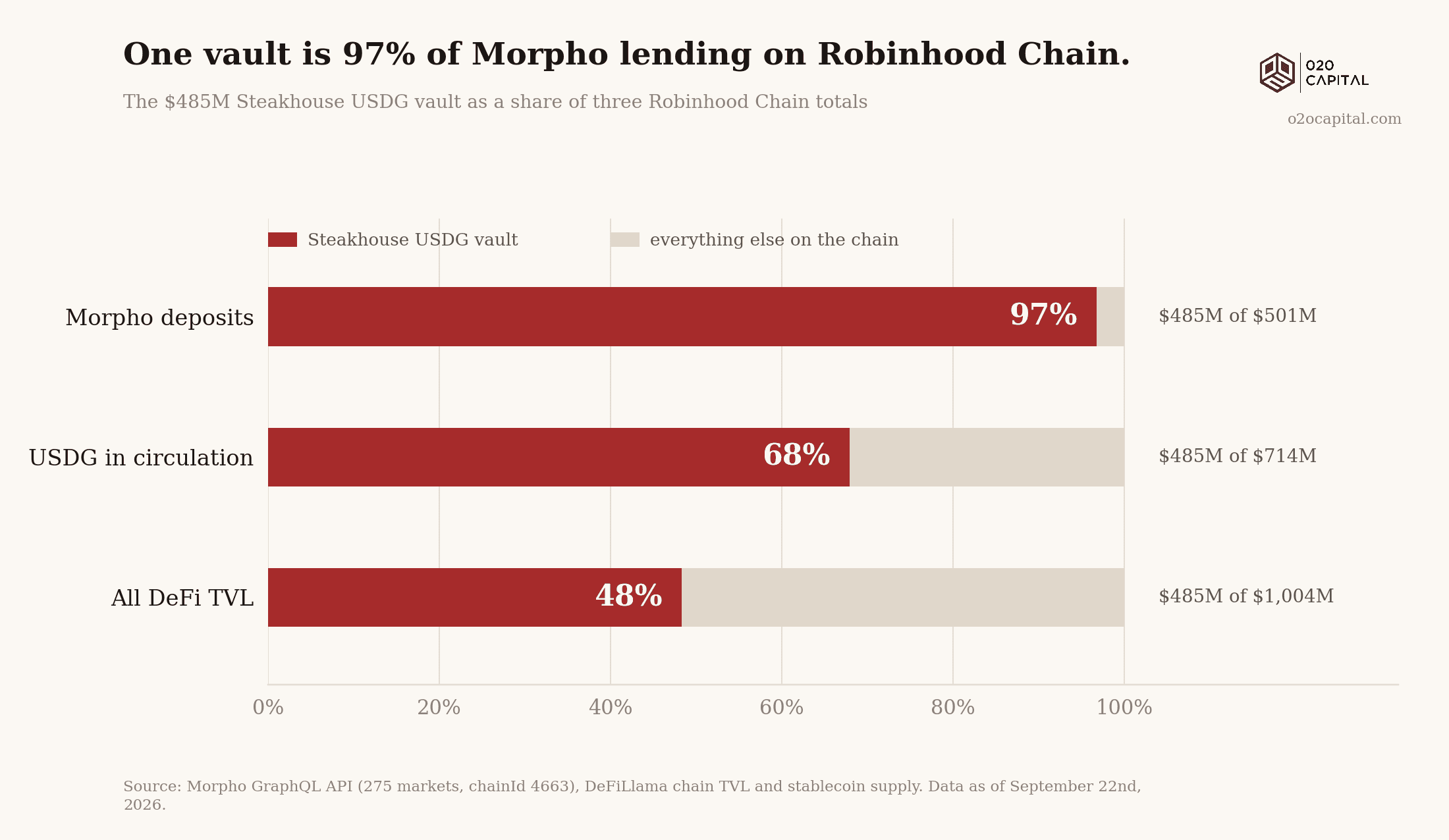
The compliance checks sit offchain and decide the rate a depositor earns. KYC, the state exclusions for New York and Texas, and the required educational onboarding primer all live in the Robinhood app. The vault contract itself carries no allowlist: all four of its gates are unset and three of them can never be set again, so anyone who can transact on Robinhood Chain can deposit and withdraw. The headline rate is restricted: the Merkl campaign is titled "[Robinhood Users Only]," so an outside depositor earns the vault's organic yield of roughly 4% while a Robinhood customer earns roughly 7%.
Where the Money Flows
The vault holds zero idle assets. It can lend into five Morpho markets, and four of them are funded, meaning the vault has actually supplied capital there, since a market can be approved and still hold nothing. The fifth is a WETH market Steakhouse has approved, capped at $50 million and holding $0.23. It is the vault's only non-dollar collateral and the only market where borrowers get liquidated at a loan-to-value (LTV) of 86%, below the 91.5% the other four share. If Steakhouse ever allocates into it, that would be the vault's first move into volatile collateral.
| Collateral | Allocation | Share | Liquidation LTV | Utilization | Cap used |
|---|---|---|---|---|---|
| USDe | $325.9M | 66.01% | 91.5% | 90.4% | 32.6% |
| syrupUSDG | $122.9M | 24.90% | 91.5% | 89.2% | 24.6% |
| mGLO | $31.4M | 6.37% | 91.5% | 90.6% | 62.9% |
| spUSDG | $13.4M | 2.72% | 91.5% | 91.2% | 2.7% |
| WETH | $0.23 | 0.00% | 86.0% | n/a | 0.0% |
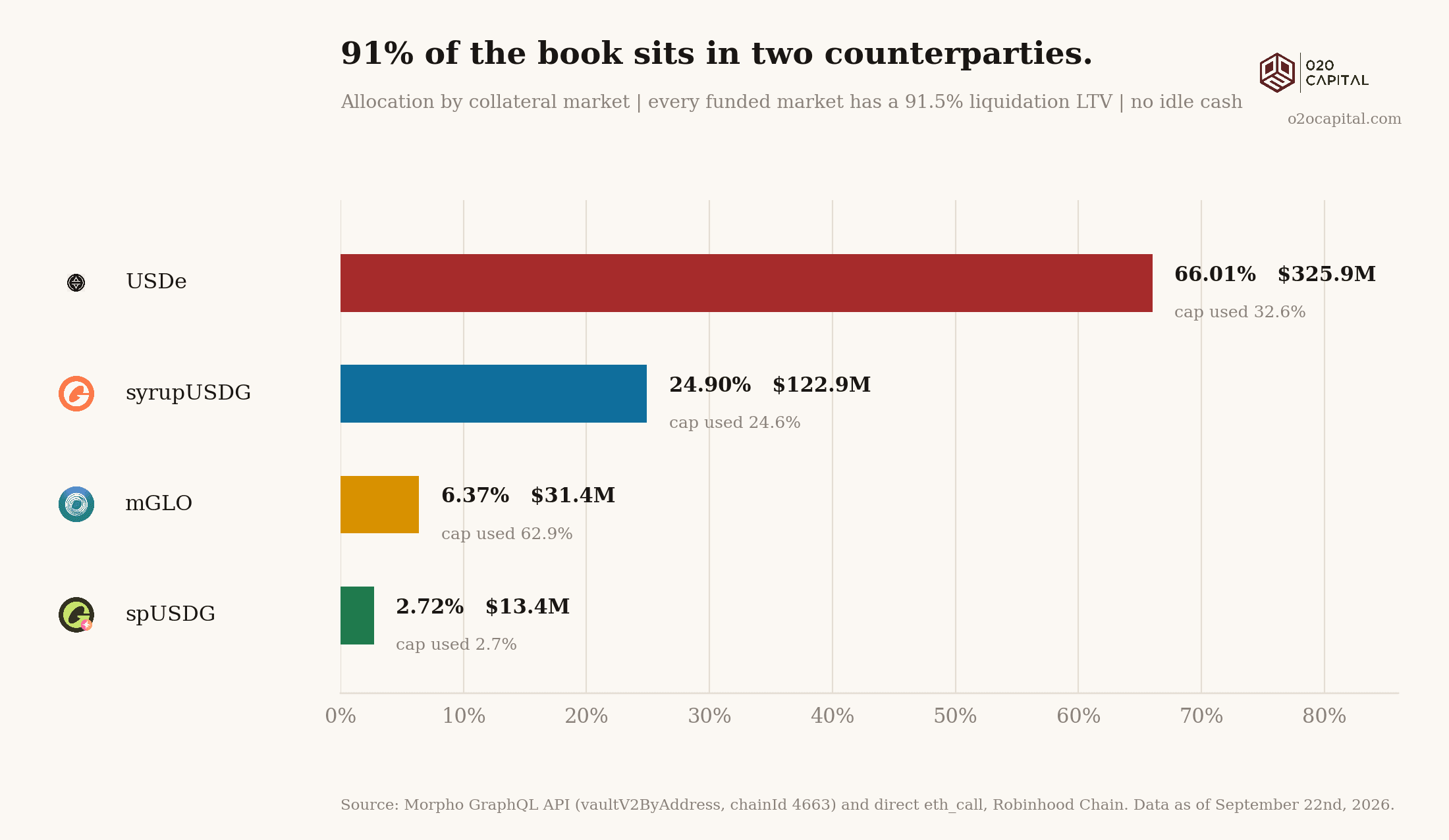
91% of the Steakhouse USDG vault is lent against collateral from two issuers: Ethena's USDe, a synthetic dollar backed by crypto positions hedged with short futures, and Maple's syrupUSDG, a claim on Maple's pool of overcollateralized loans to institutional borrowers. Both markets carry a 91.5% liquidation LTV. Retail depositors tapping a savings button are ultimately funding a crypto carry trade in USDe and crypto-backed lending via syrupUSDG. These are battle tested strategies, but most retail investors outside crypto have never heard of them.
The tokenized real-world asset thesis often attached to Robinhood Chain has not reached this vault's collateral yet. Just one non-crypto-correlated tokenized fund appears as collateral, Midas's mGLO at $31.4 million, and none of the chain's 194 tokenized equities is collateral in a funded market. The largest tokenized equity market, for Apple stock, shows $239,000 supplied against $101 borrowed.
Across the four funded markets, this single vault supplies 96.53%, 100.00%, 99.91% and 99.93% of total market supply.
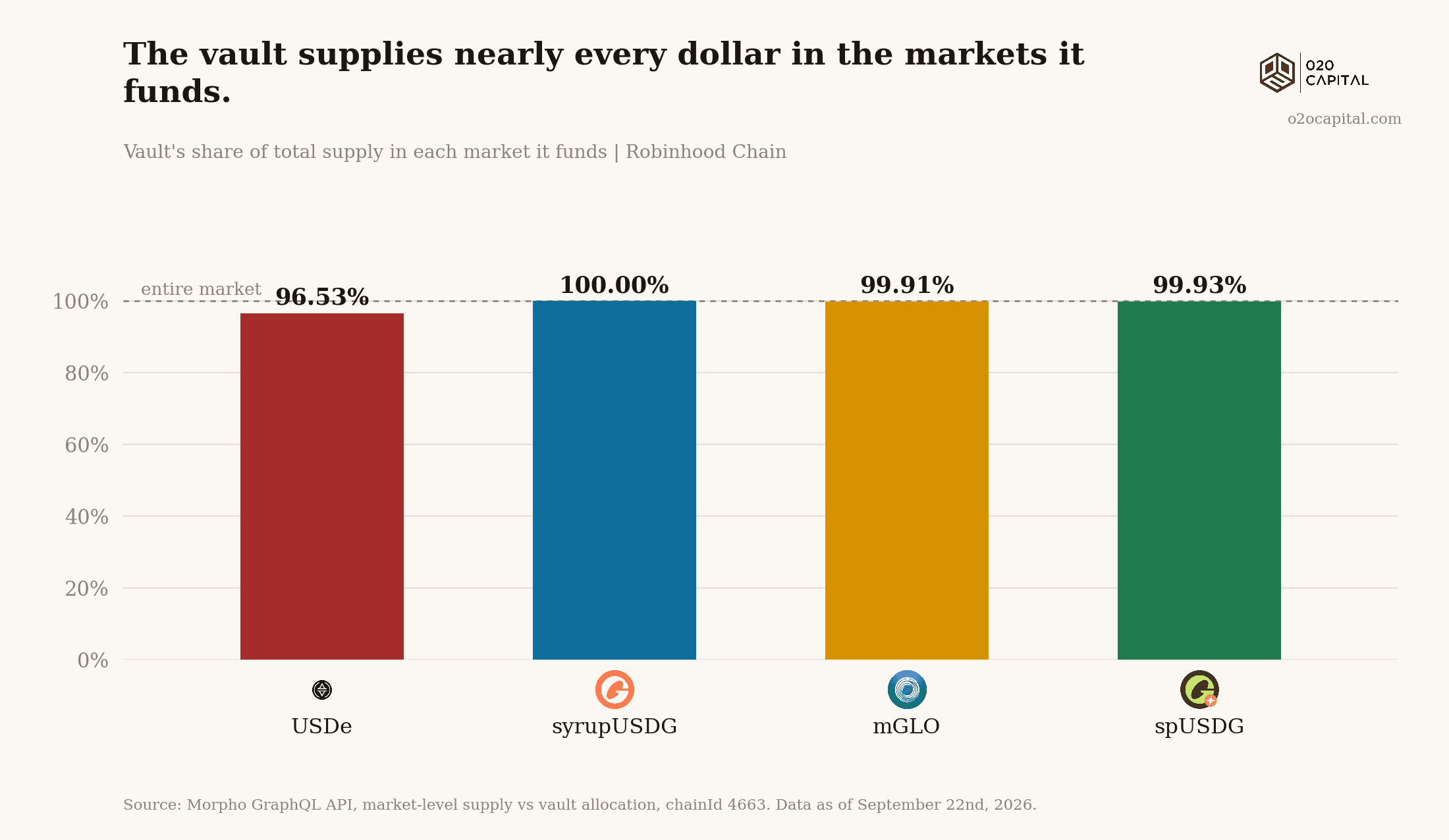
A curator that spreads deposits across markets other lenders also fund is diversifying, but a vault that supplies nearly all of each market is closer to running a direct lending book. When redemptions come, this vault has to withdraw from markets that only it funds, where 90% of the money is out on loan, with no other lender to absorb the gap.
Two collateral assets deserve a closer look from a white-hat point of view:
- The USDe oracle, the price feed for the market holding 66% of the book, is a minimal contract that always returns exactly 1.000000 USDG, a hard-coded par value. It is a dual-oracle design with a live backup feed, but switching to that feed takes a deviation above 0.5% and a 16-hour challenge window, so if USDe lost its peg, no liquidations could happen for at least 16 hours while the primary price still values the collateral at par.
- The mGLO feed, the oracle pricing the $31.4 million position, is two contracts stacked together. An admin-pushed mGLO/USD feed marks the fund at exactly $1.00 and has published 2 price updates since June, the latest on August 21st, 2026, which was 32 days old at the time of writing. That price passes through a wrapper contract that applies a fixed 6% haircut set at deployment, which is why the market sees $0.94 and why the contract's description reads "mGLO/USD PriceLowered." Because that discount can never change, it cannot track the asset in real time. Yearn's independent curation review, where a higher score means more risk, scored the Midas mGLOBAL family 3.4 out of 5.0, the weakest of the three constituents it covers.
For balance, Yearn scores the other two constituents it covers as low risk, at 2.2 for Paxos USDG and 2.3 for Maple's syrupUSDC. mGLO is also the position closest to its cap, at 62.9% of its dollar limit, which suggests Steakhouse is already keeping that exposure tight.
What Pays the 7% Yield
In a Morpho Blue market with zero fees, lenders earn exactly what borrowers pay, scaled down by utilization, the share of the market's money that is out on loan. Applying that to the four funded markets reproduces the vault's reported yield to within a basis point.
| Market | Weight | Utilization | Borrow APY | Supply APY |
|---|---|---|---|---|
| USDe | 66.01% | 90.49% | 4.634% | 4.184% |
| syrupUSDG | 24.90% | 88.94% | 4.049% | 3.594% |
| mGLO | 6.37% | 90.64% | 5.506% | 4.978% |
| spUSDG | 2.72% | 91.22% | 3.950% | 3.597% |
| Blended | 90.13% | 4.525% | 4.07% |
The vault would have to charge borrowers 7.80% to pay depositors 7% from lending alone. That rate would price borrowers out and send them elsewhere for financing, so they pay 4.525% and a subsidy tops depositors up to 7%.
The borrowers in the largest market are running a loop: they post USDe as collateral, borrow USDG against it, buy more USDe and repeat. Because the market lends up to 91.5% of the collateral's value, a borrower can turn $1 of their own money into roughly $9 of USDe while keeping a small buffer before liquidation. Their income is a 4.75% reward paid on USDe in this exact market through a second Merkl campaign, called "Ethena Liquid Leverage," and they earn it on the whole $9 position. Their cost is the borrow rate, which they pay on the roughly $8 of that position that is borrowed.
The trade breaks even at a borrow rate of 5.32% and loses money above it. Borrowers pay 4.63% today, which returns about 5.8% a year on their own money. At a 7.80% borrow rate, the same position would lose roughly 20% a year, so borrowers would close it and withdraw the collateral this vault lends against.
Borrower economics therefore set the ceiling. With about 90% of the book lent out at any time, the most the vault's own lending can sustainably pay a depositor is close to 4.8%.
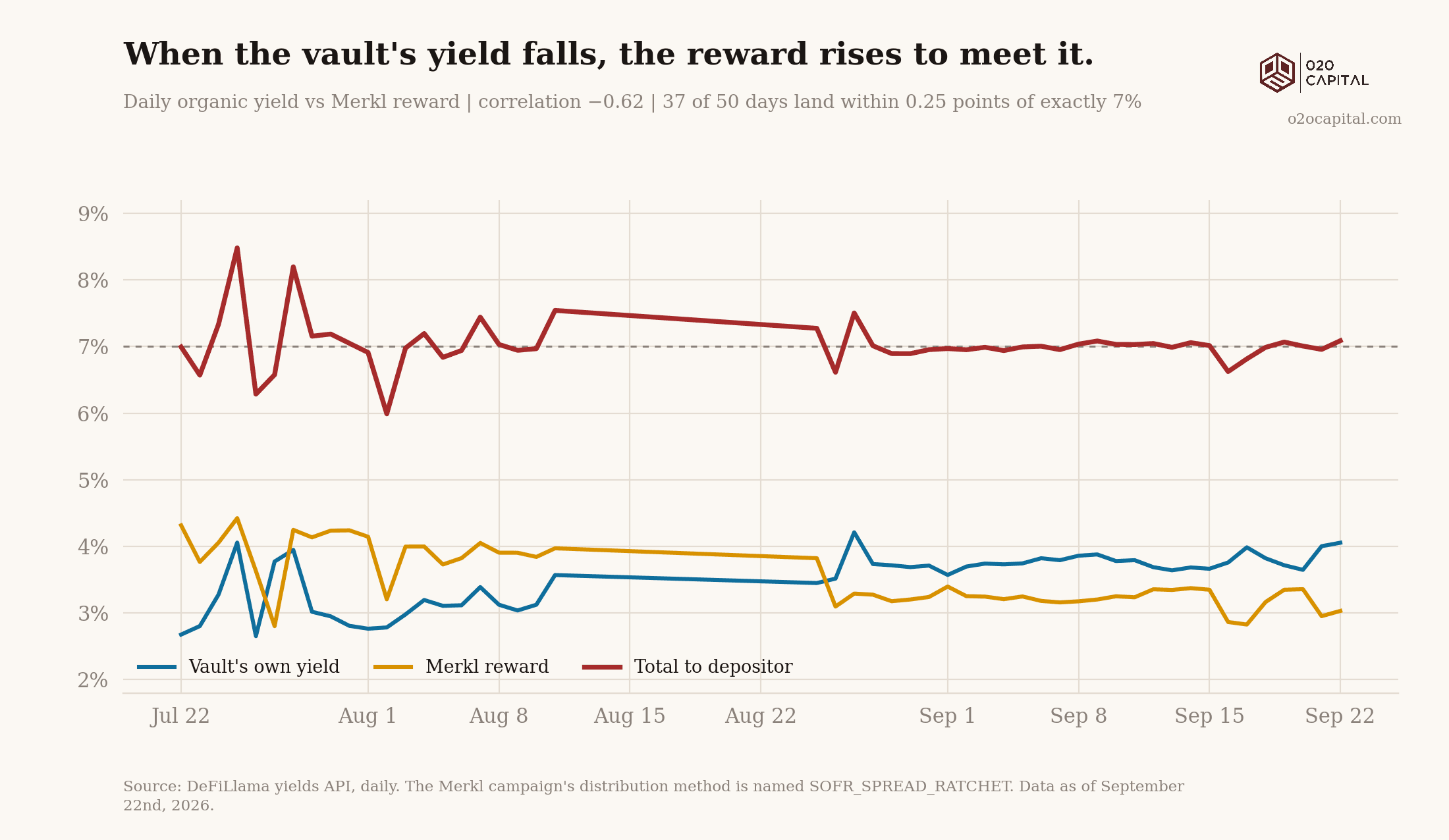
So rewards fill the gap by design. Across the 50 days for which both parts are tracked, the total yield reaching depositors averaged 7.03%, and 37 of those 50 days landed within a quarter point of exactly 7%. The vault's own yield and the reward have a correlation of negative 0.62, so when one falls the other tends to rise, the signature of a top-up mechanism. Merkl's own configuration names the distribution method SOFR_SPREAD_RATCHET.
Three common explanations for why the vault's own yield needs topping up do not hold up against the data:
- Deposit dilution. Borrowing kept pace with deposits: from July 4th to September 22nd, 2026, supply grew 51.4x and borrowing grew 52.2x, so utilization rose from 90.07% to 91.38% and lending yields rose with it.
- Collateral yield compression. Ethena's staked USDe (sUSDe) yield, a gauge of what USDe collateral earns, rose over the same period from 3.82% to 4.65%.
- Falling macro rates. Rates rose over this period: between July 1st and September 21st, 2026, SOFR gained 19 basis points, the effective federal funds rate gained 25 and the three-month Treasury bill yield gained 32. Macro moves explain only about 8% of the change in the vault's own rate.
The campaign budget is about 115 million steakUSDG, running from July 1st, 2026, to July 1st, 2027. It currently pays out about $39,700 in shares a day, or roughly $14.5 million a year, far less than the budget allows, so the end date is the limit that matters. If the markets settle at the 90% utilization they are designed to target, the vault's own yield would be about 3.65%, a step down of roughly 343 basis points from the advertised yield on the day the campaign ends.
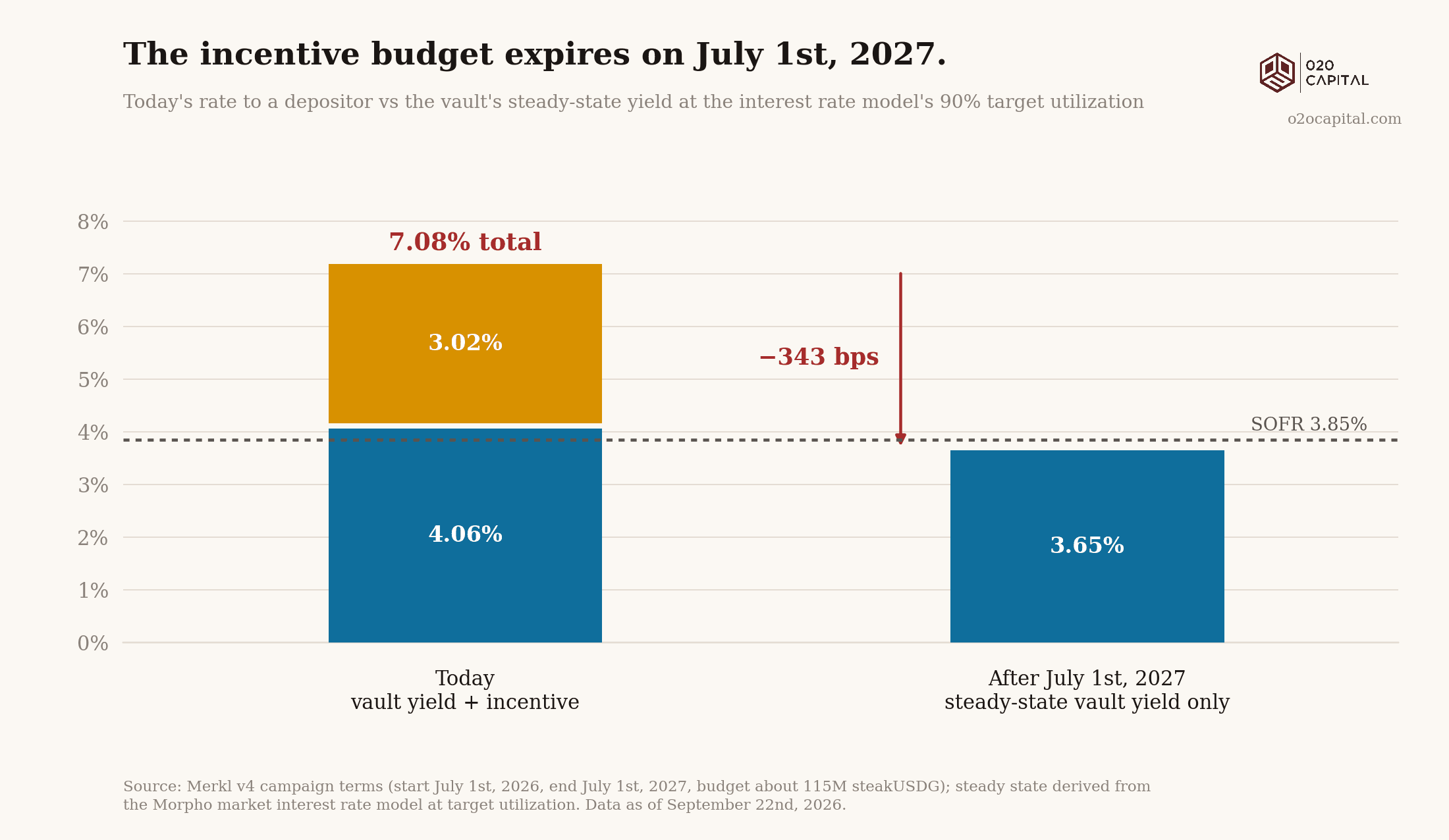
Set against SOFR at 3.85%, the vault's own yield of 4.06% is a spread of about 21 basis points (SOFR+21). Borrowers on the other side pay 4.525%, roughly SOFR+68, so about two-thirds of that premium never reaches the depositor. The difference is the cost of the roughly 10% of the book the markets keep unlent, which is the same buffer that lets depositors redeem on demand. At the 90% utilization target, the 3.65% steady-state yield would sit about 20 basis points below SOFR.
Performance and Adoption Since Launch
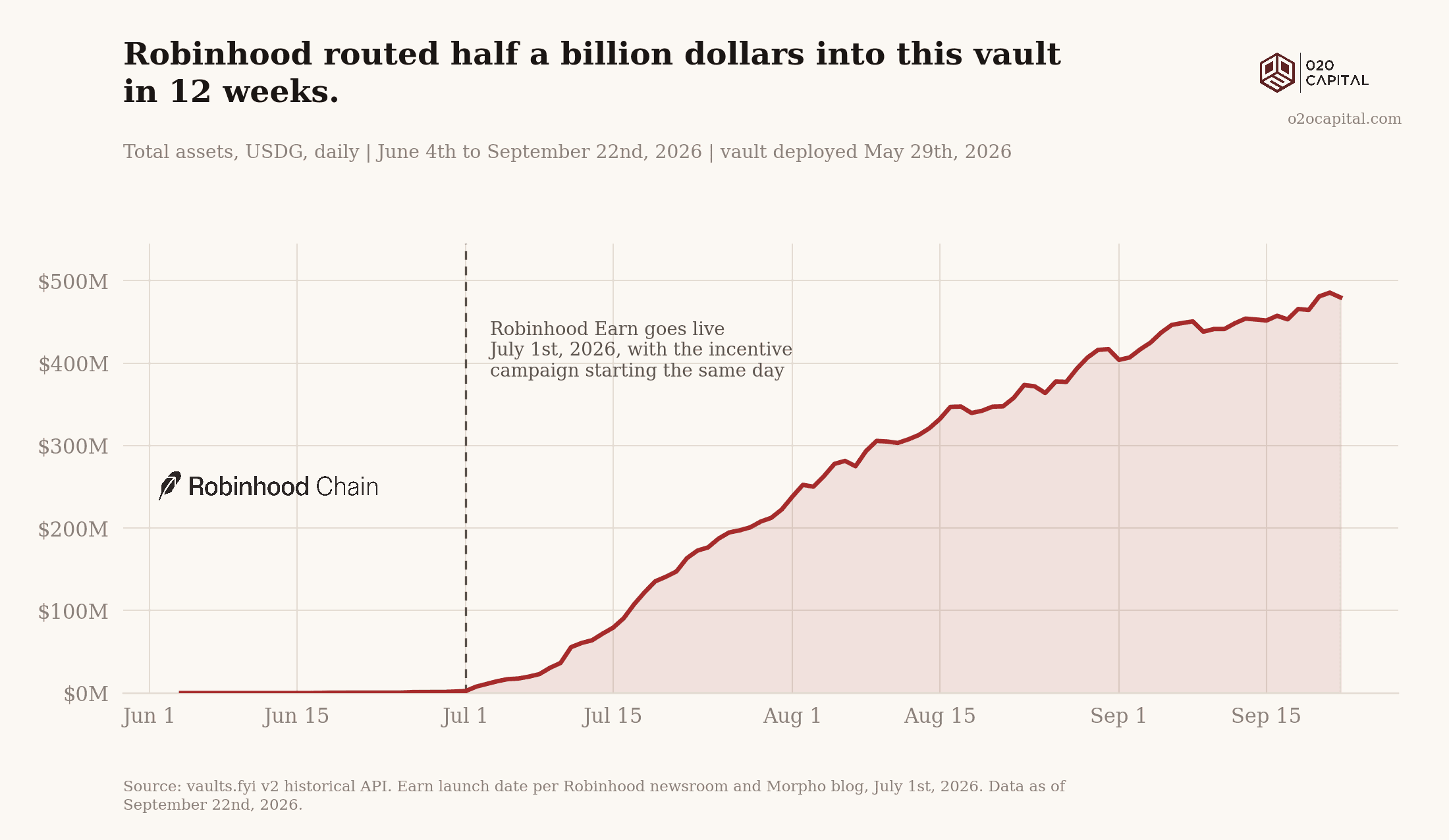
On July 1st, 2026, the day Earn went live and the incentive campaign began, the vault held $2.4 million. Twelve weeks later, it holds roughly $494 million, against an addressable base of 27.7 million funded Robinhood customers.
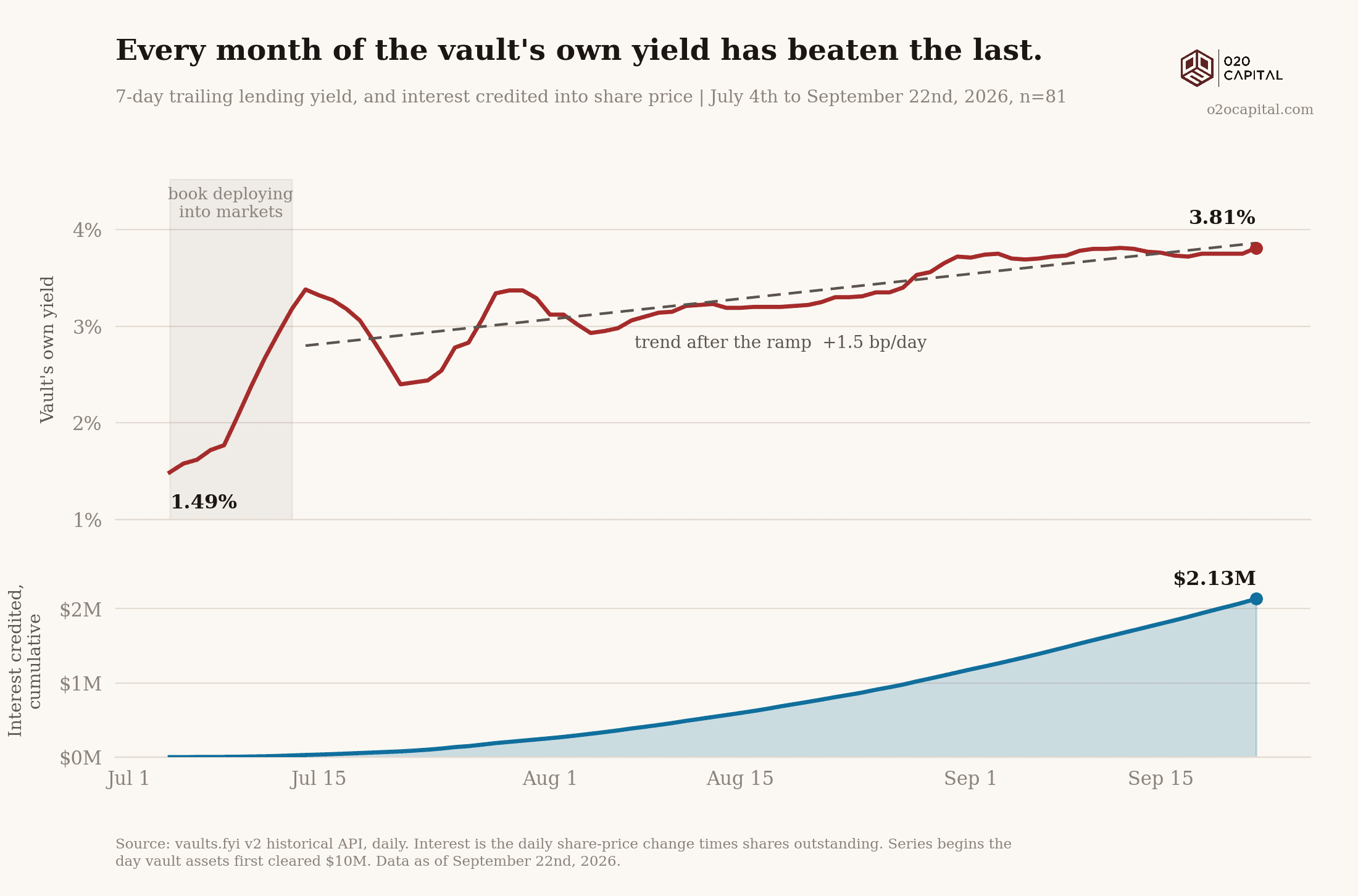
The vault's own lending yield rose alongside those deposits, measured here as a 7-day trailing average every day since assets first passed $10 million on July 4th, 2026. The series opens at 1.49% and closes at 3.81%, with 49 up days against 20 down and a worst single-day drop of 23 basis points. The first 10 days account for 169 of those basis points as deposits were lent out into markets, and the climb continues at roughly 1.5 basis points a day after that. That yield is interest depositors have actually received: the steakUSDG share price rose from 1.000583 to 1.007670 over the period, crediting 0.71%, or about $2.13 million of lending income, to depositors on top of the Merkl reward. Rebuilding the yield from the share price alone matches the vault's published lending yield to within half a basis point on a typical day.
On adoption, no single holder dominates the vault. Reconstructing all 65k+ holders from 403k+ transfer events gives the top 10 holders a combined 11.7% of shares and the largest single holder 2.55%, and that largest holder is itself a pooling contract collecting deposits from more than a hundred addresses. Bubblemaps finds zero connected clusters among steakUSDG holders, while the same tool on the same chain finds clusters among holders of both syrupUSDG and USDG. A cluster is a group of wallets that send tokens to one another and often share an owner, so finding none suggests the vault's 65k+ holders are independent depositors, with no sign of one party spreading a large position across many wallets.
The shape of that investor distribution shows a true retail story. The holder base has a Gini coefficient of 0.948, a measure of how evenly something is shared on a scale from 0 to 1, where 0 means every holder owns exactly the same amount and 1 means a single holder owns everything. For reference, US household income scores about 0.48. At 0.948, this is one of the most stratified holder bases you will find in a product with this many participants: a median position of $75 against a mean near $7,450, with the smallest 90% of holders holding 6.7% of the capital.
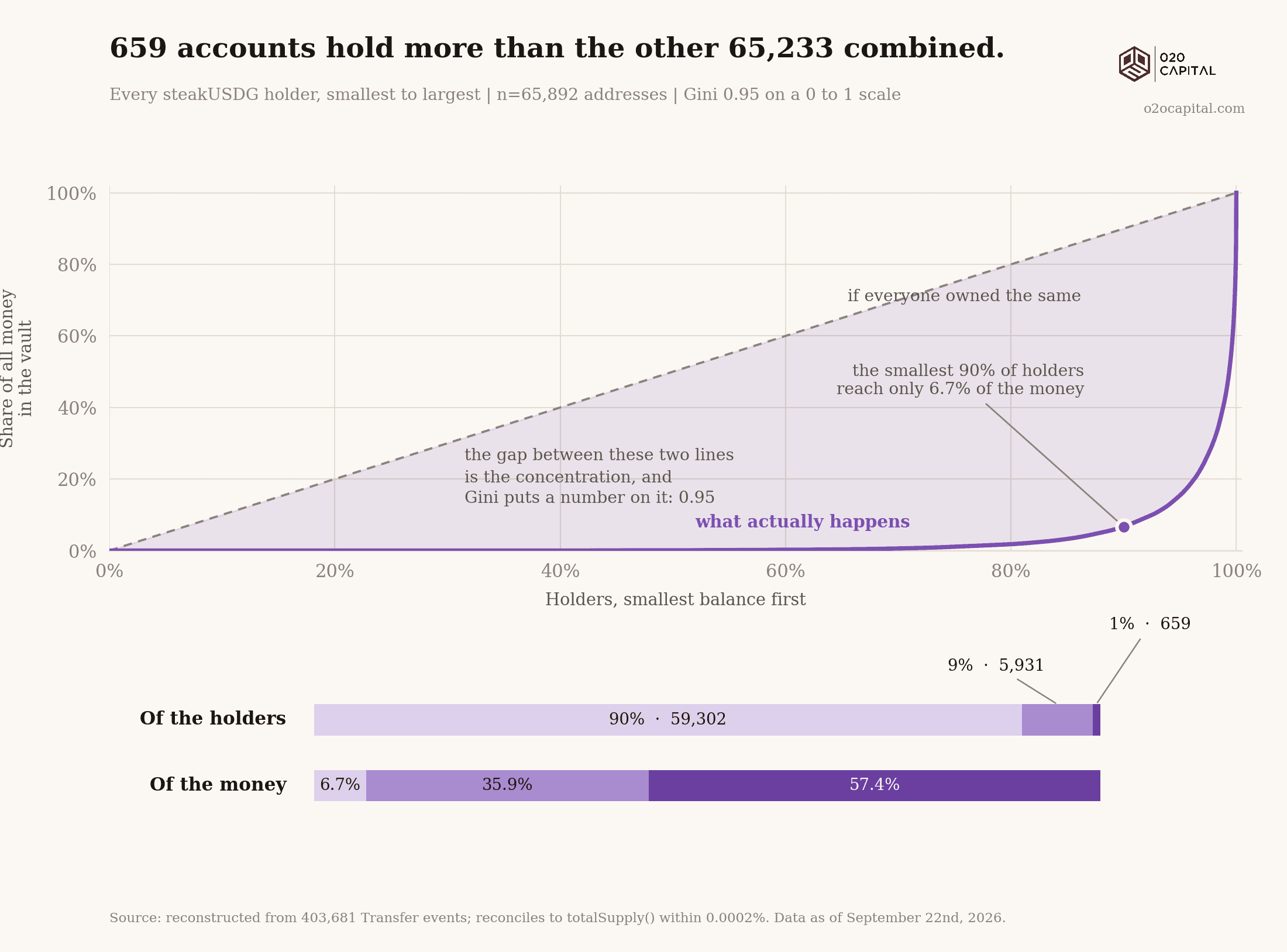
That is tens of thousands of customers who tapped a button once, sitting alongside about 6,000 accounts holding $10,000 or more that together control 92.5% of the money. Only 45 accounts in the vault hold more than $1 million, and everyone faces identical terms. What remains unclear is how redemptions would play out if million-dollar holders and small retail accounts tried to withdraw at the same time.
The Risks
The following are points allocators will likely want to work through with the Steakhouse team and the underlying asset issuers:
- Correlated yield. 91% of the book is lent against USDe and syrupUSDG, with Midas's mGLO at 6.4% the only collateral in the vault that prices something outside crypto. Return and risk therefore share a single driver: a crypto drawdown compresses the borrowers' carry, pressures the collateral and thins redemption liquidity all at once, which is the scenario in which a saver would most want their money back. The cause is a shortage of onchain assets outside crypto that can take allocations at this size. It eases as curators like Steakhouse gain access to more non-crypto-correlated collateral, which is the gap O2O Capital is built to fill with institutional yields from fund finance, payment and trade receivables, aerospace and related gap financing.
- Liquidity mismatch. Same-day capacity is $32.6 million of instant liquidity plus $17.6 million that any depositor can force out of markets, at a penalty currently set to zero, for a total of $50.3 million, or 10.2% of assets. The top 10 holders alone hold 1.15x that, and 90% of the book is out on loan in markets where this vault is almost the only lender. This brief does not predict a run, and free forced withdrawal from markets is a real safeguard most vaults do not offer. The open question is how much redemption the word "instant" can support at this scale.
- Borrower concentration. The largest borrower, a single ordinary wallet, holds 27.4% of the debt, roughly $125 million, and the top 10 hold 72.9%. About 68% of outstanding debt sits within about 2.5% of its liquidation point, a health factor below 1.025, so a 3% drop in collateral value would push a large share of the book into liquidation range at once. At a 91.5% LTV, that thin buffer is what makes the carry work.
- Incentive dependence. 43% of the headline rate is subsidized by rewards rather than produced by organic yields. Depositor stickiness is the largest open question about this product that will be answered once the incentives expire on July 1st, 2027.
- Oracle design. By design, two-thirds of the book cannot be liquidated for at least 16 hours if USDe loses its peg, and the $31.4 million mGLO position is marked by a manually updated feed that is a month old.
- Chain and issuer control. An authorized filterer can make transactions fail even when they are submitted directly through Ethereum, the escape route most rollup users assume they have. Paxos retains the power to freeze and destroy USDG wherever it is held, and a frozen vault contract would lock the USDG inside it.
- Governance independence. The curator is a multisig wallet that needs 3 of 7 signers to act, and the sentinel, which holds the veto over curator changes and also serves as an allocator, is a 1-of-7 wallet with the same seven signers, so the check on the curator sits with the curator's own team. Fee changes, new allocators and the penalty for forced withdrawals all carry zero timelock, so fees could move from zero to Morpho's maximum in one transaction with no notice. On the other side, the seven-day timelocks on adapters, caps and gates are longer than the protocol minimum, and the gates that were switched off can never be turned back on, both of which work in depositors' favor.
One clearly positive finding belongs in the same list. Capital is cleanly sourced: steakUSDG is collateral in zero of the chain's 275 markets, depositors and borrowers are effectively separate groups, and the reported total value locked does not count the same money twice. Two caveats apply: (1) Spark’s spUSDG creates a double-count of roughly 2.6%, and (2) syrupUSDG is a claim on Maple's institutional loan book, so the collateral securing a quarter of this vault sits with custodians offchain and reaches a depositor through Maple's reporting. Both issuers back that reporting with outside checks. Maple's contracts have been through 8 audit rounds since 2022 across seven firms, including Trail of Bits, Spearbit, Sherlock and Dedaub, and Maple publishes Proof of Reserves for its loan and collateral data. Ethena publishes monthly custodian attestations on the assets backing USDe.
Where Collateral Like This Is Thin
Step back from this vault and a pattern shows up across curated stablecoin lending. The largest books on Morpho are concentrated in a handful of crypto-native collateral assets, priced by oracles that are hard-coded, thinly sourced or manually set, at loan-to-value ratios above 90%. The yield those books produce is essentially a carry trade whose risk and return both move with the same crypto cycle. A vault serving 65k+ retail savers holds just one small position outside crypto, and its organic yield is capped by what a leveraged crypto trader can afford to pay.
That is the gap O2O Capital seeks to address: offering real yields backed by income-producing and cash flowing assets that do not rely on crypto funding rates, liquidity pool arbitrage or crypto price mechanics. One of O2O's flagship asset classes is private fund financing, a $1 trillion industry that curated onchain vaults haven’t even met… yet.
What to Watch
The Steakhouse USDG vault has done what it was built to do. It moved half a billion dollars of retail savings onchain in 12 weeks, passed every basis point it earned to depositors, lost zero deposits and permanently gave up the power to block withdrawals.
Four things are worth tracking into next year:
- Whether the incentive is renewed, restructured or allowed to expire on July 1st, 2027, and what deposits do in response.
- Whether the vault's own yield keeps climbing toward the level that would make the incentive unnecessary. On current borrower economics it tops out near 4.8%, well short of 7%.
- Whether Steakhouse publishes a disclosure and a third-party rating for its largest vault.
- Whether same-day liquidity grows toward the size of the positions that might want it.
The deeper question is the one this vault poses for everyone building in the category. Curated lending has now proven it can reach ordinary savers at scale through a broker's frontend, which is a huge distribution unlock. What it has not yet proven is that the collateral underneath can pay them a competitive rate without a subsidy.
O2O Research publishes a vault brief every two weeks. Allocators, curators, neobanks and issuers working on non-crypto-correlated collateral are welcome to get in touch.
O2O Research
Notes on Sources and Method
All figures are as of September 22nd, 2026, unless dated otherwise. Point-in-time vault state is read from the Morpho GraphQL API and direct eth_call against Robinhood Chain. The base and reward APY split is from the DeFiLlama yields API, cross-checked against Merkl v4 campaign data, which agree to within 2 basis points on both legs. Vault time series are from the vaults.fyi v2 API, which reads $489.7 million in total assets against Morpho's $494.3 million, a 0.9% indexer difference.
The holder set is reconstructed from 403,681 transfer events and reconciles to totalSupply() within 0.0002%, giving 65,892 addresses with a positive balance. Published holder counts near 54,829 leave out tiny "dust" balances.
Statistical work uses an at-scale sample of 81 days beginning July 4th, 2026, when the vault first exceeded $10 million, with the threshold fixed before testing. The base-versus-reward analysis uses the 50 days from July 22nd, 2026, for which DeFiLlama tracks both legs. Trend estimates use heteroskedasticity and autocorrelation consistent standard errors. On samples this short, descriptive decomposition and simple correlation are supportable and causal claims are not.
Items O2O could not verify:
- Whether the ratchet targets a flat 7% or a SOFR-linked spread. The campaign method is named SOFR_SPREAD_RATCHET, but SOFR moved only 23 basis points in sample, which leaves no statistical power to distinguish the two.
- Whether Global Dollar Network reserve income funds the incentive budget. The arithmetic does not require it, and per-partner terms are not public.
- USDG reserve line-item composition, since the transparency page renders its documents client-side.
- A single USDG supply figure. DeFiLlama reads roughly $3.20 billion against rwa.xyz at roughly $1.65 billion, a gap explained by chain coverage, since rwa.xyz does not index X Layer, Ink or Hyperliquid. Adjusting for coverage closes it to about 1%.
- The current contents of Robinhood Chain's transaction filter list.