Vault Brief, Issue 2. Data as of October 9th, 2026.
Key Findings
-
One vault, most of the money. The cbAssets Vault supplies about 80% of the USDC in the SOL market and 77% in the JitoSOL market behind Coinbase's Solana-backed loans.
-
Coinbase's fingerprints. Coinbase's wallets, network fees and 2% loan fee show that about 95% of the borrowing runs through Coinbase's loan system. No public source names Clearstar as the lender.
-
A deliberate takeover. Clearstar replaced Steakhouse as the main lender in four deposit rounds since July 27th. Higher caps of $10 million and $5 million took effect on October 9th.
-
About 6.0% for depositors. Lending pays about 4.2% after Clearstar's 10% fee, and a USDC reward adds 1.8% until October 31st.
-
One cycle. The collateral moves almost in lockstep with bitcoin. Liquidations held up on October 8th, and a deeper fall would test all eight markets at once.
The Vault Behind the Loans
A Coinbase customer holding SOL, the native token of the Solana blockchain, can tap Borrow in the app and take out as much as $100,000 in USDC, Circle's dollar stablecoin. Coinbase's borrow page credits the lending in one line: "Loans powered by Morpho." Morpho is an onchain lending protocol, and the loans run on Base, the network Coinbase built on top of Ethereum. Morpho calls this the DeFi mullet: Coinbase in the front, decentralized finance (DeFi) in the back.
Issue 1 of the O2O vaults deep dive traced Robinhood's version to the vault behind its Earn button. This second issue traces Coinbase's Solana loans to the dollars behind them.
Those dollars sit in two Morpho markets on Base. One lends against SOL and the other against JitoSOL, a staked form of SOL. Both tokens cross to Base from Solana through a bridge. One vault supplies most of the USDC in both markets: the Clearstar cbAssets Vault, with about 80% of the SOL market and 77% of the JitoSOL market. Clearstar is a risk curation firm founded in Switzerland in 2022, with about $214 million under curation.
Nearly all of the borrowing in these two markets carries Coinbase's markers. No public source names Clearstar as the lender, so the link is this brief's finding and interpretation of public blockchain data.
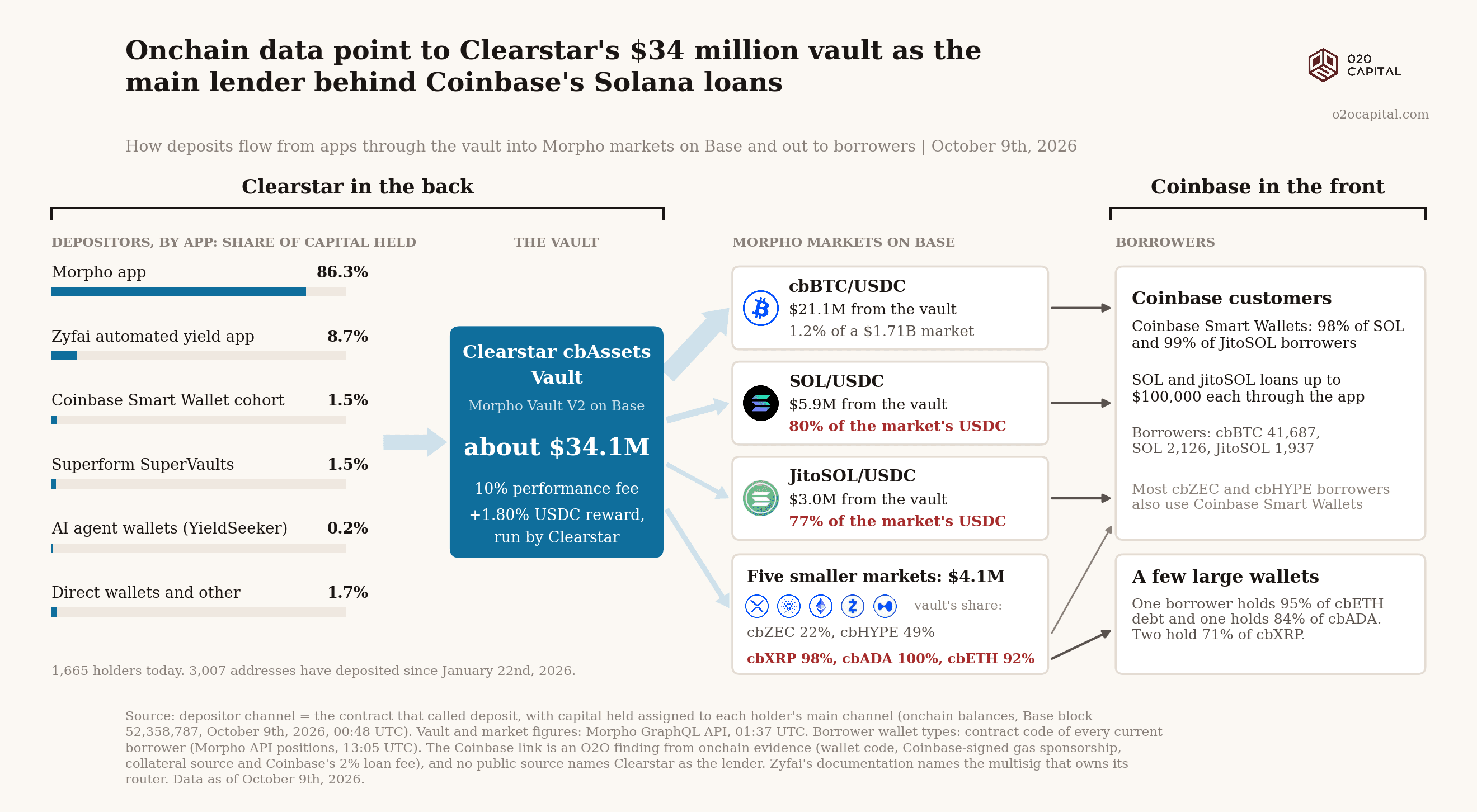
How deposits flow from apps through the vault into eight Morpho markets on Base and out to borrowers.
On the evidence so far, Clearstar has built this back end with care. The open questions concern the markets the vault funds almost on its own, and what one market cycle would do to the whole vault.
Vaults 101
A vault replaces a fund manager's daily judgment calls with roles and rules written into code. These are the ones this brief relies on, each with an example from the cbAssets Vault.
The vault and its markets
-
Vault. A pool that takes deposits in one token and lends them out. Depositors receive shares, and the share price rises as borrowers pay interest. A $1,000 deposit in this vault on October 9th bought about 971.5 shares at 1.029343 USDC each. Those shares are worth more as interest accrues.
-
Market. A Morpho lending pool for one pair of tokens. The SOL market lends USDC to borrowers who post SOL as collateral. Its collateral, price feed and liquidation level were fixed when the market was created, and no one can change them later.
-
Adapter. A Vault V2 does not lend directly. It sends money through adapters, small contracts that each handle one kind of destination, such as Morpho markets or older Morpho vaults. This vault uses one adapter, built for Morpho markets, to reach all eight of its markets. A new adapter opens a new route for depositors' money, which is why adding one waits three days here.
-
Utilization. The share of a market's deposits currently out on loan. The SOL market held about $7.4 million of deposits on October 9th and had lent about $6.7 million, 90%. Higher utilization pays lenders more and leaves less cash for withdrawals.
Who runs it
-
Curator. The firm that decides which markets the vault may lend into, sets its limits and charges its fee. Here that firm is Clearstar, which takes 10% of the interest depositors earn.
-
Allocator. Moves money between markets the curator has approved. When Coinbase customers borrow more against SOL, an allocator can shift USDC from the cbBTC market into the SOL market, up to the SOL cap.
-
Sentinel. The emergency brake. If a market's price feed broke, the sentinel could cut that market's cap to zero and pull the vault's money out at once. A sentinel can only reduce risk.
-
Owner. The top role. The owner appoints the curator and the sentinels, and can replace either.
-
Safe and signers. Each role is held by a Safe, a shared wallet that acts only when enough of its keyholders sign. Clearstar's curator Safe has three keyholders and needs any two of them, written "2 of 3."
The limits
-
Caps. An absolute cap is a dollar ceiling on one market. This vault could lend at most $6 million in the SOL market until October 9th, when the cap rose to $10 million. A relative cap limits a market's share of the whole vault. A 25% relative cap would stop any one market from taking more than a quarter of deposits. Every relative cap in this vault sits at 100%.
-
Timelock. A public waiting period between proposing a change and its taking effect. Clearstar proposed the higher SOL cap at least three days before it took effect, and depositors who disliked the change could have left in the meantime.
When loans go wrong
-
Oracle. The price feed a market uses to value collateral. The SOL market reads Chainlink's SOL price.
-
LLTV. Liquidation loan-to-value, the debt-to-collateral level at which a loan can be liquidated. In the SOL market it is 62.5%. A borrower who posts $10,000 of SOL can be liquidated once the loan reaches $6,250, or once SOL falls far enough that the collateral is worth less than 1.6 times the loan.
-
Liquidation and bad debt. In a liquidation, an outside party repays some or all of the loan and takes collateral at a small discount as its reward. On October 8th the two Solana markets ran 217 liquidations this way. Bad debt is any loan left unpaid after the collateral runs out, and lenders absorb it.
-
Forced exit. If the vault runs short of ready cash, any depositor can pull money straight out of a market for a penalty the curator sets. At this vault's 0.3% penalty, a $100,000 forced exit costs $300.
Two settings deserve a closer look in any vault.
The first is the signer count. A 1-of-7 allocator Safe lets any one of seven keyholders move money alone, so the vault can rebalance within minutes, often by automation. The cost is that one stolen key can shift money among approved markets, though never outside them or above a cap. A 2-of-4 sentinel needs two people to pull the brake, which guards against a rogue key but slows an emergency response.
The second is which changes wait. Changes that add risk, such as new markets and higher caps, can carry a timelock. Changes that cut risk are always instant. The curator sets the wait for everything else, including fees, and a change with no wait reaches depositors before they can react.
What the Vault Is
The cbAssets Vault is a Morpho Vault V2, the same design explained in Issue 1. Clearstar launched it on Base on January 22nd, 2026, and renamed it on July 1st for the Coinbase-issued "cb" tokens that secure about three quarters of its loans.
The vault is not the one behind the USDC lending feature in Coinbase's app. That feature deposits into Steakhouse's Prime and High Yield vaults, per Steakhouse. The cbAssets Vault funds Coinbase's borrowers, and its depositors arrive through other apps.
Five Safes hold the roles. The owner needs 3 of 6 signers, the curator 2 of 3 and the sentinel 2 of 4. The two allocators need 1 of 7 and 1 of 4, and the second has never moved money.
Each Safe has its own threshold, but several keys sit on more than one. Two of the 13 keys sit on the owner, the curator and both allocators. Together they can approve any curator change, and one of them also sits on the sentinel meant to check the curator. Clearstar does not publish who holds which key, so the separation of duties is thinner than five Safes suggest.
New markets, cap increases and new adapters wait three days. Fees, the forced-exit penalty and new allocators take effect immediately. The exit design deserves credit. The vault's exit gates were permanently switched off at deployment, so no role can ever block a holder from redeeming.
Who Clearstar Is
Clearstar Labs AG is a Swiss company (Zefix). Its assets under curation grew from about $44.5 million in January to about $214 million, ninth of 93 risk curators on DeFiLlama.
Its due diligence framework grades assets from A to F, and a single F fails an asset. Clearstar's five published reports score credit assets its other vaults hold at 2.68 to 2.96, where 1 is best and 5 worst. All land in the middle tier, "Adequate." None covers this vault's collateral.
One episode shows how Clearstar handles a loss. In May 2025, a manipulated price feed left about 49,300 USDC of bad debt in a market one of its vaults supplied. Clearstar covered it within hours and published a post-mortem placing the cause on the market's curation rather than on Morpho. Covering a loss fast and owning it in public is the standard allocators should ask of any curator.
The Stack Underneath the Vault
-
Coinbase issues six of the eight collateral tokens, backed by assets in its custody, and can pause, freeze or upgrade most of them. It publishes a proof of reserves for cbBTC, and this brief found none for cbXRP, cbADA, cbZEC or cbHYPE. Coinbase also runs Base's only sequencer, which orders the chain's transactions.
-
Base sits at Stage 1, the middle of L2BEAT's three trust stages. It halted for about two hours on June 25th, 2026.
-
Morpho keeps its lending core immutable and takes no fee here. Vault V2 went through five audits and a Cantina contest.
-
The Base-Solana bridge locks SOL and JitoSOL on Solana and mints copies on Base. One address can upgrade it with no delay, which L2BEAT rates critical.
Where the Money Flows
About 62% of the vault sits in the $1.71 billion cbBTC market behind Coinbase's bitcoin-backed loans. There the vault is a 1.2% lender among more than 30 vaults. About $167 million sits idle, so this market is the vault's first source of cash for withdrawals. If the vault left, cbBTC borrowers would hardly notice.
The Solana book is the opposite case, and it is where the vault matters most. In SOL and JitoSOL the vault is nearly the whole lender. If it pulled out, new Coinbase Solana loans would have little cash to draw on until other lenders arrived.
| Collateral | Share of vault | Vault's share of market | LLTV | Utilization | Supply APY |
|---|---|---|---|---|---|
| cbBTC | 61.9% | 1.2% | 86% | 90.2% | 4.64% |
| SOL | 17.4% | 80.3% | 62.5% | 90.3% | 5.49% |
| JitoSOL | 8.7% | 77.4% | 62.5% | 87.6% | 5.09% |
| cbXRP | 5.0% | 98.4% | 77% | 71.5% | 3.02% |
| cbADA | 3.1% | 100% | 77% | 78.9% | 3.47% |
| cbETH | 2.3% | 92.2% | 86% | 74.6% | 2.48% |
| cbZEC | 1.1% | 22.2% | 62.5% | 91.3% | 5.78% |
| cbHYPE | 0.5% | 49.4% | 62.5% | 92.2% | 5.77% |
| Blended | 100% | 88.4% | 4.68% |
Clearstar was not the first lender. Coinbase announced SOL loans on May 12th, 2026, and JitoSOL loans on July 24th. Until early August, Steakhouse's High Yield vaults funded most of both markets.
Clearstar's vault first lent into both markets on July 27th. It added money in four rounds, the last on October 1st and 2nd, and has never withdrawn. Each large deposit pushed utilization from about 90% toward 80%, which lowers the rate lenders earn. After 16 of Clearstar's 17 deposits of $100,000 or more, Steakhouse's automated rebalancing withdrew about as much within 25 minutes. Steakhouse never lowered its caps, so its vaults remained free to return.
Between rounds, Clearstar's share slipped. From August 6th to September 6th its vault added nothing while borrowing grew, and its share fell to 36% of SOL lending and 17% of JitoSOL. Clearstar's vault has been the largest lender in both markets every day since September 14th.
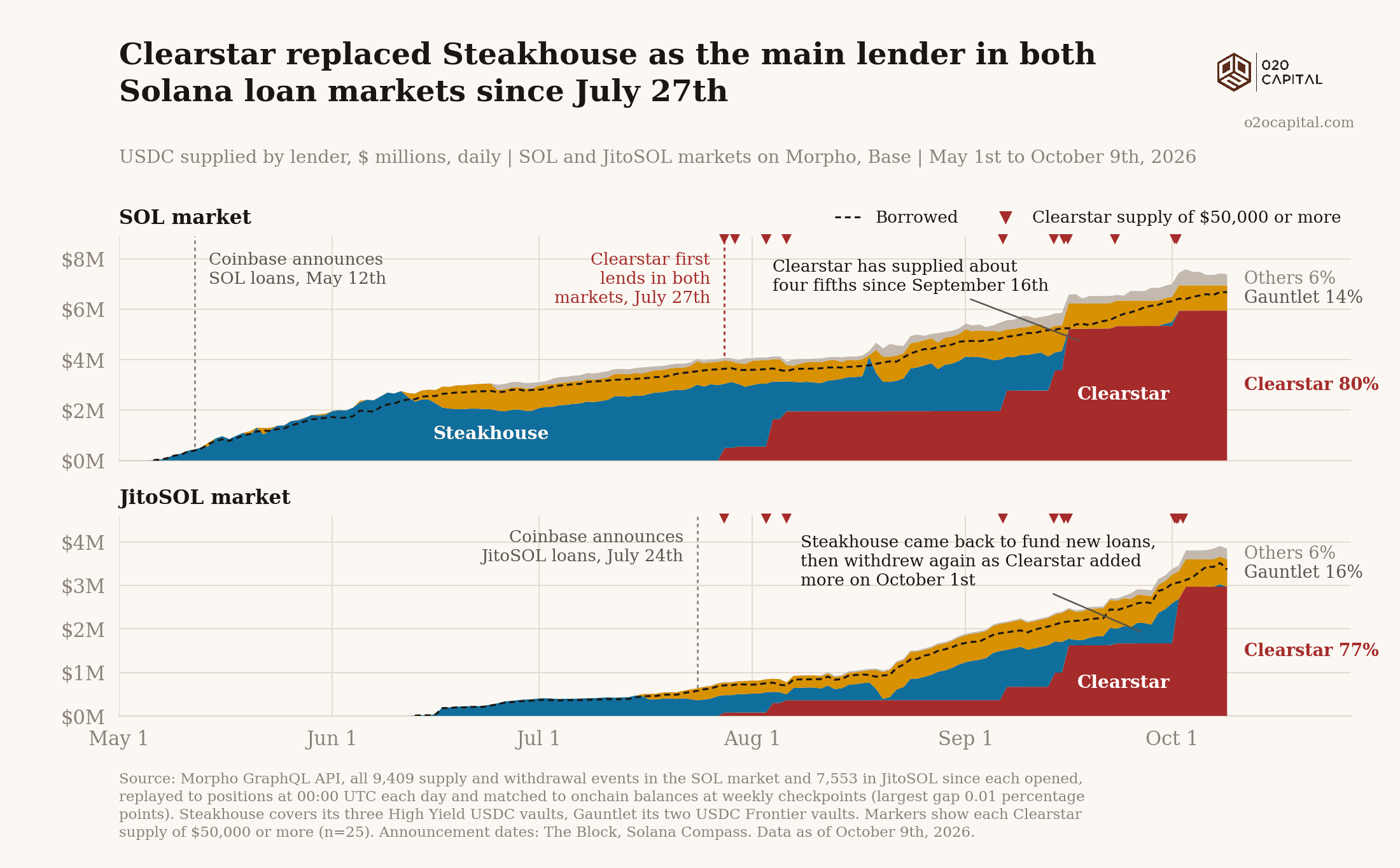
Steakhouse's vaults funded most of both Solana markets until August, and Clearstar's deposits have replaced them since.
By October 9th the vault had hit its caps of $6 million in SOL and $3 million in JitoSOL. At a cap, a vault cannot follow further borrowing growth. Clearstar's higher caps of $10 million and $5 million took effect at 18:09 UTC on October 9th, after the three-day timelock. As of October 12th the vault had not added money. Filling the new room without new borrowing would cut SOL's supply rate from about 5.5% to about 2.4%, so the room serves Coinbase's loan growth and adds no yield on day one.
Every borrower's wallet is public, and four markers point to Coinbase:
-
Wallets. 98% of the 2,126 SOL borrowers and 99% of the 1,937 JitoSOL borrowers use Coinbase Smart Wallets, and they owe more than 99% of the debt.
-
Network fees. Coinbase paid the fees on 94% of recent SOL transactions and 99% of JitoSOL transactions (n=800 per market).
-
Collateral. For about 95% of the debt, the collateral arrived through a contract matching Coinbase's MagicSpend, which lets customers spend account balances onchain.
-
The 2% fee. More than 18,000 borrows equal exactly 1.02 times a whole-cent amount, matching the processing fee in Coinbase's help center. No borrow exceeds $102,000, the $100,000 limit plus that fee.
Morpho markets are pooled, so the vault has no say over who borrows. Still, about 95% of this borrowing runs through Coinbase's loan system, and since mid-September this vault has supplied most of the dollars behind it.
What Pays the Yield
Borrowers across the eight markets pay a blended 5.29%. With 88% of the cash lent out, lenders earn 4.68%, close to the 4.70% Morpho reports. Clearstar's 10% fee takes that to about 4.2%, and the 1.8% USDC reward lifts the total to about 6.0%.
The reward runs through Merkl, an onchain rewards platform. Seven campaigns since July 7th have paid depositors about $143,700, all created by a wallet Merkl labels Clearstar. If the money is Clearstar's, it has paid depositors about 4.7 times the $30,900 in fees it has earned.
The benchmark is the Secured Overnight Financing Rate (SOFR), 3.88% on October 7th. Since the Federal Reserve's rate rise took effect on September 17th, the lending yield after fees has beaten SOFR by about 20 basis points on average, and on every day (n=22).
Performance and Adoption
Assets grew from about $1.1 million on July 7th to a $39.0 million peak on September 29th, and stand at about $34 million. Both drawdowns, 18% in August and 19% in October, came from a handful of wallets each withdrawing $1 million or more.
About 3,000 wallets have deposited into the cbAssets Vault since launch. Today 1,665 addresses hold vault shares, down from nearly 2,000 in early September. Much like the Robinhood vault in Issue 1, this is a retail-oriented product, with a median position of about $75. Still, eight wallets account for 59.5% of the money.
The share price rose or held at all 2,380 hourly readings on vaults.fyi since July 1st. Since August 10th the lending yield has beaten the vaults.fyi Base USD benchmark on all 59 days. Before fees, its markets earned about 4.46%, more than any Base vault with 90% or more in cbBTC. After Clearstar's fee it earned 4.01%, fourth of those nine vaults, and the four ahead charge no fee.
The Solana markets met a live test on October 8th, when SOL's oracle price fell 5.6% in about four and a half hours. They cleared 217 liquidations with zero bad debt, so every loan was repaid in full from its collateral. Clearstar chose to fund markets that liquidate at 62.5%, which left a wide cushion. Across all eight markets, 365 liquidations since the vault entered have left no bad debt.
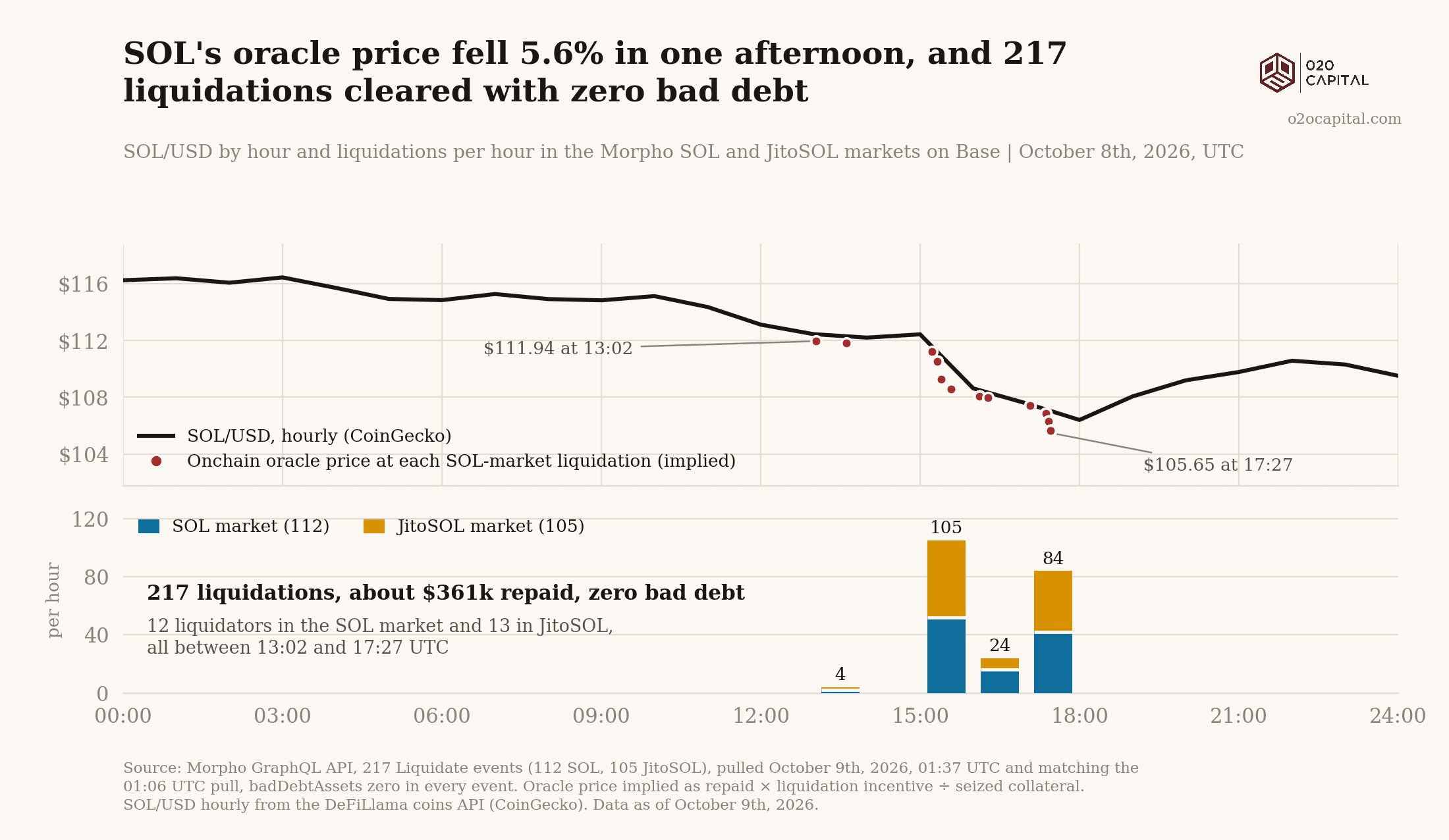
Liquidations in the SOL and JitoSOL markets cleared hour by hour on October 8th with no bad debt.
The Risks
Allocators will likely want to work through these points with Clearstar:
-
Lender of last resort. About $10.7 million, 31% of the vault, cannot be withdrawn the same day. Most sits in five markets the vault nearly funds alone, and returns only as borrowers repay or new lenders arrive. In cbXRP, cbADA and cbETH, one or two wallets hold 71% to 95% of the debt.
-
One cycle. The collateral's 90-day correlation with bitcoin is about 0.98, where 1.0 means lockstep (n=90). A deeper fall than October 8th would test all eight markets at once.
-
The bridge and the wording. The vault's Morpho disclosure says it lends only against assets "issued and secured by Coinbase." SOL and JitoSOL, about 26% of the book, are bridge copies. Naming the bridge would give depositors the full picture.
-
The reward. About 30% of the 6.0% headline comes from the Merkl reward, which ends October 31st unless renewed.
-
Speed of change. Fees can rise to Morpho's 50% cap with no wait, enough to cut the lending yield to about 2.4%. The forced-exit penalty can jump from 0.3% to 2% at once.
-
Oracle design. The feeds track each underlying asset's global price. If cbBTC or bridged SOL traded below the real asset, after a custody or bridge failure, the feeds would not show it. Markets would keep valuing that collateral at full price, so loans that should be liquidated would stay open. Any shortfall would fall on lenders as bad debt.
Same Yield, Different Risk: Where O2O Fits
The risks come back to one cycle. In the past year, all eight collateral assets fell together on 36 of the 56 days bitcoin fell 2% or more (n=365).
Clearstar already lends beyond crypto. On Ethereum, its 3Jane and Re vaults lend against tokenized credit and reinsurance, and its USDC Core vault has enabled Pareto's FalconX credit tranche up to a $10 million cap.
O2O Capital plans to offer o2oUSD, a vault token that is not live yet. It will hold trade finance, receivables and structured credit originated by tier 1 banks and alternative asset managers. Repayment comes from buyers paying invoices and borrowers servicing loans, with no direct link to crypto prices. Trade finance defaults remain below 0.3% across products, per the ICC Trade Register for 2024 (GTR).
An illustrative 10% sleeve of this vault lent against o2oUSD at 5.0% would lift the lending yield after fees from about 4.02% to 4.07%. The yield barely changes, while a tenth of the book stops moving with crypto. On Tenor's fixed-term loans, spread over its next three monthly maturities, the loans would mature in predictable $1.1 million slices. Today none of the book has a set repayment date.
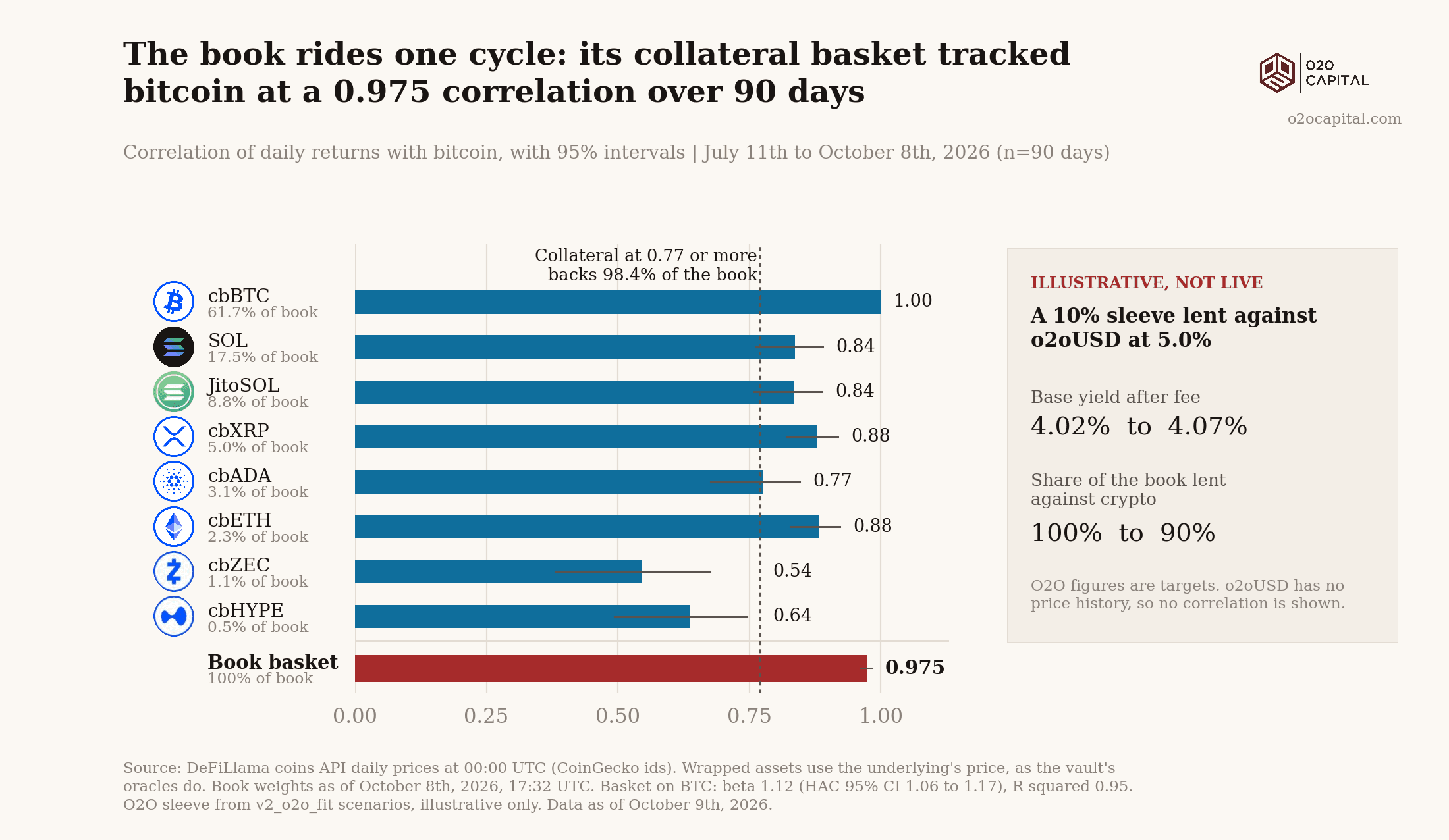
Each collateral asset's 90-day correlation with bitcoin (n=90), beside an illustrative O2O sleeve with no price history.
Fit and frictions:
-
Chain. o2oUSD is planned for Ethereum and other EVM chains, which puts both Clearstar's USDC Core vault and this vault in range.
-
Format. A Morpho vault can lend against o2oUSD but cannot hold it. o2oUSD will redeem after a delay under an Ethereum token standard that blocks the instant price quotes a Vault V2 relies on. The route is a USDC market against o2oUSD, the same route Clearstar uses for Pareto's tranche.
-
Track record. O2O is a new asset manager, and its first products will start its track record.
What to Watch
Four things are worth tracking into 2027:
-
Whether the vault uses its new caps to keep pace with Coinbase's Solana borrowing.
-
Whether the USDC reward is renewed after October 31st, and how deposits respond.
-
Whether the disclosure comes to name the bridge, and whether Clearstar rates this vault's own collateral.
-
Whether other lenders join to diversify the five markets Clearstar now funds almost alone.
The deeper question carries over from Issue 1. Fintech front ends have shown they can bring retail savers and borrowers into curated onchain lending at scale. What the category has yet to show is a scalable lending book that moves beyond crypto-correlation.
O2O Research publishes a vault brief every two weeks. Allocators, curators, neobanks and issuers working on non-crypto-correlated collateral are welcome to get in touch.
— O2O Research
Notes on Sources and Method
Figures are from October 9th, 2026, 00:45 to 02:20 UTC. Caps and lender shares were rechecked onchain on October 12th. Sources are Morpho's data interface, direct reads of the Base chain, vaults.fyi, Merkl, Tenor, DeFiLlama and the New York Fed. Holder balances cover all 3,082 addresses that ever touched the vault and sum exactly to its share supply. Lender history replays all 16,962 supply and withdrawal events in the two Solana markets to daily positions. O2O could not verify Coinbase's confirmation of the borrower link, the unverified contract that delivers borrowers' collateral, who funds the Merkl reward, who holds each Safe key, or the reserves behind cbXRP, cbADA, cbZEC and cbHYPE.