October 12, 2026 34 min read
Real-World Asset Vaults Begin their Institutional Track Record
Tokenizing a fund and building the ecosystem around it are different jobs. Value accrues to the RWA with an ecosystem.
October 2026
Peter Gaffney – Co-Founder, O2O Capital Partners
Table of Contents
01 A Note from O2O Capital
02 Executive Summary
03 The Onchain Demand Side: Who are the Capital Allocators?
04 The Non-Crypto-Correlated Yield Gap
05 Vaults: The Path from $10B to $100B
06 Evolving Beyond Single-Name Assets to Portfolio-style Vaults
07 Notable RWA Developments: What We Are Watching
08 Predictions for the Rest of 2026
09 Closing Thoughts
SECTION 01
A Note from O2O Capital
The tokenized real-world asset (RWA) market has grown into a nearly $340 billion onchain economy per RWA.xyz, anchored by $300B in Stablecoins alongside $39B in distributed RWAs spanning US Treasuries ($15B), Private Credit strategies ($7B), Commodities ($5B), Stocks and ETFs ($3B), and Institutional Funds ($3B), with an additional $388B in repo transactions that banks and asset managers now record using a blockchain-based system of record. DeFi itself holds roughly $95B in Total Value Locked (TVL) per DeFi Llama, which measures the stablecoins and crypto assets locked into lending, trading, and yield protocols. The fastest growing capital formation vehicle within this ecosystem is the Vault, a smart contract that accepts stablecoin deposits and issues a receipt token akin to Limited Partner (LP) interests representing pro rata returns on the assets inside. Onchain Vault Deposits have grown from under $100M at the start of 2024 to roughly $20B today, with nearly $17B of that sitting in Morpho vaults alone and most strategies targeting 4-8% annual yields in crypto lending pools and basis trades. Crypto ETF managers like Bitwise and Galaxy began curating vaults on Morpho in January and Kamino in September 2026, respectively, a clear signal that vaults are becoming the default wrapper for asset management onchain.
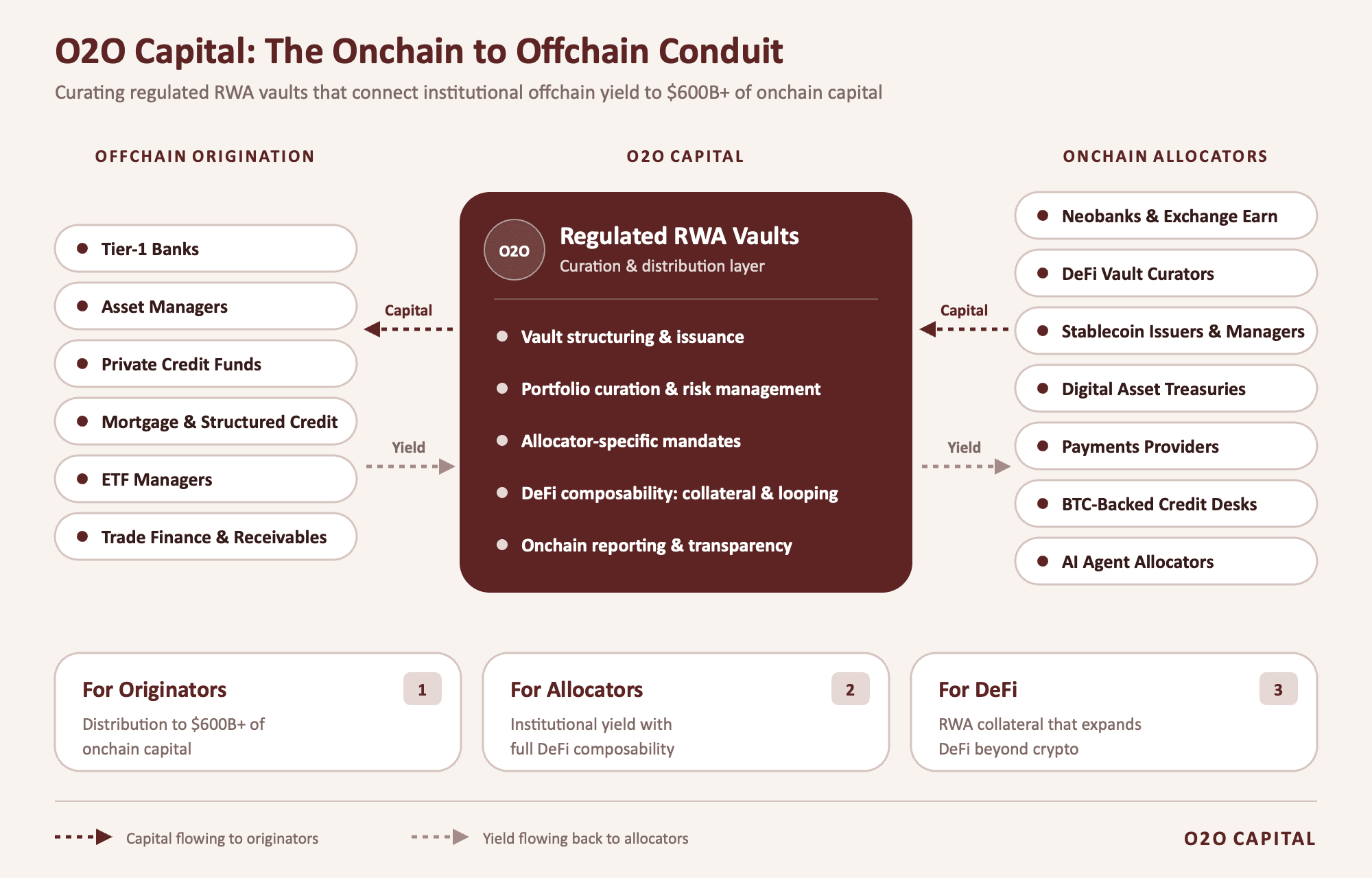
O2O Capital Partners (O2O) is the conduit between this capital and the real-world yield it cannot yet reach. It’s in our name: Onchain to Offchain (O2O). O2O’s onchain allocator base of stablecoin managers, digital asset treasuries (DATs), DeFi vault curators, exchange Earn programs, neobanks, and Bitcoin-backed credit desks represents more than $600B in capital, and these allocators are actively seeking non-crypto correlated yields delivered in the vault format they already use, with the DeFi composability they largely require. O2O Capital partners with Tier-1 banks and alternative asset managers to provide asset origination specialty-built for the next-gen allocator base including onchain allocators and AI agent-driven transactions, with O2O as the distribution and curation layer and our origination partners as the product engine.
Tokenizing a fund and building the ecosystem around it are different jobs. Value accrues to the RWA with an ecosystem.
Connect with O2O Capital on socials
SECTION 02
Executive Summary
There’s never been a better time to be a real-world asset (RWA) issuer and supplier than today: TradFi institutions are throwing their weight behind RWA acceptance, product distribution channels are established and primed for growth, and decentralized finance (DeFi) protocols are actively onboarding RWAs as collateral. The latter point – which is the most crucial measure of DeFi-nativeness – was missing for the first few waves of tokenization starting in 2018. No longer does tokenization just mean digitizing a cap table on blockchain; rather, it means a path towards using non-crypto assets like private credit funds, stocks, bonds, and loans throughout DeFi.
Tokenized real-world assets grew steadily from $25B to nearly $40B in aggregate market cap throughout 2026 while the vast majority of crypto prices descended. Even as major DeFi players like Aave and Maple continued to break records and set new Total Value Locked (TVL) and deposit milestones, their utility token prices moved inversely, with some tokens falling 40-60% in value. First-order and second-order effects of suppressed crypto prices caused a drawdown in DeFi TVL from $120B at the end of 2025 to a $70B low in mid-2026 before re-establishing the current $95B level. DeFi enables non-custodial peer-to-peer instantaneous transactions and control of one’s assets. It offers some of the most powerful financial services capabilities the world has ever known. So why should a technology this powerful have its growth tied to the arbitrary price swings of crypto assets? These data points paint the picture behind O2O Capital’s mission: expand DeFi beyond crypto with real-world assets.
Further, vaults emerged as DeFi’s preferred vehicle of capital formation, ripping from roughly $3B at the start of 2025 to nearly $20B to date largely on the back of Morpho with strong additions from Kamino, Veda, Concrete, Upshift, Mellow, Lagoon, and Ember Protocol. The next step-change in vault TVL growth is the evolution of onchain balance sheets and an emphasis on holistic portfolio management. Many vaults today offer leveraged single-name exposure like Gauntlet’s Apollo ACRED looping vault. This is a fine example of delivering a singular product to market and enabling allocators to craft their own portfolios with it. A layer above that, groups like Bitwise are offering professionally-managed portfolio-style vaults holding various RWAs, which is ultimately where O2O Capital sees onchain asset management moving as vaults grow to $100B over these next 2 years.
Tokenized RWAs Reached $39B and Kept Growing Through the Crypto Recovery
Per RWA.xyz, tokenized RWA distributed asset value, which covers assets that are natively issued on blockchain and is widely seen as the “truest form” of tokenization, stands at $39B as of October 2026, with an additional $388B in represented value, which includes assets whose recordkeeping uses blockchains or whose assets operate on a private distributed ledger technology (DLT). The collective $427B sets a scale for funds, Treasuries, private credit, commodities, and equities that are already wrapped onchain or eligible to be – a strong precursor for the expansion of the current $95B locked into DeFi protocols per DeFiLlama.
As our team covered in CoinDesk back in 2024, Tokenized US Treasuries are the onchain capital onboarding tool for all major institutional asset managers and allocators: earning the risk-free rate on idle cash is a must, not a nice to have. Now the largest RWA asset class, Tokenized Treasuries sit at $15B across 100+ products led by BlackRock's BUIDL peaking at $2.8B, Circle's USYC at $2.6B, Ondo's USDY at $2.2B, and Franklin Templeton's iBENJI at $1.7B. These assets bring serious allocators to the table and provide the capability to then rotate into other RWAs, which credit and equities have been beneficiaries of. Tokenized private credit reached $8B in distributed value, up 37% since the start of the year and up parabolically since 2024. Tokenized stocks became the talk of the town in 2026, growing more than 4x to $3.3B with over 4 million token holders as both US and non-US sponsors offer native share (Securitize, Figure, Superstate) and wrapped share (Robinhood, xStocks) products for institutional allocators and retail traders.
Onchain Allocator Demand Draws Custom Yield Products
Stablecoin supply stands at $295B, largely stabilized around that $300B mark the past 12 months. Publicly-traded Digital Asset Treasury Companies (DATCOs) collectively recovered to a $340B aggregate market capitalization on venues like NYSE and Nasdaq as the winning ones move beyond passive crypto holdings into active management. Two great examples include SharpLink launching a $125M onchain yield fund with Galaxy in August 2026 and Hyperion DeFi pioneering its “triple dip” monetization strategy driving win-win value to both Hyperliquid perps market operators it sponsors and its DAT shareholders. Sky's Prime Agent Vaults closed the second quarter at $6.84B with $2.58B deployed across six institutional counterparties including Janus Henderson, BlackRock, Anchorage, PayPal, Securitize, and Galaxy. Sky has since expanded its onchain credit base with a $500M Grove-sponsored warehouse to Galaxy and a $100M Galaxy commitment to sUSDS, ultimately enabling borrowers to earn the 3.60% Sky savings rate on USDS collateral while accruing interest on loans. This will result in cheaper net financing rates enabling leveraged buyers to allocate into lower-yield opportunities like private fund finance and investment grade credit, rather than having to reach for double-digit yields due to 8% borrowing costs on crypto. Solutions like these will continue to expand the onchain buyer base as both crypto-native and non-crypto-native yields become composable and modular.
Vault TVL Accelerates as DeFi’s Preferred Capital Formation Vehicle
Morpho's vault network holds just under $17B in deposits with $5B under active curation and annualized curation fees more than doubling to $15M from roughly $6M in August. Maple grew its crypto-backed loan AUM to $4.85B with about half of that across DeFi-composable products. DeFi composability is a key first-mover advantage as roughly $4B (or just 12%) of all tokenized RWAs is actually deployed in DeFi with BlackRock's BUIDL carrying $2.8B in market value and $18M working in DeFi, Circle's USYC $2.6B against $32M, and Franklin Templeton's iBENJI $1.7B against zero. The DeFi-native access point a vault offers is an accelerant to RWA DeFi composability. Couple that with the data showing more than half of vault TVL sits in homogenous crypto-yield strategies offering sub-4%, we foresee non-crypto-correlated yield RWAs taking up to half of all vault market share in time.
Professional Managers Now Run RWA Vaults
Vault Curation is becoming a professional business as onchain balance sheets grow. Bitwise launched its Premium RWA Vault (PAPY) on Morpho and Premium RWA Vault (PPLUS) on Ember Protocol in September 2026. PAPY took in $8M of deposits in the first 24 hours and $22M in the first 30 days against a 5% to 6% target yield. PPLUS, with $14M in deposits, aims to deliver higher yield via leveraged RWA strategies. Additionally, Galaxy launched 2 new strategies on Kamino and its institutional curator is live through Fireblocks Earn & Turnkey, JP Morgan launched a money market vault for applicable onchain allocators, and GSR just committed $100M to its Hare vault curation initiative on the Turtle platform. Incumbent managers in the digital assets space, including Grayscale who put out a vault and CLO deep dive, are well positioned to capture this wave of onchain asset management that has so far been led by boutique crypto-native managers like Steakhouse, Gauntlet, Re7, and Sentora. A rising tide lifts all ships, so there will be plenty of market capture for all names involved as it is anticipated that the latter category of crypto-native curators will create looping markets for single-name assets that the former category can package into portfolio vaults, rather than acting as head-to-head competitors.
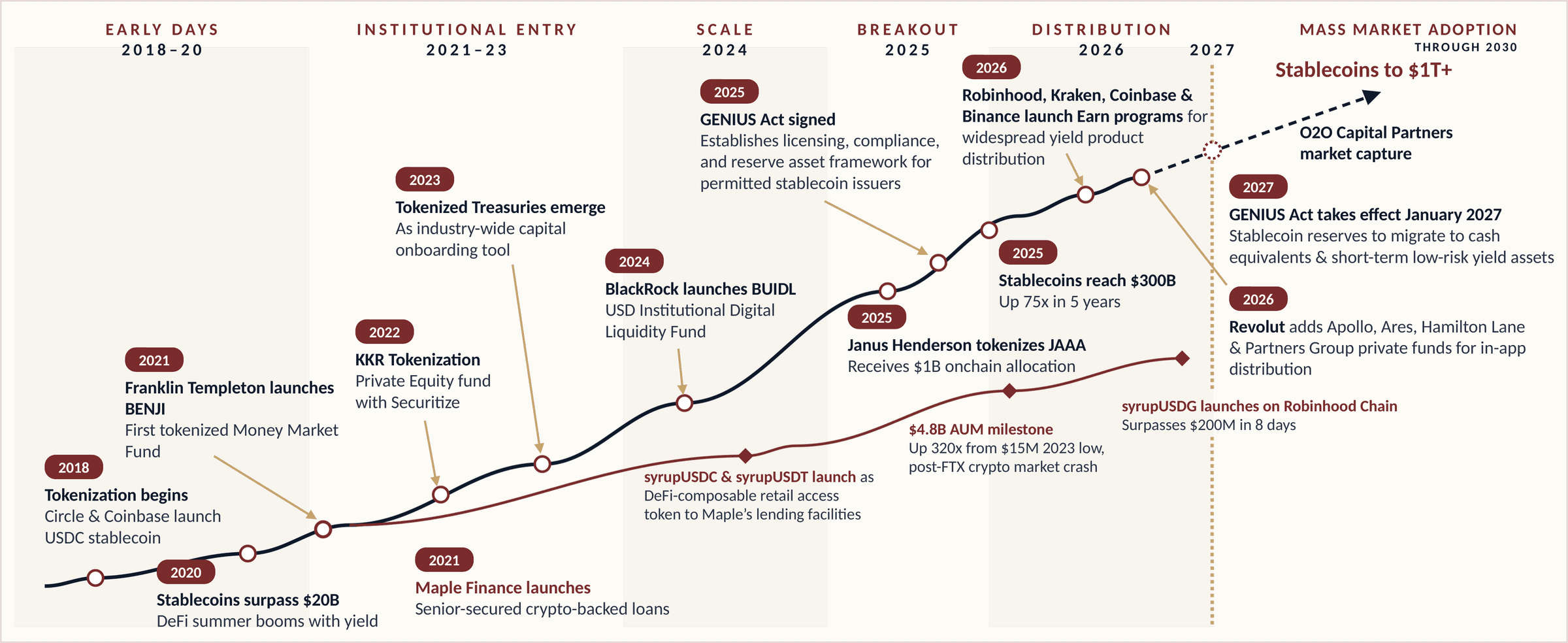
The Adoption Path to Vault Distribution
SECTION 03
The Onchain Demand Side: Who are the Capital Allocators?
Most tokenization coverage focuses on the supply side: what assets can be tokenized, why they should be, and how to do it. The $600B question is: how do we access the buyers? O2O Capital sees five key buyer cohorts among a larger 10-segment distribution network driving demand for tokenized, non-crypto-correlated yields.
- Stablecoin Issuers: Total stablecoin supply sits around $300B, led by Tether’s USDT at $183B and Circle’s USDC at $73B. Tether and Circle still earn the spread between their Treasury-backed reserves and the zero yield they pay stablecoin holders. The GENIUS Act is on pace to become effective January 18, 2027, which will open compliant stablecoins to pass yield on to qualified parties and create newfound demand for short-term yields and cash equivalents like US Treasuries, repos, money market funds, short-duration commercial paper, and other related assets. This is one of the single largest anticipated demand drivers for the RWA market. For sizing, a 5% reallocation of issuer reserves into tokenized RWA products represents $15B of inflows whenever that switch flips. Products that fit into a “savings account+” sleeve will be the largest beneficiaries of GENIUS.
- Digital Asset Treasury Companies (DATs). The DAT cohort hit bottom in July 2026 and has since recovered to a $340B aggregate market capitalization, still well below the $490B peak of late 2025. Public companies hold roughly $130B in digital assets across more than 230 tracked entities whose valuations vary widely. Strategy trades near 1.1x net asset value, Metaplanet remains below 1.0x, and the ETH treasuries trade near half of NAV. While a number of DATs wound down in 2026, surviving ones are converting to active onchain management. SharpLink and Galaxy launched their $125M onchain yield fund in August 2026 and SharpLink (NASDAQ: SBET) committed $200M of ETH to Lido staking the following week. Hyperion DeFi (NASDAQ: HYPD) has solidified a number of deals supporting Hyperliquid’s perps and newly-opened institutional credit facility. Sol Strategies (NASDAQ: STKE) collateralized a portion of its Solana holdings to borrow stablecoins against on Kamino to finance an acquisition and launched its native STKESOL liquid staking token to be more productive in Solana DeFi. Although the DAT cohort is smaller than it once was, the adapting ones have become considerably more likely to allocate or provide liquidity to the ecosystems they represent.
- Bitcoin Lending Platforms. Bitcoin is a $1.7 trillion asset class dominated by a buy-and-hold investor base across self-custodial holders, exchange holders, ETFs, trusts, separately managed accounts, and corporates. The crypto-backed lending market measured $56B at the end of Q2 2026 per Galaxy Research, down 17% on the quarter with centralized lenders at $23B overtaking onchain protocols at $20B for the first time since 2023. Qualified Custodians (QCs) hold hundreds of billions of dollars of BTC on behalf of clients, led by the likes of Anchorage, BitGo, Copper, and Coinbase Prime. Many of their clients want to borrow stablecoins against their BTC positions rather than selling any. A borrower paying to stay long Bitcoin is looking to deploy proceeds into something that does not move with Bitcoin, which is the gap that tokenized income and credit opportunities serve to fill.
- DAOs and Protocol Foundations. Arbitrum's Stable Treasury Endowment Program (STEP) program directed roughly $45M in treasury tokens to liquid RWA issuers including BlackRock, Franklin Templeton, Spiko, and WisdomTree. The Ethereum Foundation opened a 3,400 ETH position on Morpho in March 2026 as one of the foundation’s first non-direct ETH holdings, signaling a shift in yield generation and runway diversification for one of the largest organizations in the industry.
- Crypto Central Banks and Yield-Bearing Issuers. Sky, the rebranded MakerDAO, acts as the closest thing to an onchain central bank. It has a number of sub-DAOs like Grove, Obex, and Spark who operate Prime Agent Vaults with the ability to borrow from Sky at a wholesale 3.60% rate. The sub-DAOs, acting like commercial banks, then redeploy their borrowed assets into higher-yield crypto and RWA strategies, earning revenues for themselves and for the collective Sky DAO while providing diversified non-crypto backing to Sky’s USDS stablecoin. As a whole, Sky reported $107M of gross revenue for Q2 2026 on $12.3B of protocol collateral. Its Prime Agent Vaults hold $6.8B and have historically deployed around $3B to real-world assets. For example, Grove allocated $1B to Janus Henderson's tokenized CLO and Treasury funds, Spark allocated $1B to BlackRock (Securitize), Superstate, and Janus Henderson (Centrifuge) as early as 2024 with another $1B follow on, and Obex is approved for up to $2.5B in structured credit allocations. Prominent algorithmic stablecoin pioneer Ethena has also approved up to 20% of its USDe stablecoin reserves to be allocated to RWAs, a maturity signal moving away from a pure crypto basis trade yield strategy which will provide a stability floor under USDe. The stablecoin recovered to $5B from its $15B 2025 peak and recently executed $450M of CLO allocations on Solana: a $250M investment into the Securitize AAA CLO Tokenized Fund (STAC) and $200M investment into Janus Henderson Anemoy AAA CLO fund (JAAA). Sky and Ethena represent one of the most crypto-native pathways for RWA distribution by proxy of their reserves, with allocation demand growing alongside USDS and USDe supply. This is a model for the countless other algorithmic stablecoins entering the market as well.
The onchain snapshot shows a buy-side measured in hundreds of billions of dollars that has been through several significant drawdowns and is actively searching for diversified, non-crypto-correlated yield-generating investments for longevity and stability. Tokenization is the entry ticket for any traditional asset manager who wants to access this universe.
SECTION 04
The Non-Crypto-Correlated Yield Gap
DeFi is a capable real-time capital markets execution engine. Its limitation has always been the overreliance on crypto-native assets as both the collateral and the return-generating layer, which effectively holds the growth of the technology hostage to crypto price action. This limitation was put on display during the $19 billion liquidation cascade on October 10, 2025, which saw DeFi TVL sink from $165B to $68B over the following 8 months. Bitcoin is still a third below its peak, crypto-backed lending is down 40% from its 2025 high, and curated stablecoin vault yields settled around 4% as leverage demand evaporated and never fully returned. Each of those outcomes traces back to crypto collateral as the same source of risk, and the recovery in prices has done little to change what onchain allocators earn on it. At the time of writing, the Steakhouse Prime and Gauntlet Prime USDC Vaults on Morpho pay 4.45% and 4.51%, Aave's core USDC market pays 3.78%, and tokenized Treasuries average 3.66%.
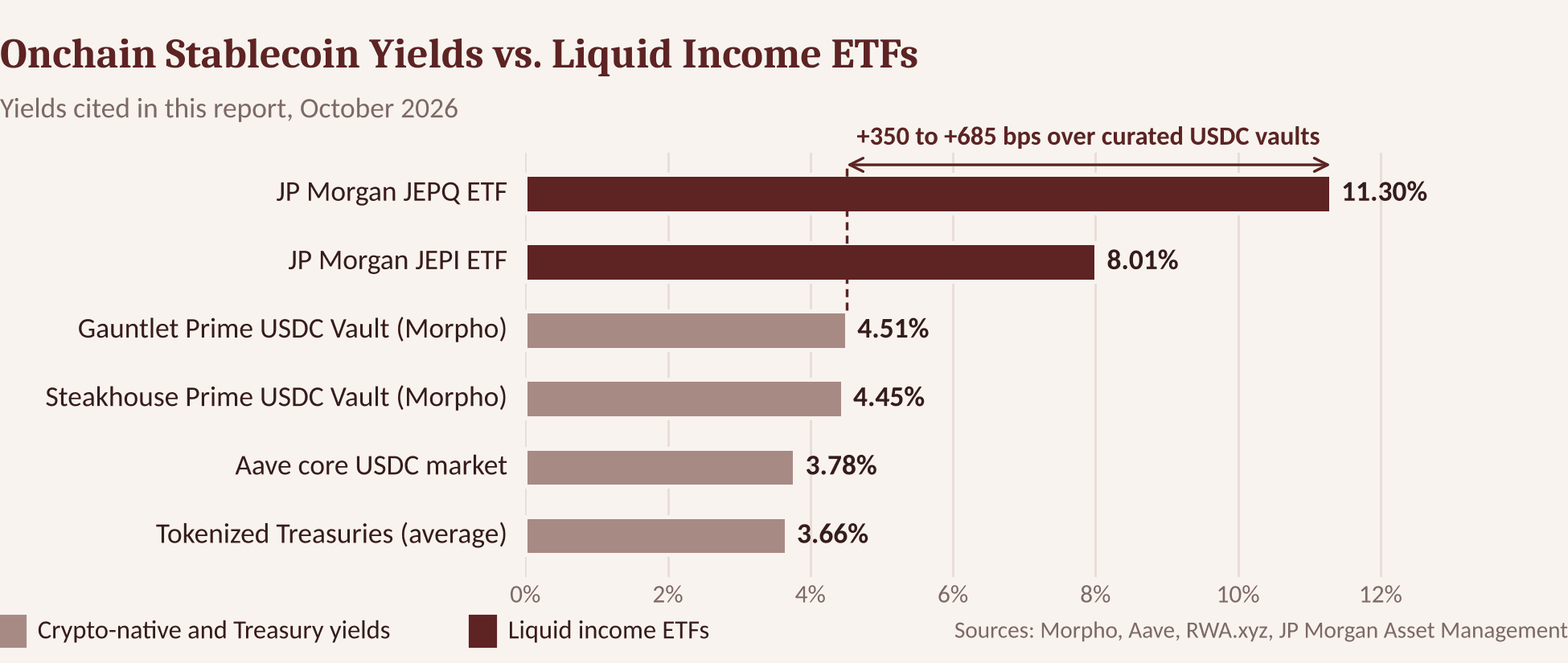
Onchain allocators do not need more homogenous crypto yield strategies reliant on funding rates and onchain borrow demand. They need non-crypto-correlated yield-generating assets that match the risk profiles of their stakeholders, staggered over various durations and liquidity horizons. The assets which held up over the past eleven months — tokenized Treasuries, AAA CLO strategies, and short-duration credit — are still the ones with the least onchain distribution built around them. Liquid income ETFs are the most visible next entrant, with JP Morgan's JEPI and JEPQ ETFs at $46B and $42B in AUM paying 8.01% and 11.30%. The same logic extends to asset-backed securities, commercial paper, loan receivables, and alternative credit strategies, each of which can be structured as a sub-90-day or self-liquidating credit product that institutional allocators already understand and that a dedicated vault can hold. With liquid income ETFs alone paying roughly 350 to 685 basis points over curated stablecoin vaults for a similar level of liquidity, the yield spread between that product suite and native DeFi has never been wider, and asset managers bringing those products onchain are well positioned to capture reallocations over time.
SECTION 05
Vaults: The Path from $10B to $100B
Vaults have emerged as the preferred capital formation vehicle in DeFi because they enable portfolio-style allocation rather than single-asset exposure. A vault allows individual portfolio selection with programmatic allocation guidelines, which provides tailored opportunities for depositors. A DeFi allocator can spread $100M in deposits across yield strategies in ten different vaults, limiting risk to each underlying strategy. Each vault is managed by a Curator, who sets the allocation guidelines, monitors vault activity, and adjusts strategy on behalf of depositors. Curators earn fees on TVL — the DeFi equivalent of AUM — and on performance, which creates a directly aligned incentive to grow and steward depositor capital. Morpho alone now runs an annualized $15M in curation fees on $5B under curation within Grayscale’s estimated $7B under active curation across roughly 3,000 Vaults and 57 curators, with Steakhouse at $2.5B, Sentora at $2.5B, and Gauntlet at $1.6B leading the curator table.
The homogeneity of the vault market is starting to show weaknesses, creating a great opportunity for professionally-managed onchain portfolios. Most vault capital remains parked in the same nuanced crypto yield strategies, now paying between 4% and 6% on USDC deposits shown in the VaultsFYI dashboard below. A fair number of these yields are derived from both organic lending activity and crypto incentives like the Steakhouse USDG vault powering Robinhood Earn’s 7% yield with roughly 4% of organic yield and 3% of subsidized rewards expiring July 2027.
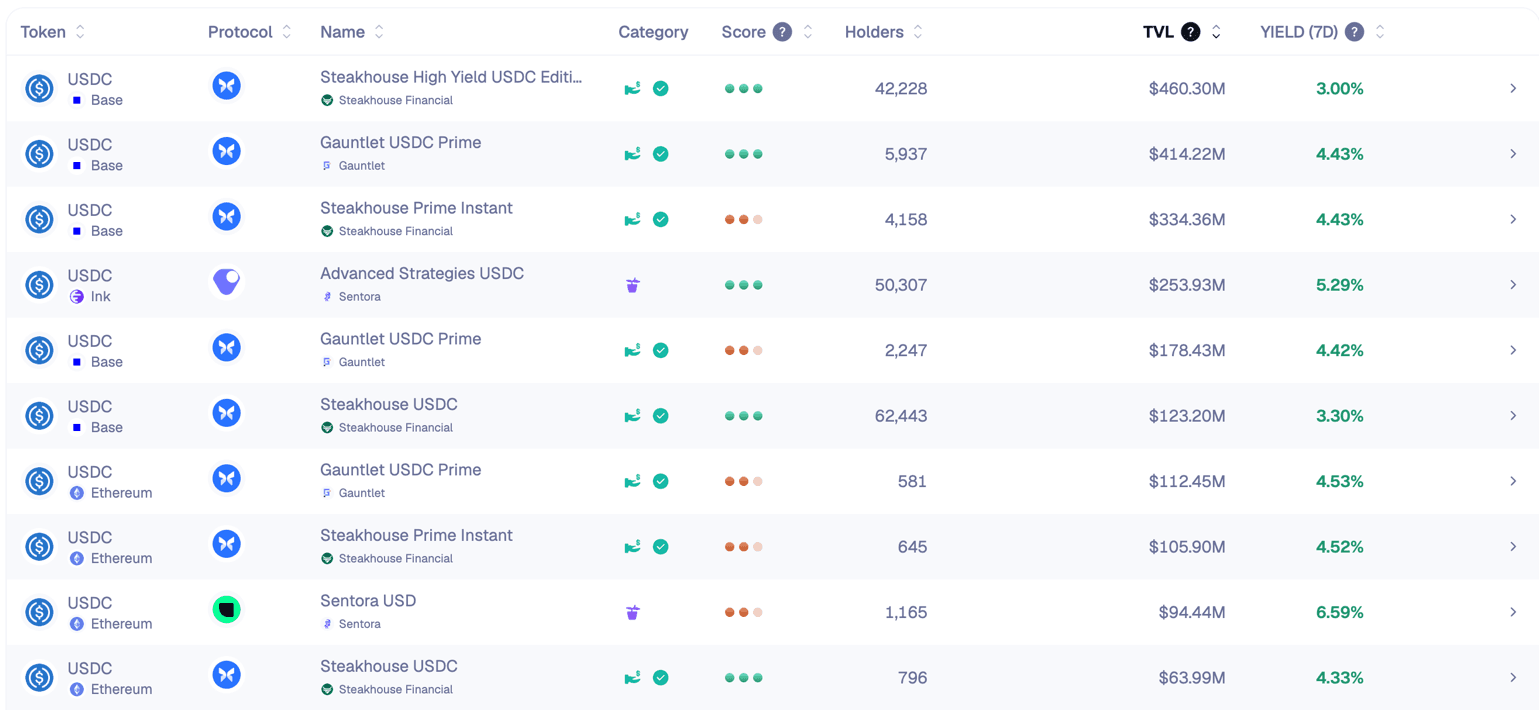
Source: Vaults.fyi
Of the $39B in tokenized Real-World Assets (RWAs) onchain today, roughly $4B is actively deployed across DeFi. Maple's syrupUSDC and syrupUSDT account for the largest share of that figure at roughly $1B and $265M, which speaks to a broader pattern in the market: the products built with a DeFi delivery strategy from day one are absorbing most of the onchain demand, while the largest tokenized funds by AUM largely sit unused in DeFi. This low penetration rate is a function of the lack of quality, professionally managed RWA vault strategies with sufficient DeFi delivery; it’s not a lack of interest from onchain allocators. That leaves roughly $35B of existing tokenized RWAs that have yet to be put to work in DeFi and a growing roster of new issuers and distribution platforms beginning to fill that gap.
One playbook a select number of service providers identified is as follows: set up the tokenized fund, build the DeFi ecosystem around it, and hand it to a larger asset manager to scale. For example, Superstate grew the Superstate Short Duration US Government Securities Fund (USTB) to nearly $1B in AUM, built out the DeFi integrations around it, and handed investment management to Invesco in a Q2 2026 commercial deal, with the fund rebranded to Invesco USTB. Centrifuge ran the same model with Janus Henderson, whose Janus Henderson Anemoy AAA CLO Fund (JAAA) and Janus Henderson Anemoy Treasury Fund (JTRSY) now sit at $715M and $810M. In both cases the issuer did the legwork of building the ecosystem first, which is what made the product worth taking over. Although this precedent exists for incumbent asset managers to follow, O2O anticipates similar service provider-to-asset manager handoffs to follow given the pace and expertise depth required for successful DeFi composability.
The vault distribution layer followed in a wave over the summer and now reaches nearly every large exchange, custodian, and wallet. Coinbase's High Yield USDC Vault, which is curated by Steakhouse on Morpho, crossed $200M in its first month while Coinbase's total USDC lending deposits on Base passed $500M in September 2026. Similarly, Robinhood Earn program went live on Morpho with Maple's syrupUSDG and the Steakhouse USDG Vault as yield sources: syrupUSDG reached $200M in 8 days and Steakhouse USDG surpassed $500M within 2 months. Kraken's DeFi Earn, curated by Sentora and powered by Veda, passed $600M in deposits from more than 80,000 depositors into strategies across Aave, Morpho, and Sky, and OKX's Onchain Earn routed more than $300M of USDT into a Gauntlet-curated Vault.
Custodians are building the same access directly into the institutional workflow. Fireblocks Earn places Galaxy and Sentora Vaults inside the custody workflow of 2,400 institutions, BitGo announced a DeFi Vault offering with Morpho that keeps the receipt tokens in qualified custody, and Anchorage Digital opened Morpho connectivity for its qualified custody clients.
The Earn program and curator combo is a coveted distribution route for many real-world asset issuers. However, most of these aforementioned yields are crypto-native strategies. RWA practitioners are waiting for the RWA switch to flick on and get their assets onboarded as potentially higher-yielding or non-crypto-correlated value propositions to Earn program clients.
Nonetheless, some of these channels are already placing tokenized funds on the shelf. Binance accepts Circle's USYC as off-exchange collateral with over $2B of it sitting on BNB Chain, runs a Treasury-benchmarked RWUSD product in Binance Earn, and connected Binance Wallet to a Plume Vault holding Invesco USTB and Bitwise USCC, while Bybit's RWA Earn distributes tokenized PIMCO and CMBI bond funds through Plume and DigiFT. In this context, each channel is a retail or institutional front-end seeking professionally-managed collateral to power it and therefore relying on asset managers and curators to supply the yield.
The path from $10B to $100B in Vault Total Value Locked (TVL) will be defined by the mix of assets backing those vaults and meaningful expansion beyond crypto-correlated strategies. A hundred billion dollars is not going to flow into the same commoditized stablecoin lending strategies that have defined DeFi yield for the past three years, particularly now that those pools compressed down to 4%-6% yields. The vault growth path is built on:
- Short-duration loans through onchain credit platforms like Morpho and Maple, with traditional bank lenders increasingly originating directly onchain simply because the onchain universe has grown large enough that being involved means doing business onchain. Kraken settling a $500M warehouse facility through Maple on a Saturday serves as the proof of concept.
- Tokenized income ETFs as the primary backing for income sleeve vaults, which offer competitive yields, non-crypto correlated returns, daily liquidity, and a wrapper allocators already understand. Covered calls, preferreds, and bond funds can all create liquid income opportunities well suited for DeFi.
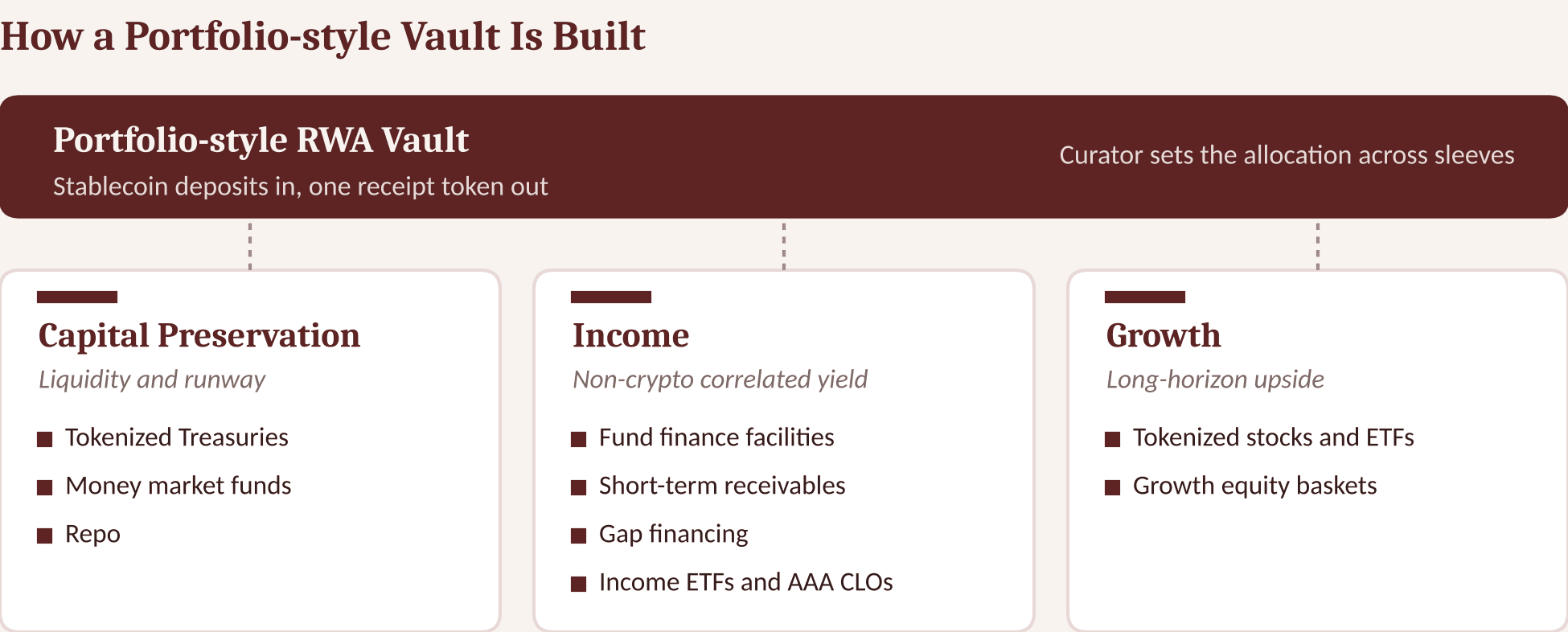
- Dedicated RWA Vaults by asset class, with one vault mandate each for asset-backed securities, commercial paper, loan receivables, and fund finance as examples. These are structured so that allocators can build model portfolios across capital preservation, income, and growth sleeves instead of relying on the single-name looped structures that make up most RWA vaults in market today.
- Earn program inclusion for distribution to KYC’ed and KYB’ed clients, with exchange, custodian, and wallet Earn programs placing RWA vaults directly in front of verified retail and institutional users. This gives issuers a compliant route to scale without having to build their own onboarding and distribution infrastructure.
- Fixed-rate lending and looping to enable the construction of longer-term RWA facilities and portfolios. The variable rates that drive DeFi lending today keep borrowers and lenders in a constant anxious state, which limits RWA utility and, in turn, limits DeFi growth.
This is DeFi delivery in practice: an ecosystem around the tokenized product that makes it useful and investable at scale, as opposed to a static wrapper that reports AUM without ever being put to work onchain. With vaults nearing the $20B TVL milestone, asset managers and curators building around these five drivers are well positioned to be beneficiaries of the next $80B in Vault TVL.
SECTION 06
Evolving Beyond Single-Name Assets to Portfolio-style Vaults
The first generation of onchain allocation was built on two questions: what is the liquidity, and what is the yield? Those questions produced the market described above, in which nearly every dollar of institutional onchain capital sits in either an overnight tokenized Treasury product or a double-digit crypto carry strategy. That barbell made sense when onchain balance sheets were small, the assets on offer were few, and the treasurer's job was to park cash safely or chase a headline number, but it makes far less sense for a stablecoin issuer managing $70B of reserves, a Digital Asset Treasury (DAT) running a multi-billion-dollar mandate, or a protocol treasury responsible for $6B in reserves. O2O's view is that balance sheets of this size will begin to be managed as true portfolios, simply because the stakeholders and depositors behind them will expect the same diversification and risk management applied to any traditional pool of capital at that scale.
A true portfolio is built in sleeves, typically capital preservation, income, and growth, and it includes a low-risk, lower-yield bucket that exists for duration and diversification more than for the coupon. Think of fund finance facilities, short-term receivables, and gap financing as that bucket. These assets may pay a few hundred basis points over Treasuries, self-liquidate on defined schedules, and offer non-crypto correlated returns that do not move with Bitcoin, stablecoin supply, or DeFi leverage demand, which is exactly what an allocator needs when the rest of their balance sheet is exposed to all three. In this context, the allocation focus is moving from single-name assets toward multi-asset vaults and diversified RWA plays. In the same vein, investment committees shift their questions from "what is the liquidity and what is the yield?" to "where does this asset fit into our long-horizon portfolio makeup?" Traditional asset managers already know how to answer that question, as evident in Bitwise's PAPY, which takes a stablecoin deposit and lends it against a basket of three uncorrelated real-world credit exposures. O2O Capital sees portfolio-style vaults accruing market share as traditional asset managers begin curating thematic portfolios.
SECTION 07
Notable RWA Developments: What We Are Watching
Bitwise Premium RWA Vault (PAPY). Bitwise, with roughly $9B in client assets and more than 5,500 wealth teams, RIAs, and institutions on its platform, launched the Bitwise Premium RWA Vault on Morpho in September 2026. The vault takes deposits in Agora's AUSD, a GENIUS-compliant stablecoin whose reserves are managed by VanEck and custodied at State Street, and lends against a diversified basket of overcollateralized real-world credit: Huma's payment financing pool with no historical defaults across $17B of transaction volume, USDai's GPU-backed infrastructure loans held in a bankruptcy-remote SPV with Munich Re reinsurance, and Hastra's warehouse line against Figure HELOCs. PAPY targets a 5% to 6% yield, charges a 0.39% management fee with no performance fee, carries roughly $1B of capacity, and took in $8M of deposits within its first 24 hours. Bitwise remains the only traditional asset manager operating as a Morpho curator, a position it staked out back in January 2026 when CIO Matt Hougan described vaults as “ETFs 2.0” and said that eventually all asset management would be done through them. In O2O's view, PAPY is the first product from a regulated manager that resembles the diversified RWA credit vault our team has been calling for.
Bitwise Automated Token Portfolios (ATPs). A week before PAPY, Bitwise introduced Automated Token Portfolios in August 2026, a rules-based model portfolio format built on Coinbase's tokenized US stocks and rebalanced by Glider inside the investor's own non-custodial wallet for a 0.15% methodology fee. The first three ATPs (Mag7X, Robotics, and AI Leaders) accessible to non-US investors are growth equity baskets rather than income products. Unlike a vault receipt token, DeFi composability is not yet a core design feature of ATPs. They act more like Separately Managed Accounts (SMAs) and individual holdings can be collateralized across DeFi, but the entire portfolio cannot at this time. The ability to do so will be a key unlock for ATPs. Regardless, a prominent ETF issuer shipped the onchain equivalent of a separately managed account and a vault within weeks of each other, and both serve as natural distribution channels for a tokenized income ETF sleeve.
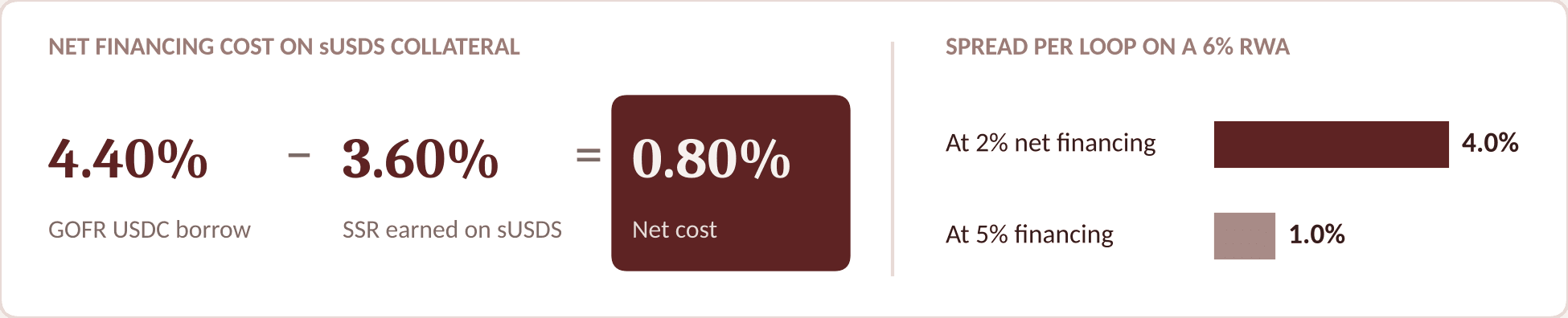
Sky Savings Rate and Galaxy Onchain Financing Rate (GOFR). Onchain credit has formed its own benchmark rates, which is a prerequisite for pricing longer-dated RWA facilities. The Sky Savings Rate (SSR), the governance-determined yield paid to sUSDS holders, dropped to 3.60% in September 2026 (15bps decline from its Q2 2026 3.75% rate) with roughly $4.5B of sUSDS earning it. The SSR now functions as the closest thing DeFi has to a policy rate for operating cash as detailed in the Sky central bank analog earlier in the report. Galaxy launched Galaxy Onchain Financing Rate (GOFR) in July 2026 as an actively-managed lending program that provides borrowers with a blended variable borrowing rates across Aave, Morpho, Spark, and Kamino. The value proposition is large borrowers don’t need to work with DeFi protocols hands-on in order to access the rates – Galaxy does that part for them. Galaxy publishes indicative GOFR rates daily for USDC, USDT, and ETH, with USDC at 4.40% and USDT at 4.00% as of mid-September. Further, SSR and GOFR rates now sit on the same balance sheet with Galaxy pushing $100M of its corporate treasury into sUSDS in September 2026 as part of a broader partnership with Sky. Galaxy also approved sUSDS as eligible collateral across its $1.4B institutional loan book, so a borrower can post sUSDS against a loan and continue earning the SSR on the full position for the life of the loan. The savings yield partially offsets the borrowing cost, and a USDC loan at the 4.40% GOFR rate against sUSDS earning 3.60% carries a net rate closer to 0.80% before accounting for overcollateralization. Similarly, Grove, a Sky Prime Agent, already provides Galaxy a $500M USDS-funded warehouse facility to finance its institutional loans secured by BTC and ETH. Galaxy is extending the same model to digital asset treasuries (DATCOs) through the $125M Galaxy SharpLink Onchain Yield Fund, launched in August 2026 with $100M of SharpLink's staked ETH and $25M from Galaxy, with Galaxy as facility manager. The significance of these developments shines onto and foreshadows RWA market growth: the onchain market now has both a published savings rate (SSR) and a published SOFR-style financing rate (GOFR). The spread between the two gives RWA issuers and curators a reference point on yields to beat. RWAs generating 6% annual unlevered yield become more loopable against a 2% net financing rate than a 5% financing rate, for example, which greatly opens DeFi to investment grade RWA credit opportunities that were previously unattractive at typical borrow costs.
Maple’s syrupUSDC and RWA distribution. Maple’s syrupUSDC is the clearest proof point of widespread RWA distribution possibilities. Maple’s crypto-backed loan AUM reached $4.85B, growing 22% in the first half of 2026 while DeFi lending overall contracted 31%. A few key initiatives drove this: 1) the syrupUSDG strategy behind Robinhood Earn launched and raised $200M in eight days, 2) Kraken’s $500M OTC lending warehouse funded by Maple ensures significant flow, and 3) Revolut brought Maple onto its platform for more than 70 million users across the UK and EU. Maple has already validated RWA yield integrations into major neobanks and exchanges. Comparable RWAs now have precedent to follow suit and gain access to distribution that did not exist to the market for the last 8 years.
OnRe DeFi composability. OnRe’s ONyc is one of the most utilized RWAs in DeFi. OnRe is a Bermuda-licensed reinsurer underwriting global property catastrophe and specialty risk, and ONyc is its tokenized reinsurance vehicle on Solana. The token holds $300M of assets and generates over 10% yield, returning underwriting premiums plus the yield on its collateral. More than 80% of ONyc's market cap sits in Solana DeFi rather than idle in wallets, where it is used as collateral for lending, borrowing, and looping strategies. As of September 2026, over $225M of ONyc was deployed as follows: $166.6M on Kamino, $49.3M on Loopscale, and $6.4M on Exponent. ONyc is a prime example of a non-crypto-correlated asset with a professional underwriter expanding DeFi beyond crypto. In O2O's view, reinsurance is a strong signal for the broader asset classes our team is focused on, since onchain allocators will put a differentiated yield to work across DeFi when the asset is built to be used rather than simply held.
SECTION 08
Predictions for the Rest of 2026
- Vault TVL closes 2026 between $22B and $28B aggregated from platforms like Morpho, Veda, Concrete, Upshift, and Kamino. RWA-backed collateral moves from under 12% of onchain RWA value deployed in DeFi toward 20% as curators gain access to professionally-managed portfolios.
- Ten asset managers will curate vaults by year-end. Bitwise, Galaxy, GSR, J.P. Morgan, and Wintermute make up the first five live in market, and O2O expects Grayscale, 21Shares, and other ETF issuers to round out the next five. The first movers from the traditional side will be major beneficiaries of vault capital inflows.
- Bitwise's PAPY passes $50M before year-end and at least two more curators launch diversified RWA credit Vaults of the same design and format: a stablecoin deposit lent against a basket of overcollateralized real-world credit opportunities.
- Sky’s USDS will expand capacity as institutional onchain allocators seek to leverage the Sky Savings Rate (SSR) and Galaxy Onchain Financing Rate (GOFR) to create looping opportunities of existing liquid assets like Janus Henderson’s JAAA and the Neuberger Securitize High Income Tokenized Fund (HINC).
- Fixed-rate RWA looping emerges as one of the fastest-growing DeFi segments. RWA looping remains limited in today’s variable rate landscape where borrow costs are driven by crypto supply and demand. When rates spike, as Aave’s flagship USDC market did to 14% in April 2026, most RWAs become unloopable because of their moderate yields. To scale institutional RWA use cases, lenders and borrowers alike want to match terms, durations, and rates. Groups like Tenor Finance and Kamino are well-positioned to scale fixed-rate looping through their existing integrations into Coinbase Earn and Kraken Earn, respectively.
- GENIUS Act final rules land in the first quarter of 2027 following the October 19, 2026 comment deadline, with the January 18, 2027 effective date holding. O2O expects short-term assets sitting just outside the Treasury and repo category to begin positioning for GENIUS Act reserve capital: liquid credit in the SOFR+100 tier as the core bucket, and less liquid SOFR+200 assets as a smaller allocation. These allocators are significant, with GENIUS-compliant stablecoin supply expected to grow toward $1T by the end of the decade, and even a 2% allocation to less liquid assets equals $20B in inflows.
- DAT consolidation continues through year-end and the surviving vehicles collectively commit their first $1B tranche to onchain yield strategies, with the SharpLink and Galaxy fund as a template for the type of initiatives that can be led.
- Tokenized equities pass $6B in distributed value by year-end, up from $3.3B in October 2026, as 1:1-backed native share tokenization continues to wrangle with offshore wrappers enabling synthetic exposure. Tokenized stocks in DeFi establish composability frameworks and traction for other non-crypto-correlated yield offerings to supplement and gather assets through.
SECTION 09
Closing Thoughts
Eleven months of falling and then recovering crypto prices proved what no amount of pitching could: onchain capital needs liquid, non-crypto-correlated yield that does not move with the collateral backing it, and that demand survived the recovery. Curated stablecoin vaults settled around 4.5% and tokenized Treasuries around 3.7%, while liquid income ETFs pay 8% to 11% with similar daily liquidity, and GENIUS-compliant stablecoin issuers join the hunt for yield come January 2027. The opportunity is no longer limited to double-digit yields. With the Sky Savings Rate at 3.60% and GOFR at 4.40%, a borrower posting sUSDS can finance positions at a net rate closer to 0.80%, which makes moderate-yield RWAs like investment grade credit, fund finance, and short-term receivables loopable rather than priced out by 8% crypto borrow costs. The next step is locking those rates in. Variable rates that spiked to 14% on Aave in April 2026 keep RWA looping capped, and fixed-rate lending from groups like Tenor Finance and Kamino is what lets lenders and borrowers match terms, durations, and rates the way institutional credit always has.
The rails between traditional lenders and onchain lending rates are now being built in both directions. Kraken settled a $500M warehouse through Maple on a Saturday, Grove funds a $500M USDS warehouse to Galaxy, Galaxy accepts sUSDS across its $1.4B institutional loan book, and Bitwise, Galaxy, J.P. Morgan, and GSR now curate vaults alongside Steakhouse, Gauntlet, and Sentora. Every new integration makes the next RWA more composable, and every composable RWA gives investment banks and lenders another reason to originate onchain. The AUM from that flywheel accrues to the early movers: PAPY took in $8M in its first 24 hours, syrupUSDG raised $200M in eight days, and Superstate and Centrifuge built ecosystems valuable enough for Invesco and Janus Henderson to take over. Only $4B of the $39B in tokenized RWAs is working in DeFi today, and as vaults move from $20B toward $100B, the asset managers and lenders that show up over the next 24 months with a live vault, a fixed-rate financing partner, and a curator network will be the ones that capture it.
If you manage asset-backed securities, commercial paper, loan receivables, or structured credit facilities and you are evaluating how to bring those products onchain, O2O is standing up dedicated vaults by asset class in partnership with traditional asset managers and lenders on this. Get in touch to explore tokenization, vault placement, curator partnerships, and distribution networks into the $600B allocator universe.
— Peter Gaffney, Co-Founder @ O2O Capital Partners