O2O Vault Brief, Issue 5. Data as of November 21st, 2026, with holdings, liquidity and deposit settings rechecked on November 24th. Vault links: Gauntlet app page, Morpho app page, Etherscan explorer, Gauntlet.
O2O Research publishes general market commentary for information only. Nothing in this brief is investment advice, a recommendation or an offer of any security, including interests in any O2O vault. O2O is developing credit vaults of its own and may seek business relationships with protocols, curators or issuers it writes about.
Key findings
This brief reaches seven findings:
- Holdings: Over 30 days the vault's two wrappers, V1 and V2, averaged $11.3 million in total value locked (TVL). Real-world assets (RWA) backed 52%, private credit to a crypto prime broker 31% and bitcoin 17%, so 83% of the vault was lent against non-crypto collateral (Exhibit 1). On November 24th the vault held no bitcoin at all.
- Base yield: Net of fees and excluding incentives, V1 earned 5.24% over 30 days, 5.21% over 90 and 5.51% over 365. That is roughly 0.5%, 0.7% and 1.8% a year above the crypto-only peer median (Exhibit 3). V2 earned 6.91% over 30 days, mostly because of one market, PT-reUSD, which matures on December 10th.
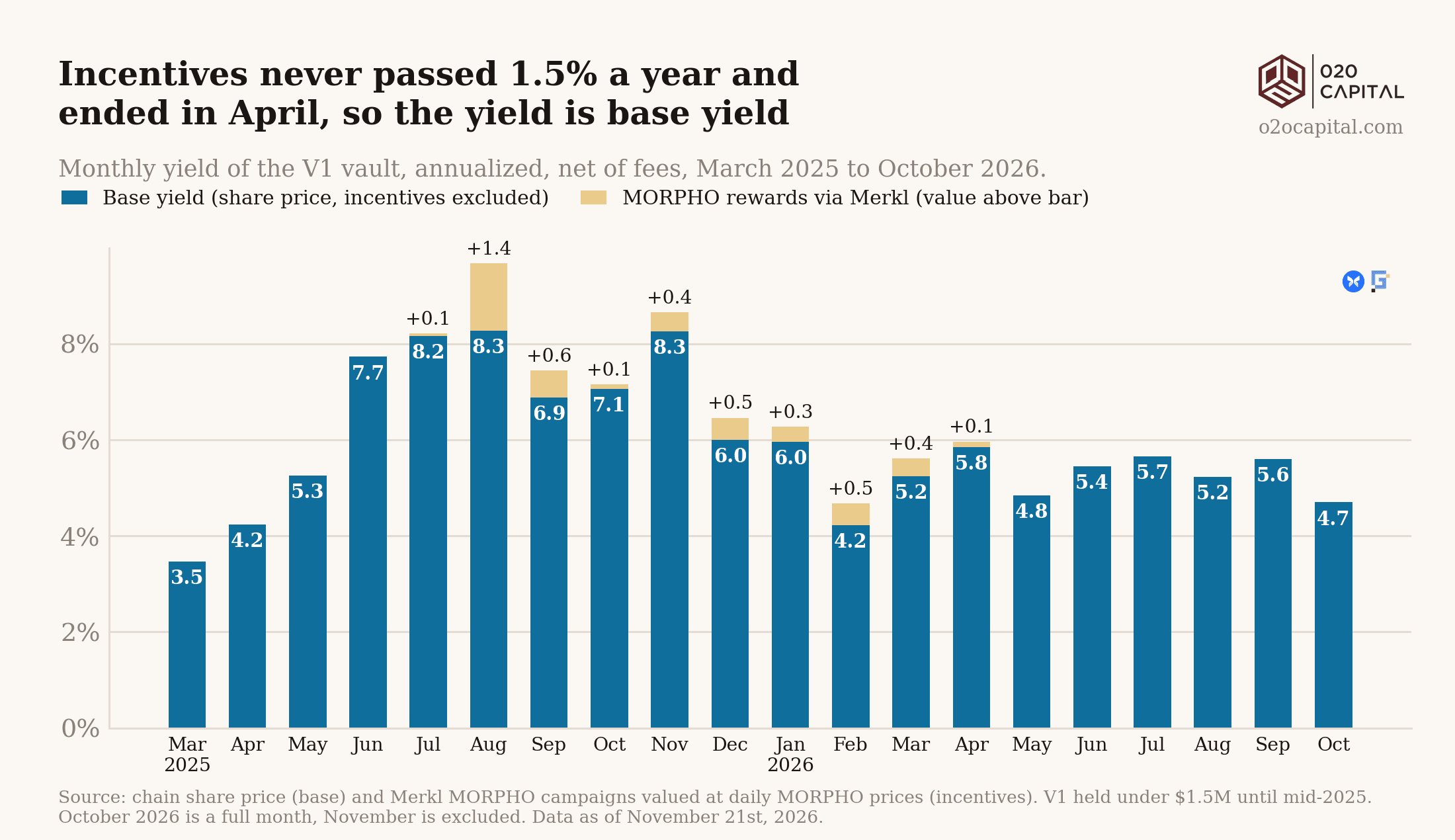
- Incentives: The yield is organic. No reward program pays depositors today. MORPHO token rewards through Merkl added at most 1.4% a year and ended in April 2026.
- Crypto link: Over 88 weeks, the correlation of V1's weekly returns with bitcoin (BTC) was -0.08, which means no measurable link. In the 30 days to November 21st, BTC fell about 30% while V1 earned 5.2%.
- Deposits: V1 stopped taking new deposits from October 29th to November 6th. No public statement explains why. Since reopening, V1 sends every new deposit to one market, the Pareto FalconX market. V2 stayed open throughout. Neither wrapper can switch withdrawals off.
- Liquidity: One holder owns about 81% of V1, a position of about $5.2 million. That is more than V1 could pay out the same day on November 21st ($4.8 million) or November 24th ($2.9 million). A full exit by that holder would use all of V1's free liquidity, and other holders would wait until borrowers repay or new lenders arrive.
- The headline rate: The rate shown in the Morpho and Gauntlet apps is an instantaneous reading that jumps whenever money moves between markets. For V1 it read 10.6% on November 2nd and 3.9% on November 21st. The share price shows V1's actual yield over the 30 days was 5.2%.
Why this vault
Gauntlet USDC RWA ($gtusdcrwa) is a Morpho vault on Ethereum that takes deposits of USD Coin (USDC), Circle's dollar stablecoin. Its description mentions tokenized equities, but those markets held under $1,000 at the time of writing. Gauntlet, the curator, is a quantitative risk manager founded in 2018 that DefiLlama shows curating about $1.4 billion across chains. As curator, Gauntlet chooses the markets, sets how much each one can receive and moves the money between them.
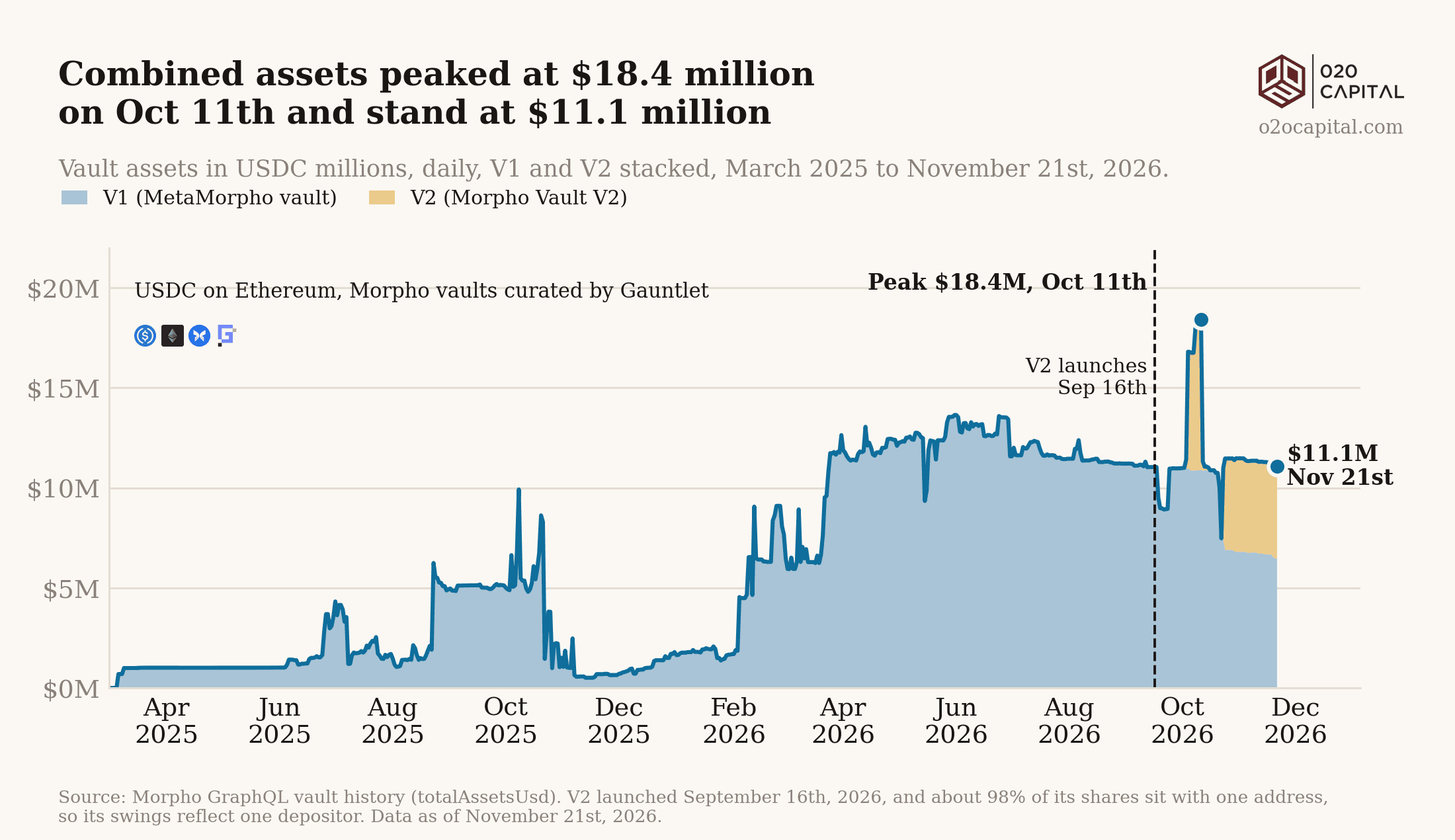
The strategy runs in two wrappers, V1 and V2, that lend directly into Morpho markets, so their assets add up without double counting. V1, a MetaMorpho vault at 0xA887...5C45, was created in January 2025 and held $6.5 million on November 21st. V2, a Morpho Vault V2 at 0x18E8...5119, launched on September 16th, 2026 and held $4.6 million. Combined assets peaked at $18.4 million on October 11th and stood at $11.1 million (Exhibit 5). One address holds about 81% of V1 and another about 98% of V2, so a single holder's deposit or withdrawal can move the totals.
The series asks whether lending against real-world assets earns more than lending against crypto. Ethereum offers the largest set of crypto-only vaults to measure against. Issue 3 found that Kraken's RWA vault did not earn a higher base yield than its crypto-only peers. Issue 4 found a premium for RockawayX's RWA vault on Kamino.
Vaults 101
A vault pools deposits of one asset, issues shares and invests under set rules. Six mechanics govern this one:
- Shares: Each deposit buys shares, and the share price rises as borrowers pay interest. Every yield in this brief comes from the change in share price, so it shows what depositors actually earned.
- Fees: V1 charged a 15% fee on interest for its first six weeks and has charged nothing since March 18th, 2025. V2 charges no fee. Depositors therefore keep all of the interest the markets pay.
- Isolated markets: Each Morpho market pairs USDC with one collateral token, one price oracle and one liquidation loan-to-value (LLTV). The LLTV is the most a borrower can draw against the collateral's value before being liquidated. A loss in one market stays in that market.
- Deposit queue: A V1 deposit flows into the markets on its supply queue, in order, up to each market's cap. Allocators set the queue and can change it at once, so they decide where new money lands. V2 has no queue.
- Roles and delays: Owner actions need 4 of 7 signers and curator actions 3 of 7, so no single signer can add a market or change a fee. In V1, new markets and higher caps wait three days, which gives depositors time to leave before new risk arrives. Fees, reallocations and the queue change at once. V2 adds waiting periods of one hour to seven days on most settings.
- Exits: Withdrawals draw on USDC that borrowers have not taken, so a vault can pay out only part of its assets on any given day. V2 adds a backstop called a forced deallocation. Any V2 holder can make the vault pull USDC out of a lending market to pay them, for a fee of 0.001% of the amount.
What the vault holds
Gauntlet's allocators move money between markets almost daily, so Exhibit 1 averages 30 daily reads to November 21st and shows each market's range.
- Pareto FalconX tranche, 30.6%: The senior AA tranche of a Pareto credit vault that lends to FalconX, a digital asset prime broker. Its net asset value (NAV) rises on a monthly basis, at about 7.5% per year at recent rates, and it offers redemptions monthly. O2O categorizes it as private credit to a crypto firm and counts it as non-crypto collateral, because its value does not move with crypto prices. Its credit risk still depends on FalconX, which lends to crypto funds and trading firms. Because the tranche redeems only monthly, a liquidator who seizes it may wait weeks to turn it into cash, so the market's 77% LLTV is the lenders' main protection. Liquidation starts while the tranche is still worth about 1.3 times the loan. On November 21st V2 briefly lent through a wrapped version, wFalconX, whose 91.5% LLTV starts liquidation at about 1.09 times. By November 24th V2 had moved back.
- Figure PRIME, 20.9%: Hastra's token for interest on home equity lines of credit that Figure originates. The market's oracle values each PRIME at about $1.07. That figure is PRIME's exchange rate into wYLDS, a wrapped form of Figure's yield-bearing stablecoin, with each wYLDS counted at exactly $1. Neither input is a trading price, so liquidations in this market follow the reported exchange rate rather than what PRIME sells for.
- Coinbase cbBTC, 17.3%: Bitcoin is the vault's most liquid collateral asset. The vault lends through Morpho's main cbBTC/USDC market, where all lenders together supplied about $272 million, and its average position was under 1% of that market. Bitcoin's share of the vault swung between zero and 36% over the 30 days. Until October 29th, V1 sent new deposits to this market first.
- Pendle PT-reUSD, 16.1%: A fixed-term principal token on Re's reinsurance-backed reUSD, maturing on December 10th, 2026. A principal token trades below its value at maturity, and that discount is the holder's fixed return. It accounts for 40% of V2's assets.
- Re reUSD, 13.0%: Re's reUSD is the senior token of Re, an onchain reinsurance protocol. Re's own capital and a junior token absorb reinsurance losses before reUSD does. Both wrappers hold it.
- Hastra AUTO, 2.0%: Near-prime and subprime car loans that Agora Data originates and Figure structures. Hastra's guide cites $25 million of first-loss capital from Figure and about 2.4 times the cash flow needed to pay holders. Only V2 holds it, at up to 8% of the vault.
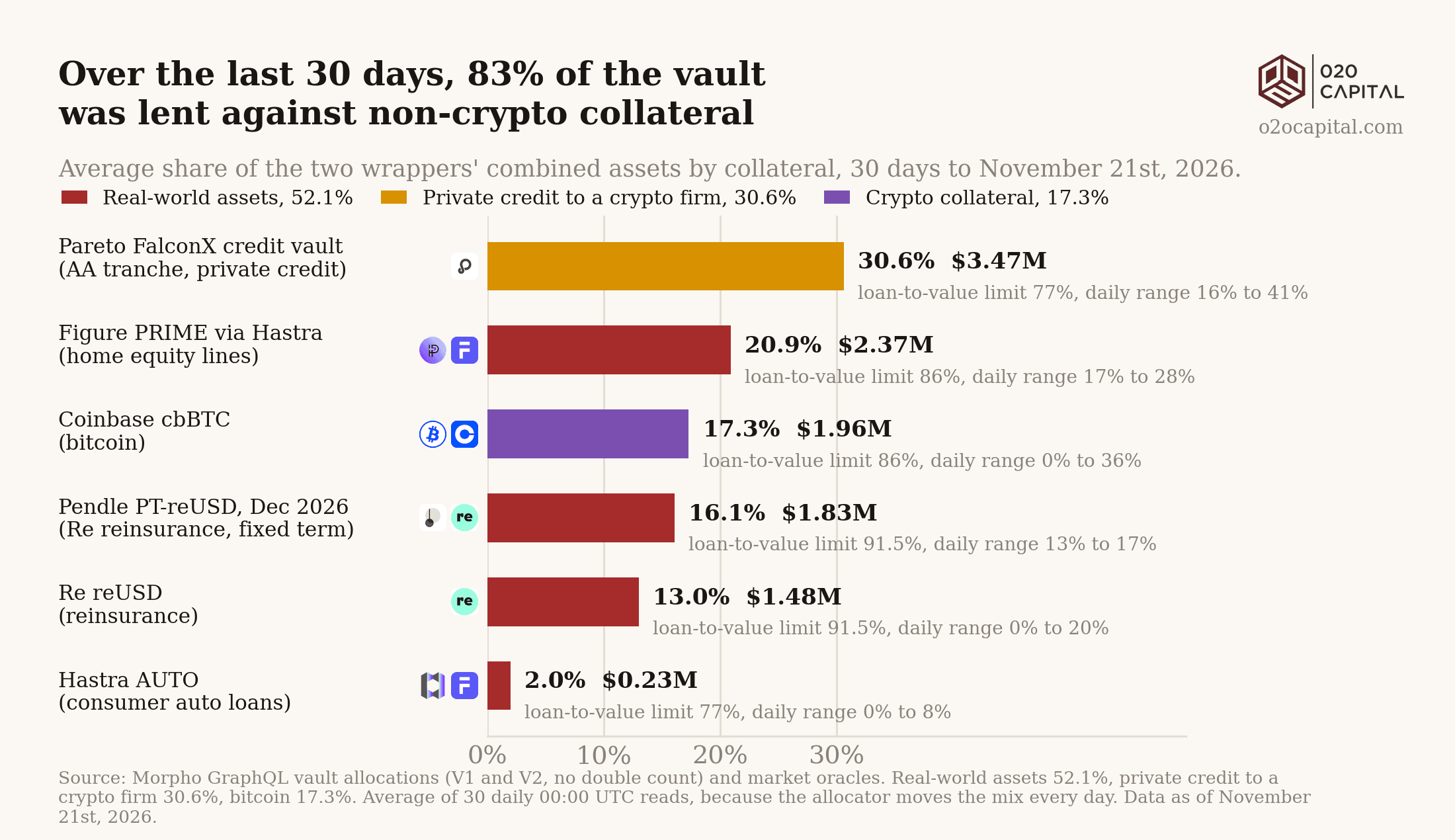
On November 24th the vault held $11.2 million and no bitcoin, so every dollar was lent against non-crypto collateral. The Pareto FalconX tranche made up 35.2%, PRIME 24.7%, PT-reUSD 16.9%, reUSD 15.5% and AUTO 7.6%.
In 2025 the vault held mostly Midas tokens tied to crypto yield strategies. In ten of eleven month-start reads from November 2025 to September 2026, more than 90% of V1 sat in the Pareto FalconX tranche. October 2026 brought in PRIME, reUSD, a return to the bitcoin market and V2's PT-reUSD market, and AUTO followed in November. The current mix is about two months old, so most of the vault's one-year record reflects the Pareto tranche.
Where the yield comes from
V1's base yield averaged 6.2% per year since March 2025. Monthly yields ran from 3.5% to 8.3% in the nascent months of 2025, then between 4.2% and 6.0% in 2026 (Exhibit 2).
Who pays the yield. Borrowers in most of these markets run a carry trade. They post a token that earns 6% to 12% a year and borrow USDC at a lower rate. Over 30 days the PT-reUSD market paid lenders 9.8% while its collateral accrued about 11.8%. The Pareto market paid 5.4% against 8.1%. Most borrowers loop the asset to achieve leveraged returns: they borrow USDC, buy more of the token, post it and borrow again. About 74% of PT-reUSD borrowing in the last 90 days came in the same transaction as a collateral deposit, the signature of a loop. Borrowers' collateral in that market is worth about 6.9 times their own capital. That demand keeps utilization, the share of supplied USDC that borrowers are using, near 88% to 90% without any reward programs.
In the reUSD market the trade lost money over 30 days, as borrowers paid 7.3% against collateral earning 6.9%. If that continues, some may repay, which would lower the rate the vault earns there.
Why V2 earns more. Over 30 days V2 earned 6.9% against V1's 5.2%, almost entirely because of the PT-reUSD market. By O2O's estimate, PT-reUSD added about 1.8% a year to V2's yield. Without it, V2's markets paid about 5.4%, in line with the 5.3% paid by V1's markets.
How the base yield compares
O2O selected the peer set based on the following criteria: Ethereum Morpho USDC vaults that lend only against crypto collateral, hold at least $5 million and have operated at least 90 days. Fourteen vaults qualified. Aave v3 USDC and the Secured Overnight Financing Rate (SOFR) are benchmarks (Exhibit 3).
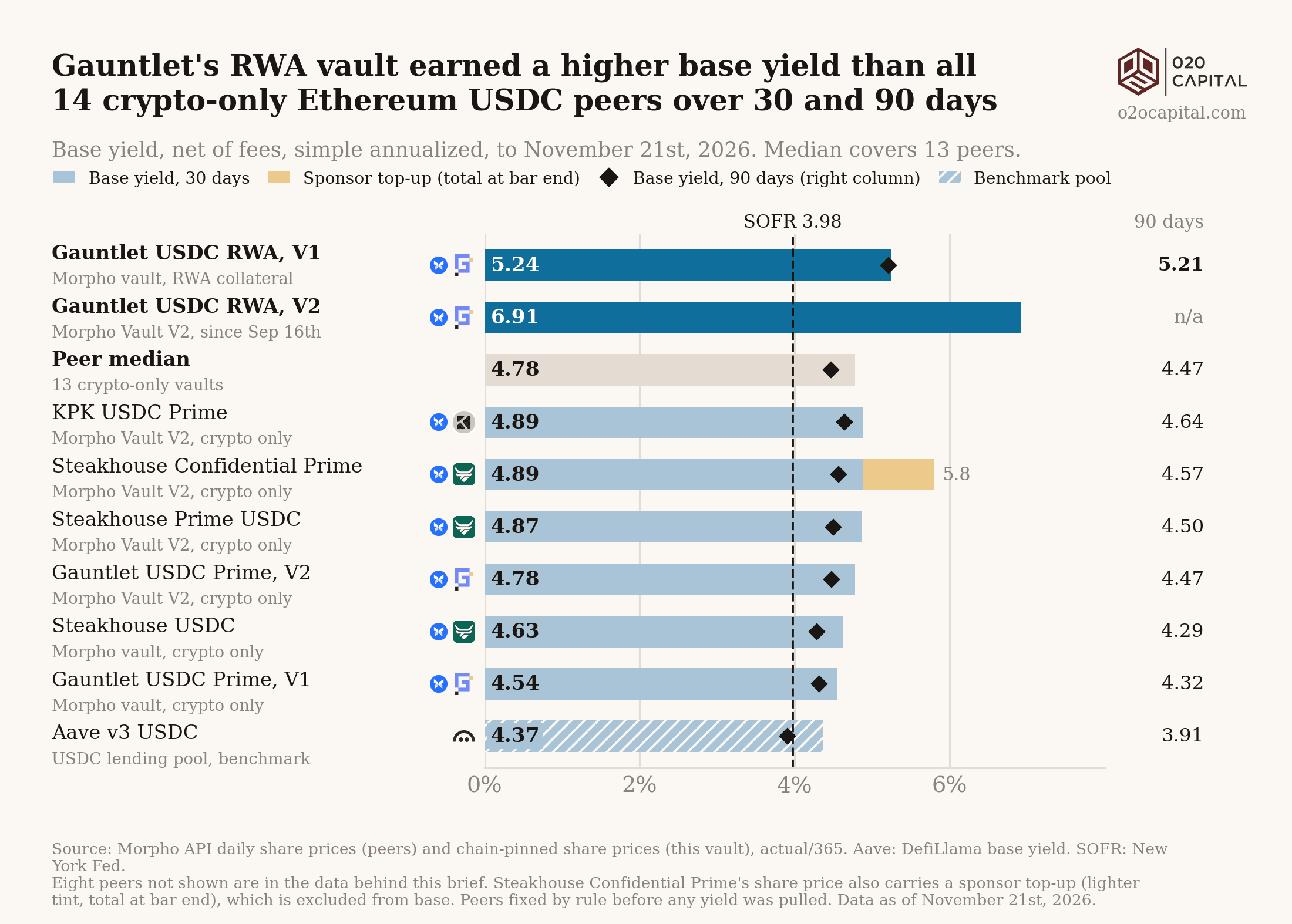
- 30 days: V1's 5.24% beat every peer, led by KPK USDC Prime and Steakhouse Confidential Prime at 4.89%. The median was 4.78%, and Gauntlet's own USDC Prime V1 earned 4.54%.
- 90 days: V1's 5.21% again led, against a median of 4.47%.
- 365 days: V1's 5.51% was the highest of 11 vaults with a full year, against a median of 3.74%.
- V2: 6.91% over 30 days, about 2.1% above the median, with about 65 days of history.
- Cash: V1 ran about 1.3% above SOFR over 30 and 90 days. Aave v3 USDC earned 4.37% over 30 days.
V1's lead does not come from its zero fee alone. Eight of the 14 peers also charge no performance fee. The best of them, KPK USDC Prime, earned 4.89% over 30 days, below V1's 5.24%.
Steakhouse Confidential Prime's share price also carries a sponsor top-up of about 0.9% a year, so O2O counts only its market yield and leaves it out of the median. Counted at its share price, it would sit above V1 over both windows.
Is the yield correlated with crypto?
Over 88 weeks to November 16th, 2026, V1's weekly return correlated -0.08 with BTC and +0.06 with ether (Exhibit 4). A correlation runs from -1 to +1, and a reading near zero means the two series move independently. Peers ranged from -0.17 to +0.08. With 88 weeks of data, a reading must pass about 0.21 to be distinguishable from zero, and none did. O2O concludes that this vault's performance is not meaningfully correlated with crypto markets. That independence is core to O2O Capital's thesis of expanding decentralized finance (DeFi) beyond crypto.
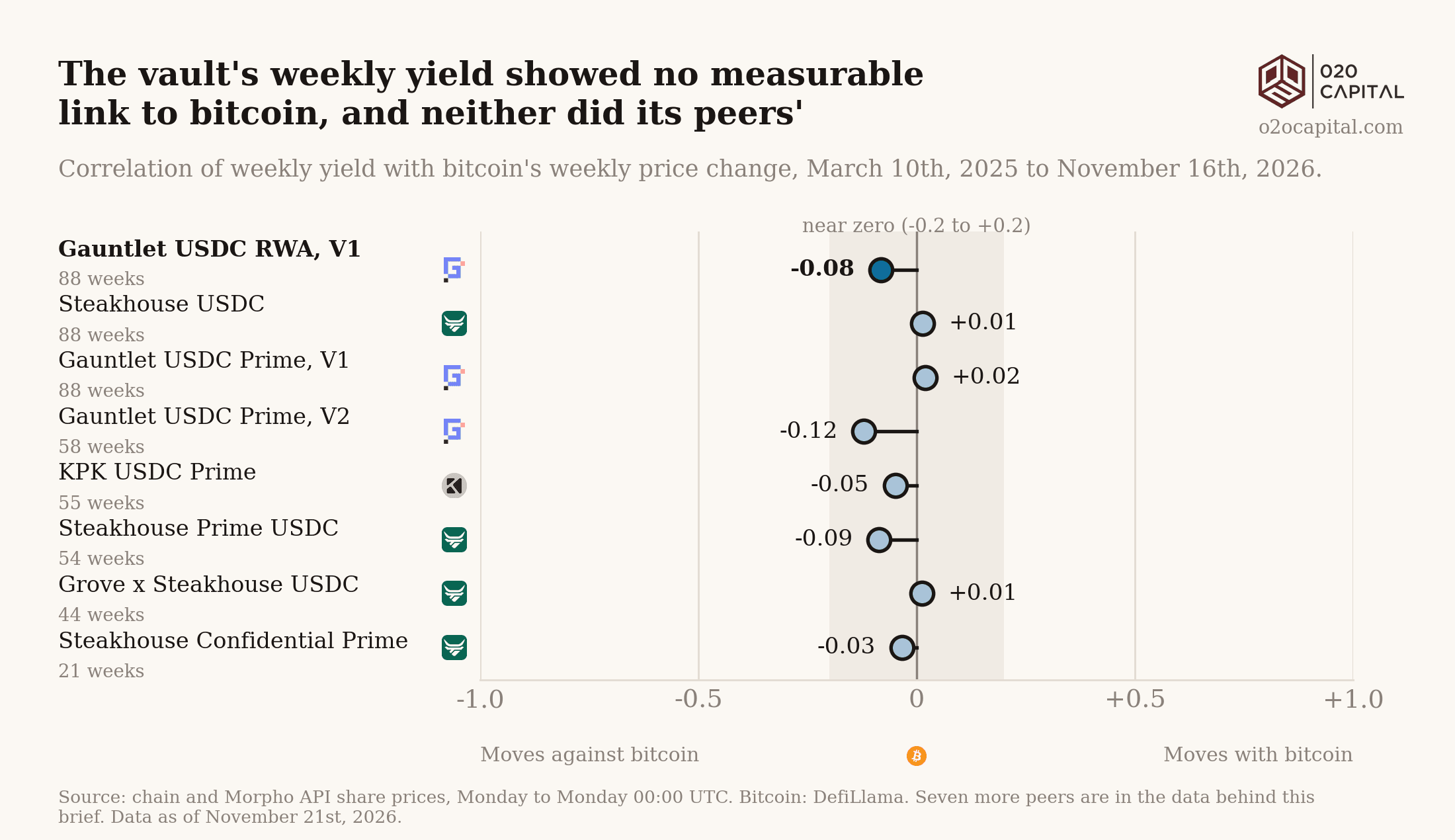
Drawdowns corroborate the story. BTC fell about 53% from about $124,700 in October 2025 to about $58,600 in July 2026 while V1 earned about 6.0% per year. The eight peer vaults that ran through that whole period earned just 3.1% to 3.6%. In the 30 days to November 21st, BTC fell about 30% from about $84,100 to $58,800, and V1 earned 5.2%.
One crypto link remains. V1's weekly yield correlated +0.43 with the funding rate on bitcoin perpetual futures, which rises when traders pay more for leverage. The peer median was +0.51. Most of the vault's collateral sits outside crypto, but its rate still tends to move with demand for crypto leverage.
Deposits closed for a week, then reopened through one market
On October 29th, 2026, at about 21:00 Coordinated Universal Time (UTC), one of V1's allocators emptied the vault's supply queue, which blocks new deposits. Until then, V1 had sent new deposits to the bitcoin market first.
No public statement explains the closure. A week later, on November 5th, The Defiant reported that Gauntlet was closing the supply queues of its V1 vaults, pausing allocations and cutting exposure to tokens bridged through LayerZero. The trigger was a reported vulnerability in op-reth, software that runs some blockchains built on Optimism's OP Stack. Reports said those measures covered V1 vaults on the affected chains. This vault runs on Ethereum, and its allocations kept moving daily while deposits were closed. O2O found no statement linking the two actions.
On November 6th the same allocator reopened V1 with one market on its queue, the Pareto FalconX market. As of November 21st, that market could take about $17.8 million more from V1 before reaching the cap Gauntlet set. V2 has no queue and no deposit gate.
For new depositors:
- Where capital flows: A V1 deposit sits in the Pareto FalconX market until an allocator moves it. On November 24th that market held $6.7 million, and the two wrappers supplied 59% of it. A $10 million deposit would cut its utilization from about 89% to about 36%. That would flood the market with supply and cause a drop in yield until the money is reallocated.
- Which vault: V2 is a different mix, earning 6.9% against V1's 5.2% over 30 days. Most of that lead comes from PT-reUSD, about 40% of V2, which matures on December 10th.
- Notice: V1's queue can change at any moment with no waiting period.
For existing holders:
- Withdrawals: No controls in either wrapper can switch withdrawals off. V2's curator has permanently given up the gates that could limit who redeems or receives USDC, which is favorable to depositors.
- Liquidity: V1 could pay out 75% of its assets the same day on November 21st and 45% on November 24th. Its largest holder owns about $5.2 million, more than V1 could pay out on either date. A V2 holder can use a forced deallocation, which could free 89% of V2 on November 21st and about 65% on November 24th. Gauntlet can raise that 0.001% fee with one hour's notice, up to a 2% limit set in Morpho's contract.
- Concentration: The two largest holders own 87% of the combined assets. V2 shrank from $4.6 million to $3.7 million within hours on November 21st and was back at $4.7 million by November 24th. A large exit draws on the same liquidity every other holder relies on and therefore can adversely affect the surrounding depositors.
What to watch
Five signals to follow:
- The December 10th maturity: PT-reUSD was about 40% of V2 and paid the vault's highest supply rate, 9.8%. As of November 24th, Morpho listed no market for a later PT-reUSD maturity, so there was no rollover to move into. V2's yield after December 10th depends on where that cash goes. If it returns to V2's other markets, which paid about 5.4% over 30 days, V2's yield would likely fall toward V1's.
- Leverage in the PT-reUSD market: A borrower's health factor compares the most they may owe with what they actually owe, and below 1.0 the position is liquidated. On November 21st, 58% of the debt in this market sat below a health factor of 1.10, where a price drop of less than 9% triggers liquidations. As a past reference point, a 2.8% oracle dip on August 25th, 2026 liquidated about $35 million with no bad debt.
- Deposits and concentration: Watch whether V1's queue adds markets again. On November 24th the vault supplied about 59% of the Pareto market, 20% of PRIME's and 24% of AUTO's, so its own flows move those rates.
- Marks: Issuers price the Pareto tranche, PRIME, reUSD and AUTO, so a credit loss would show only when one of the issuers or their data providers marks assets down. Since October the Pareto tranche's NAV has dipped between its monthly increases in five weekly reads, each by less than 0.004%. These are the first declines in a series that began in June 2025.
- Fees: Neither wrapper charges a management or performance fee at present. Gauntlet charges 5% to 10% of interest on its other V1 vaults. V1's owner can add a fee with no waiting period, and V2's fee changes wait one day in the event Gauntlet turns a fee switch on.
Curators and portfolio managers who want the data behind this brief, or who see something it missed, can reach O2O Research through o2ocapital.com/research.
— O2O Research